
Thailand sees no impact from Cambodia’s plan for UN map recognition
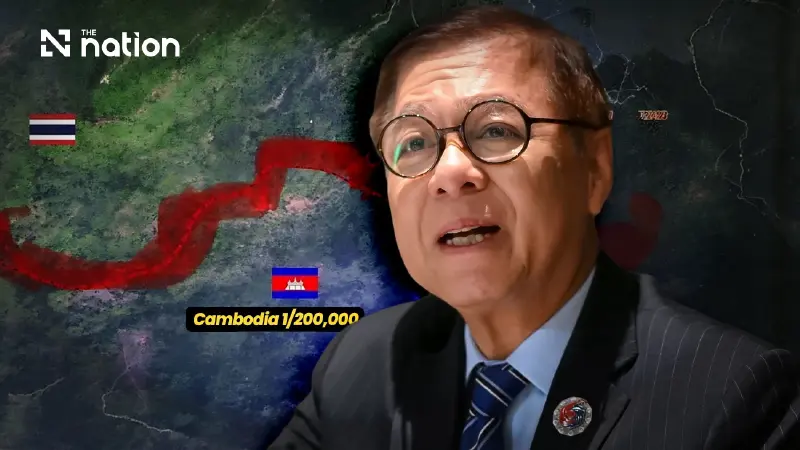


Sihasak Phuangketkeow says the documents are already with the United Nations and Thailand must follow compulsory conciliation, but he is confident it can protect its interests.
- Thailand's Foreign Minister stated that Cambodia's plan to seek UN recognition for MOU 43 and a 1:200,000-scale map concerning the land boundary will have no impact on Thailand.
- The Thai government's reasoning is that these documents are already recognized by the United Nations, so Cambodia's move presents nothing new and is not a cause for concern.
- Thailand maintains its own position on the border, which is based on a different 1:50,000-scale map and other treaty provisions, such as the watershed line.
Minister of Foreign Affairs Sihasak Phuangketkeow said at Government House on Wednesday (August 5, 2026) that Cambodia’s plan to ask the United Nations to recognise MOU 43 (on the survey and demarcation of the land boundary) and a 1:200,000-scale map would have no impact on Thailand.
Such documents and MOUs were already recognised by the UN, he said, meaning there was nothing new and no cause for concern.
He added that MOU 43 was not confined to the 1:200,000-scale map, as treaty provisions also covered matters such as the watershed line, while Thailand had maintained its position on the 1:50,000-scale map in its possession.
Cambodia’s move would therefore have no effect on any party because the evidence was already held by the UN, he said.
Turning to Cambodia’s move to bring Thailand into compulsory conciliation, Sihasak said both sides were participating in the nomination process.
Six or seven names had already been submitted, after which each side would have to select three.
Names from both sides were still being compiled, while the decision would rest with the panel of conciliators, which currently had four members.
The prime minister had maintained that Cambodia could not compel Thailand to participate.
Sihasak said, however, that compulsory conciliation was a process under the United Nations Convention on the Law of the Sea (UNCLOS) and that the rules governing it had to be followed.
Even if a party did not follow the process, it would continue regardless, and the UN would appoint a conciliator for Thailand.
Thailand therefore had to proceed under the mechanism, he said, expressing confidence that it could fully protect its national interests.
Sihasak said Thailand had consistently maintained that the matter had not yet reached the compulsory conciliation stage and that bilateral negotiations should take place first under UNCLOS.
Cambodia, however, had argued that Thailand’s cancellation of MOU 44 (on overlapping maritime claims to the continental shelf) made compulsory conciliation necessary.
Thailand had previously explained that it cancelled the agreement because no progress had been made under it for 20 years and because it wanted to begin a new negotiating process under UNCLOS.
Noting that Cambodia had become a party to the convention only in March, he said it could have tried bilateral talks first, potentially creating a positive atmosphere for the two sides to begin discussing the land-border issue.
“The two leaders spoke at the ASEAN Summit in the Philippines and discussed all bilateral issues, including building trust and ending attacks on each other in international forums. On that basis, there should have been an opening to discuss maritime territory first, allowing Thailand to make some progress on the land-border issue. But Cambodia did not accept any of this and entered the compulsory conciliation mechanism. That means Cambodia itself closed the door on land-border talks and has continued to use every opportunity to attack Thailand on the world stage,” he said.
Sihasak also reiterated his position on comments by UN Special Rapporteur Tom Andrews concerning human rights in Cambodia.
He said Andrews was carrying out his duties, but saying which side had encroached on the other fell outside the UN’s mandate.
The sensitivity of the Thailand-Cambodia situation also had to be taken into account, he added, because any statement referring to Thailand would be used by Cambodia.
The human rights body must also consider political sensitivities when carrying out its duties, he stressed, adding that he did not want Andrews to become a tool of the Cambodian side.
