
Thai Foreign Ministry delegation escorts EU diplomats to Surin hospital to witness civilian impact from Cambodian attacks
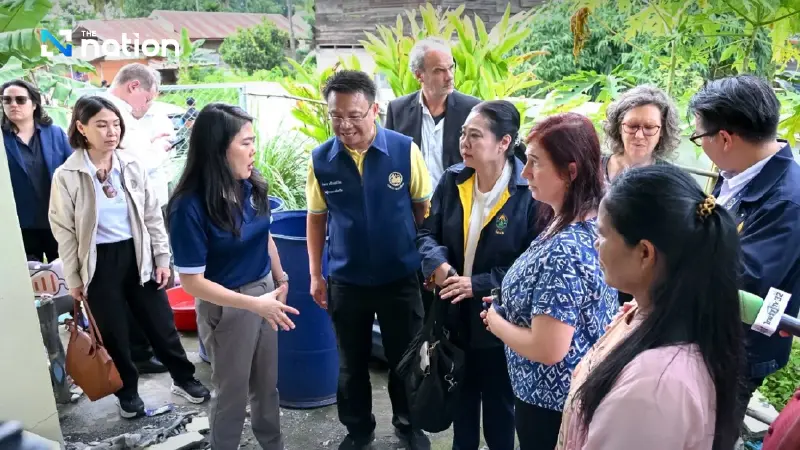


The visit followed recent border attacks by Cambodia, and EU officials were shown extensive damage to civilian infrastructure and briefed on landmine threats, with the goal of tailoring future humanitarian support and mine clearance operations.
Lalivan Karnchanachari, Vice Minister for Foreign Affairs, and Chayika Wongnapachant, Advisor to the Minister of Foreign Affairs, on Wednesday led a delegation of diplomats from the European Union to Phanom Dong Rak Hospital in Surin Province.
The visit followed an earlier field mission on August 16, led by Maris Sangiampongsa, the Minister of Foreign Affairs, who escorted diplomats and representatives from international organisations under the Ottawa Convention to the Thai-Cambodian border in Sisaket Province. Two days later, the European Union announced humanitarian aid totalling €700,000 (approximately 26.5 million baht) for civilians affected by the escalating border situation.
Today’s visit offered EU representatives a firsthand look at the civilian impact of the Thai-Cambodian border conflict, particularly damage to homes, children, women, and healthcare facilities. Among the sites visited, Phanom Dong Rak Hospital was the hardest hit, suffering extensive damage during Cambodia’s indiscriminate assault on July 24. Several buildings were left unusable, and critical medical equipment was destroyed.

During the visit, the Foreign Ministry provided the EU delegation with a comprehensive briefing on the civilian toll, followed by meetings with local agencies such as the Provincial Governor’s Office, Public Health Department, Region 3 Provincial Police, and the Thailand Mine Action Centre (TMAC). Delegates also had the opportunity to speak directly with affected civilians from surrounding communities.
The EU delegation intends to use insights from today’s field visit to formulate future humanitarian assistance plans, including tailored mine clearance strategies. The diplomats showed deep engagement, asking in-depth questions and holding a nearly three-hour discussion with TMAC officers.
Chayika stressed that the International Committee of the Red Cross (ICRC) had once hoped for a world free from anti-personnel landmines by 2025, yet the situation remains dire.
“Today, we stand here listening to details of landmines—both old and newly planted—that have already harmed five Thai soldiers. It is heartbreaking to think we wouldn’t have known about these new mines if those brave men hadn’t stepped on them first.”

She went on to caution about the future risks posed to civilians:
“Today, only five soldiers were injured. But what happens tomorrow—when the troops withdraw, and local people resume their daily lives? What happens when a child is injured by a hidden landmine simply while gathering vegetables, or playing on this land?”
Chayika reaffirmed the Thai government’s unwavering commitment:
“The Minister of Foreign Affairs has made it clear: it does not matter which countries join us in mine clearance efforts. It does not matter whether these mines are relics from the 1980s or newly planted—we will not wait. Thailand will press forward with mine clearance, because it is the right thing to do for humanitarian reasons. We must protect our innocent civilians.”

She concluded:
“That is why we are here today—to look ahead to the process of mine clearance. I hope the information you’ve gathered will help guide us in working together, so that these lands may become safe and mine-free for the benefit of the civilians who call them home.”
In the afternoon, the delegation attended a briefing session in the hospital’s conference room before inspecting the hospital grounds and damaged buildings. They also visited affected homes in nearby communities, spoke with local residents, and attended a live demonstration on explosive ordnance disposal.
