
Thailand prepares 10 water cannon trucks to control protest at Ban Nong Ya Kaew
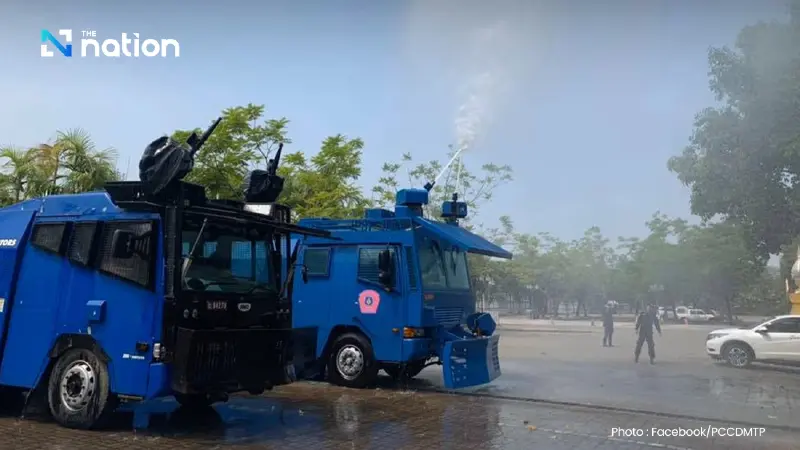


Riot police in Thailand have prepared 10 water cannon trucks in response to ongoing protests by Cambodian nationals at Ban Nong Ya Kaew, Sa Kaeo province, awaiting orders from the Royal Thai Police (RTP) for mobilisation.
On Wednesday afternoon, a group of Cambodian protesters attempted to tear down barbed wire fences and confront Thai border forces stationed at the Ban Nong Ya Kaew area, causing several injuries to Thai officers.
The Thai police used tear gas and rubber bullets to disperse the crowd, resulting in four injuries among the officers.
Pol Maj Gen Chaikrit Pho-ah, Commander of the Protection and Crowd Control Division (PCCD), confirmed that the RTP had instructed the division to prepare for crowd control operations. This includes the mobilisation of 10 water cannon trucks that have been routinely maintained for such operations.

These water cannon trucks, previously used to disperse Ratsadon pro-democracy protesters in October 2020, are equipped with a 12,000-litre capacity and are capable of shooting water up to 65 metres.
The trucks also feature adjustable nozzles for precise control and can incorporate colourants into the water to make protesters easier to identify.
In addition to the water cannon, the crowd control vehicles are fitted with Long Range Acoustic Devices (LRADs) for high-frequency sound that helps manage crowds, as well as tear gas dispensers and fire-retardant foam systems.

The trucks are fitted with bulletproof wheels and a metal cage on the front to clear obstacles. They are also equipped with surveillance cameras around the vehicle to record events for future legal use.
The coloured water used in the operations is designed to be difficult to wash off, making it a useful tactic for distinguishing protestors who attempt to rejoin the crowd after dispersal.
Similar tactics were used in late 2013 during clashes with the People's Democratic Reform Committee (PDRC) protesters who breached barriers and barbed wire in an attempt to force their way into the Government House.
