
Launch of Low-Cost "AIoT Landslide Warning System" for Real-Time Alerts
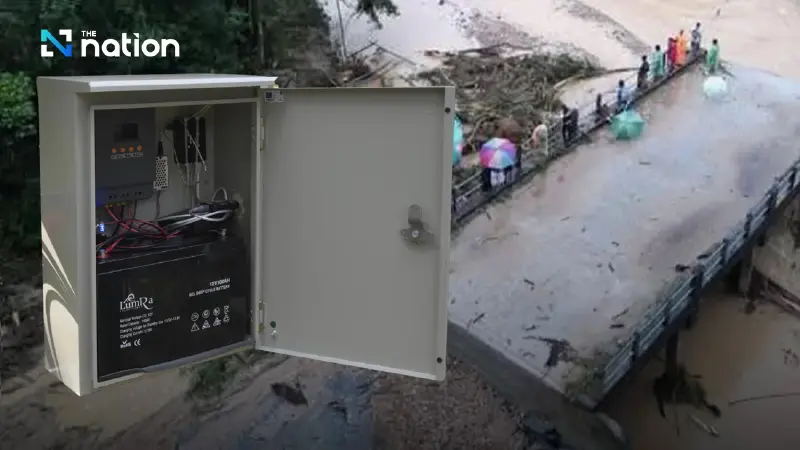


This project is implemented in high-risk areas, such as Sichon District, Nakhon Si Thammarat, to enhance proactive disaster warning efficiency and reduce damage to lives and property from landslides.
A team of researchers from Walailak University (WU) has successfully developed a "Low-Cost Real-Time Landslide Warning System" by applying cutting-edge AIoT technology.
The system integrates LoRaWAN networks, AI-driven risk analysis, and solar-powered sensor nodes to create an automated system that operates even during power outages or internet disruptions.
This innovative solution provides peace of mind and enhances disaster preparedness during the monsoon season for residents in high-risk areas like Sichon District, Nakhon Si Thammarat.
The research project was led by Assoc Prof Ajalawit Chantaveerod , along with Asst Prof Eshrat E. Alah, Asst Prof Korakot Suwannarat, and Asst Prof Jantira Rattanarat, under the support of the Asia Pacific Network Information Centre (APNIC) Foundation.


Ajalawit, the principal investigator, explained that the areas of Theppharat and Si Khit Subdistricts in Sichon, Nakhon Si Thammarat, are highly susceptible to repeated landslides, affecting over 1,000 households. Traditional warning systems lacked the efficiency and speed required to respond to emergencies.
The research team developed this proactive disaster management system using AIoT technology, which integrates IoT devices with AI-driven data analysis, enabling timely and location-specific alerts to minimise damage to lives and property.
The system is designed to operate through two levels of communication to ensure continuous alerts under any circumstance.
In normal conditions, the gateway device transmits data from five sensor nodes to the system administrator for AI-based risk analysis, followed by real-time alerts through LINE and a Web Dashboard.
In emergencies (power outages/internet disruptions), the backup LoRaWAN communication system sends direct alerts to the administrator, who will then use a radio transmitter to notify the public in the affected area immediately.


All gateway devices and sensor nodes are solar-powered, allowing them to operate 24/7. The sensor nodes are strategically placed in high-risk areas to measure various parameters, including vibration, soil moisture, rainfall, and slope angle, with built-in GPS and backup data logging for high accuracy.
"I would like to express my gratitude to the APNIC Foundation and the Information Society Innovation Fund (ISIF Asia) for their research funding, as well as to the research assistants who contributed to the successful completion of this project," said Ajalawit.
