
TSEA urges govt to suspend large-scale construction projects to review safety measures
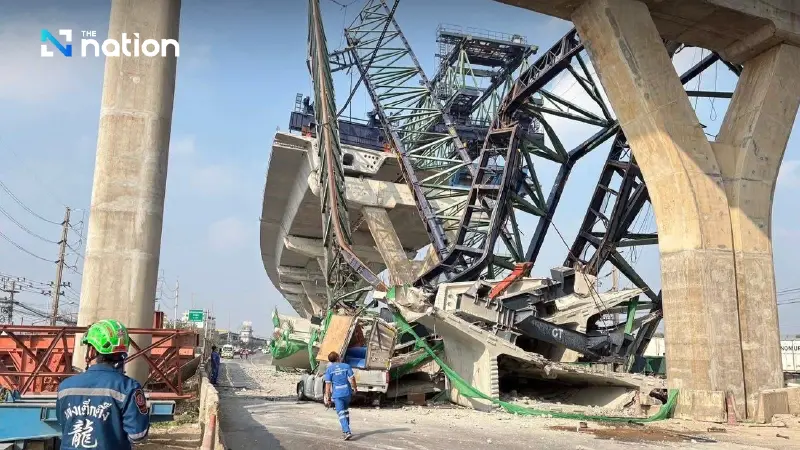


The president of the Thailand Structural Engineers Association (TSEA) urges the government to suspend large-scale construction projects following two deadly crane accidents. The suspension would allow for a review of safety standards and help prevent further fatalities.
The president of the Thailand Structural Engineers Association (TSEA) has called on the government to suspend large-scale construction projects in public areas following two deadly accidents on consecutive days. He also provided possible causes for the crane collapse on Rama II Highway.
Safety Issues Highlighted by Recent Crane Collapses
TSEA president Professor Dr. Amorn Pimanmas stated that the recent incidents involving the collapse of two launching gantry cranes — one in Nakhon Ratchasima on Wednesday and another on Rama II Highway on Thursday morning — have highlighted serious safety concerns regarding large-scale construction projects in public spaces.
Professor Amorn emphasized that the fall of the metal bases of a launching gantry crane used for the Thai-Chinese high-speed railway construction project in Nakhon Ratchasima and the collapse of the crane on Rama II point to inadequate safety standards in these projects.
Call for Suspension and Review of Construction Safety Standards
Amorn recommended that the government suspend large-scale construction projects near public areas until further investigation. He suggested that the suspension period should be used to review the safety standards of all major construction projects, ensuring stricter adherence to regulations.

In addition, Amorn called for the establishment of an independent committee to investigate the causes of both accidents. He emphasized that the government must enforce the law strictly and ensure that those responsible are held accountable. Furthermore, he proposed amendments to existing laws to better address the challenges posed by large-scale construction in public spaces.
Hypothesized Causes of the Rama II Crane Collapse
Regarding the Rama II incident, Professor Amorn stated that while the exact cause of the crane collapse remains unclear, several potential factors have been identified:
- V-Shaped Collapse: The crane collapsed in a V-shaped manner, indicating that the crane’s steel structure was unable to support the weight it was carrying.
- Hanging Concrete Segments: Several concrete segments were hanging at the time of the collapse and fell onto two passing vehicles. This suggests that the collapse occurred during the installation of the segments, with the weight of the hanging concrete causing the crane to break in the middle.
- Crane Joint Weakness: The break in the crane could have occurred either at the crane’s own components or at the joint where sections of the crane are connected. Typically, launching cranes are made up of several sections fastened together with pins or bolts. Therefore, an inspection is needed to determine whether the point of the break corresponds with the joint and whether the crane’s assembly or installation was faulty.
Comparing the Rama II and Si Khiew Crane Incidents
Professor Amorn further explained the differences between the crane collapse on Rama II and the incident in Si Khiew. In the Rama II case, the crane itself broke, while concrete segments were still hanging. In contrast, the Si Khiew collapse involved the base supporting the crane, with the crane itself remaining intact. The Si Khiew collapse occurred while the crane was being moved to the next section of the project.
Rama II Incident: Details of the Fatal Collapse
The Rama II accident occurred at 9:15 am on Thursday when the beam-launching crane, used in the construction of the elevated M82 motorway, broke in the middle. This caused both the crane and several concrete segments to fall onto two passing vehicles, tragically killing two people.
