
Strait of Hormuz closure risks disrupting 20% of global oil supply
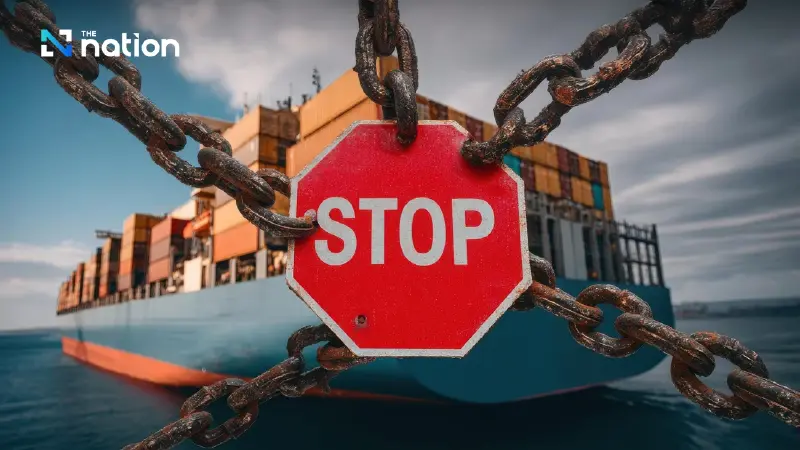


Japanese shipping lines have paused transits after Iran ordered vessels to avoid the key chokepoint, fuelling concerns over crude and LNG flows and renewed pressure on energy prices.
- The closure of the Strait of Hormuz by Iran's navy has halted traffic through a critical shipping route that handles about 20 million barrels of oil per day, representing 20% of global consumption.
- In response, three major Japanese shipping companies have suspended voyages through the strait, and at least 150 crude oil and LNG tankers are currently anchored and unable to pass.
- A prolonged closure threatens the economies of nations heavily reliant on Middle Eastern energy, such as Japan, which imports over 90% of its crude oil through the strait.
- Europe's energy security is also at risk, as it has increased its dependence on LNG from Qatar, which ships through the strait, after reducing its reliance on Russian gas.
After Iran’s navy ordered ships not to pass through the “Strait of Hormuz”, a critical route for shipping crude oil and liquefied natural gas (LNG) from the Middle East, Mitsui O.S.K. Lines, one of Japan’s largest shipping companies, said on Sunday (March 1) that the order followed reports that Iran’s Islamic Revolutionary Guard Corps told all vessels: “Do not pass through this strait,” after the US and Israel launched air strikes on Iran.
Nikkei Asia reported that three major Japanese shipping companies, Mitsui O.S.K. Lines, Nippon Yusen and Kawasaki Kisen, decided to “temporarily suspend voyages through the Strait of Hormuz” for safety reasons.
The “Strait of Hormuz” lies between Iran to the north, and Oman and the United Arab Emirates to the south.
Closing the strait “may not be difficult”, because although the narrowest point is 33 kilometres wide, the shipping lanes on each side are “only 3 kilometres” wide, to prevent cargo ships running aground if they travel too close to shore.
Each month, around ~3,000 vessels pass through the strait (~100 a day).
It carries about 20 million barrels of oil a day, around 20% of global consumption, and, crucially, shipments through this strait account for about 11% of global trade.
As the main passage linking the Persian Gulf with the Gulf of Oman, a prolonged closure would immediately hit Japan’s economy, as Japan relies heavily on energy imports from the Middle East.
Japan imports more than 90% of its crude oil from the region, especially from Saudi Arabia and the United Arab Emirates.
Most oil must pass through the Strait of Hormuz and takes about 20–25 days to reach Japan.
Normally, Mitsui O.S.K. Lines has around 10 LNG carriers and crude oil tankers in the Persian Gulf at any one time, but ships preparing to enter the gulf have been instructed not to enter, while those preparing to leave have been told to wait in safe waters.
The company said it has stepped up monitoring 24 hours a day, putting the safety of its crews and cargo first.
At present, at least 150 tankers, both crude oil and LNG vessels, are anchored outside the strait, while several dozen more have come to a halt on the opposite side of the strait.
However, refiner Idemitsu Kosan said there has been “no immediate impact”, as Japan has both domestic stockpiles and government reserves.
As of the end of December, Japan’s oil reserves were equivalent to 146 days of domestic use.
But if severe cold weather drives up demand for electricity and gas, the situation could tighten.
Power producer JERA said the conflict could affect “energy resource prices” and it is monitoring the situation closely.
In Europe, the impact could be even heavier.
After Russia invaded Ukraine, Europe cut its reliance on Russian gas from 45% to around 15%, and turned instead to long-term LNG contracts with Qatar.
If the Strait of Hormuz remains closed for an extended period, Europe may have to rethink its entire energy security policy.
