
Thailand slips to 116th in TI corruption index, score 33
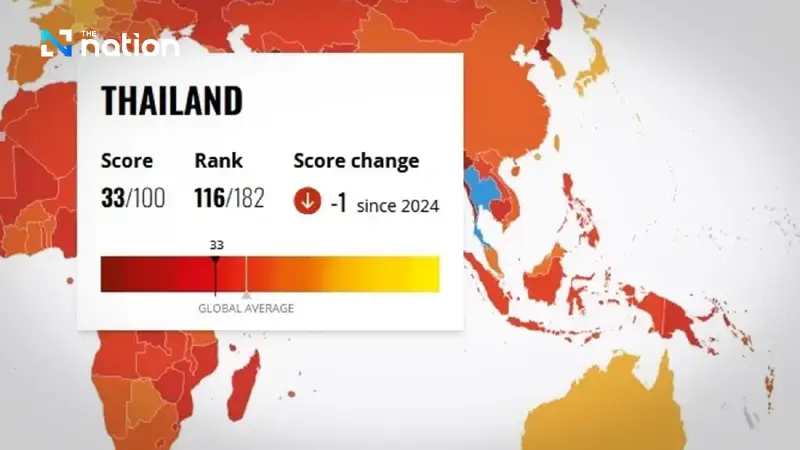


Transparency International’s CPI 2025: Thailand scores 33/100 and ranks 116 of 182, down from 34 points a year earlier. Denmark tops the index; Singapore leads ASEAN.
On February 10, 2026, KRAC Corruption, a Chulalongkorn University page, shared the 2025 Corruption Perceptions Index (CPI), showing Thailand scored 33/100 and ranked 116th globally—below the world average of 42.
The index, released by Transparency International, placed Thailand 116th out of 182 countries and territories, down one spot from 2024 when it scored 34.
Global CPI highlights
Denmark ranked first with 89, followed by Finland with 88. Singapore placed third and remained ASEAN’s top performer with 84. New Zealand and Norway tied for fourth with 81, while Sweden and Switzerland tied for sixth with 80. Luxembourg and the Netherlands shared eighth place with 78, and Germany and Iceland were tied for 10th with 77.
TI’s analysis said Thailand (33) and Mongolia (31) remain low-scoring and have shown a steady downward trend since 2012. In Mongolia’s case, the decline was linked to weaker rule of law and accountability, alongside increasing restrictions on civic space.
The analysis noted that compared with 2024, Thailand’s CPI score fell by one point, and that Thailand’s standing worsened relative to the global field, reflecting a deterioration compared with other countries.
Looking into the component indicators used in the CPI calculation, the largest declines were concentrated in indices linked to the views of investors and private-sector operators—particularly the competitiveness-related measure in the IMD World Competitiveness Yearbook.

By contrast, assessments of Thailand in the political and legal-structure dimension showed improvement in most areas.
Regionally, Thailand was ranked seventh in ASEAN, down from fifth previously, behind Singapore (84), Brunei (63), Malaysia (52), Vietnam (41), Indonesia (34) and Laos (34), according to the figures cited.

For 2026, TI highlighted four priorities:
- guaranteeing an independent, transparent justice system that the public can access;
- tackling undue influence over political decision-making;
- ensuring victims of corruption can access justice; and
- protecting civic space and reporting of wrongdoing, including safeguarding basic freedoms, civil society and whistleblowers.
The recommendations focus on strengthening public participation in the justice process and increasing political transparency to reduce the influence of individuals outside formal politics on the direction of national administration.
The report also noted that while the CPI is a perception index and does not directly measure the full reality of corruption in a country, it remains a useful signal showing that anti-corruption efforts are still necessary—and increasingly so.
Kittidej Chantangkul, Director of Anti-Corruption Organization of Thailand (ACT), said the global average score is 42, while Thailand scored 33. He added that when comparing by regime type, “flawed democracies” average 47, while Thailand’s score sits close to countries classified as non-democratic, which average 32—a point he said reflects Thailand’s democratic standing through the CPI lens.
Later that day, at around 5.10pm, Dr Mana Nimitmongkol, Chairman of Anti-Corruption Organization of Thailand (ACT), said the result was “very bad” for Thailand, calling 33 points the country’s lowest score in 19 years and its worst ranking since TI began publishing the index. He said that over the past two-plus years and three governments, he had not seen clear anti-corruption policies or measures, which in his view dragged the score down.
Dr Mana argued that when governments show little interest in tackling corruption, it emboldens corrupt officials and private actors. He said corruption in Thailand was not just the problem of a few bad individuals, but a structural issue—pointing to a lack of good governance, disclosure and transparency in the bureaucracy, as well as weaknesses across the justice system, from police to prosecutors, courts and independent agencies, which he said have failed to provide the public with effective oversight.
Asked whether the State Audit Office building collapse earlier in 2025 contributed to Thailand’s lower score, Mana said it had a significant impact because it highlighted weaknesses in corruption prevention and the fragility of independent oversight, particularly the inability to hold major offenders accountable. He added that reports on money-laundering networks linked to scammer gangs emerged after the assessment period had closed, noting the CPI evaluation cycle typically ends around August–September.
He said the past year had seen multiple serious scandals, yet accountability remained limited, adding that corruption was widely perceived across many sectors, including the clergy and politics.
