
Princess Sirindhorn marks out Phra Merumas layout for Queen Mother’s royal cremation
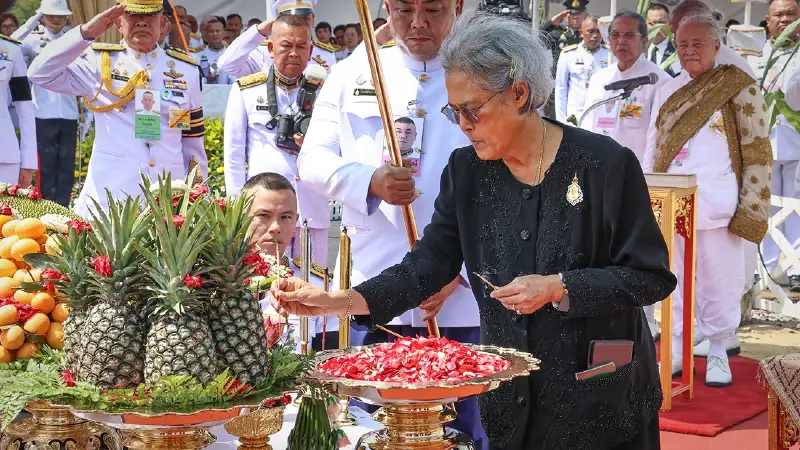


Her Royal Highness Princess Maha Chakri Sirindhorn on February 23, 2026 presided over the boundary-post ceremony marking the construction plan for the Phra Merumas for the Royal Cremation Ceremony of Her Majesty Queen Sirikit The Queen Mother at Sanam Luang, Bangkok.
Auspicious ceremony at Sanam Luang
At 1.27pm on Monday, Her Royal Highness Princess Maha Chakri Sirindhorn presided over the ceremony to place boundary posts marking out the construction layout for the Phra Merumas (royal crematorium) for the Royal Cremation Ceremony of Her Majesty Queen Sirikit The Queen Mother at Sanam Luang, Bangkok.
The ceremony was held to ensure auspiciousness and smooth progress befitting the occasion, and to bolster the morale of all personnel carrying out their duties in honour of Her Majesty.
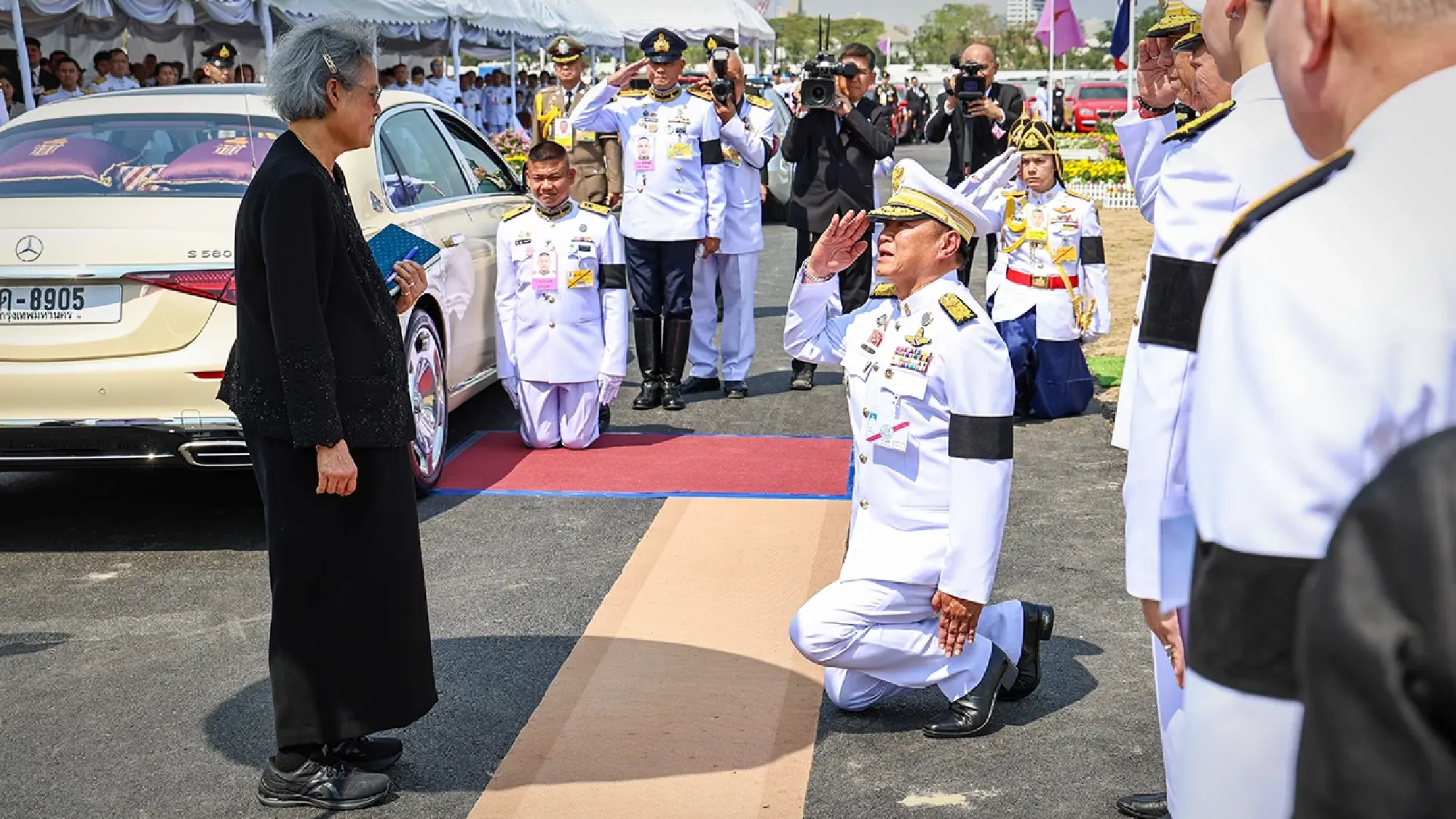
Those in attendance to receive Her Royal Highness included Thanphuying Sirikitiya Jensen, Prime Minister Anutin Charnvirakul, Deputy Prime Minister Bawornsak Uwanno, Chabida Thaiset, Minister of Culture, Prasop Riangngern, permanent secretary for culture, and Phanombut Chandrachoti, director-general of the Fine Arts Department.

Rituals led by royal astrologers and Brahmin priests
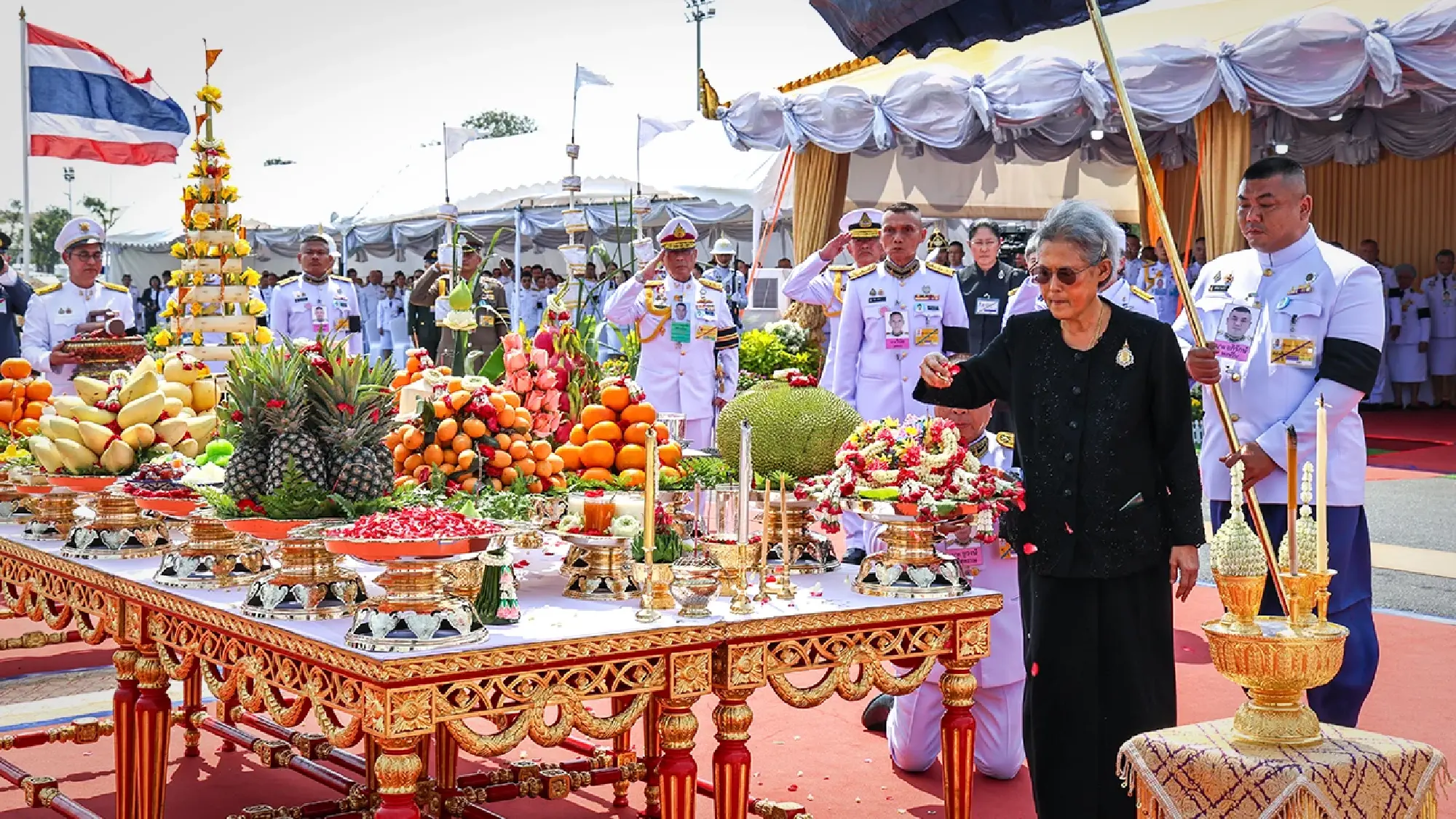
Her Royal Highness lit the gold and silver candles and placed incense at the offerings. Royal astrologers sounded the victory gong, Brahmin priests blew conch shells, Phusa Mala officials swung the bandao drum, and ceremonial trumpets and the piphat ensemble played the Sathukan piece.
She then lit incense and candles at the Thong Noi set and trimmed the wicks before entering the ceremonial pavilion. Seated on the royal throne, Phramaharatchakhru Pithi Sri Wisutthikhun, the presiding chief Brahmin priest, read an invocation paying reverence to the deities and former monarchs, accompanied by the victory gong, conch shells, the bandao drum, ceremonial trumpets and the piphat ensemble performing the Trasan Nibat piece.
Prime Minister hammers four boundary posts
Her Royal Highness proceeded to the ceremonial area, where she sprinkled lustral water over the boundary posts and craftsmen’s tools, and scattered popped rice and flowers over them.
She then presented a boundary post to Anutin, who hammered in posts at all four cardinal points. The posts were made from auspicious teak, 4 centimetres in diameter and 29 centimetres long, sharpened at one end. The tool used was a teak mai sam kleua (a “three-brother” wooden mallet), 39 centimetres long.
The mallet is regarded as representing all branches of craftsmen’s tools in rites honouring master artisans, with Vishvakarman as the presiding deity of the celestial masters. The four post positions were set based on the locations of the four main corner pillars of the central Phra Merumas structure. Hammering began at the north-east position and proceeded clockwise, following the same tradition used when placing or raising a building’s principal pillar.

Why the boundary-post ceremony matters
The boundary-post ceremony is regarded as the first step in construction, defining key structural pillar positions so the building can be erected accurately according to plan.
In this case, it also serves as a formal offering and notification to the deities of the site and throughout the land, seeking permission to proceed and praying for auspiciousness so construction progresses smoothly and without obstacles. It additionally forms part of rites paying reverence to former monarchs and a wai khru (teacher-honouring) ceremony for the team of craftsmen building the Phra Merumas.
Design to reflect tradition and Her Majesty’s legacy
For the Phra Merumas for the Royal Cremation Ceremony of Her Majesty Queen Sirikit The Queen Mother, His Majesty the King has granted royal approval for the government — through the Ministry of Culture and the Fine Arts Department — to produce a design in line with ancient royal tradition, artistically refined, and reflective of Her Majesty’s royal conduct and benevolence.
The uppermost portion is designed in a transformed crown style, modelled on royal head ornaments, with a roof of seven tiers comparable to major palace structures. The pinnacle takes the form of a Brahma face, symbolising ascent to the Brahma realm and reflecting Her Majesty’s epithet as the “Mother of the Land”. At the very top sits the Nopphadon Maha Sawet Chatra, a nine-tiered white umbrella, signifying the highest royal rank.

The structure follows a square plan in a castle-like form with porches on all four sides, set on a two-tiered base decorated with deity figures symbolising the journey to the heavens. The roof is a muted blue alternating with iridescent beetle-wing tones. Each gable bears the royal initials “S.K.” on a blue background associated with Friday, Her Majesty’s birth day, against a pink backdrop linked to auspiciousness. The gable pediments are constructed in a soum na nang style inspired by the crown and necklace Her Majesty wore during her lifetime. Decorative patterns draw on plants associated with the name “Sirikit”, while fire screens are embroidered by artisans of the Sirikit Institute.
Surroundings and timeline
The surrounding landscape is arranged on a cosmic-universe concept, with circular ponds decorated with Himavanta creatures and characters from the Ramakien, reflecting Her Majesty’s work in conserving the Khon masked dance tradition.
Additional buildings include the Phra Thinang Song Tham, the Sala Luk Khun, the Thap Kaset, and the Thim, to accommodate and receive ambassadors, envoys and invited guests during the royal rites.
Following the boundary-post ceremony, work will proceed through the main structure, architectural and fine-arts elements, and landscape architecture, with completion scheduled within October 2026.
