
Asia deepens AI leadership as AI+ transforms key industries
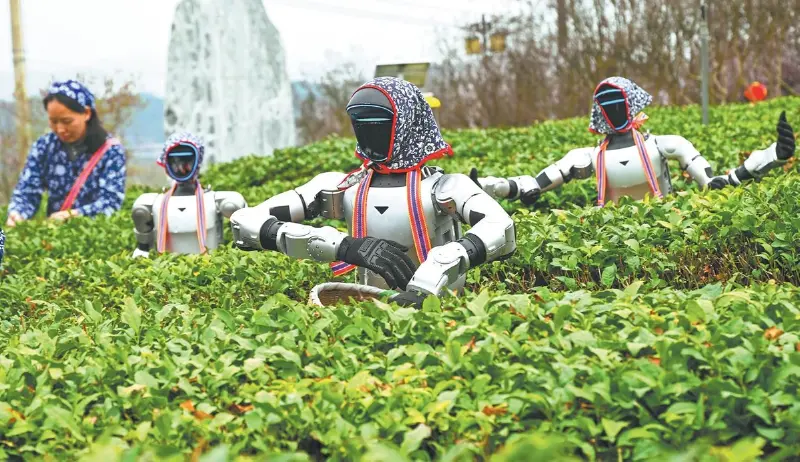


Boao Forum speakers said Asia is gaining ground in AI as AI+ expands from labs into business, healthcare and public policy across the region.
- Asia is emerging as a global leader in artificial intelligence, with reports suggesting the centre of AI development is shifting from the US and Europe to the region, driven by its large markets, industrial chains, and strong policy support.
- The "AI+" concept, a national strategy in China, is driving the deep integration of artificial intelligence across various sectors, moving the technology from a stand-alone tool to a transformative force for business models.
- AI is actively reshaping key industries in Asia, including optimizing e-commerce supply chains, revolutionizing healthcare diagnostics and drug development, and creating intelligent, agent-based smartphones.
- The region's growing leadership is supported by statistics, with Asian enterprises accounting for 28% of global AI unicorns and submitting 55% of recent AI-related cases to the International Telecommunication Union.
What began as a futuristic idea is now being treated as a force already changing industry, daily life and global governance, with Asia increasingly positioning itself not as a late mover but as a rising leader in artificial intelligence.
At the 2026 Boao Forum for Asia Annual Conference in Boao, Hainan province, speakers and reports pointed to the region’s broad industrial chains, huge market scale and policy backing as major advantages in that shift.
The Asian Economic Outlook and Integration Progress Annual Report 2026, released during the forum, said the global centre of AI development is gradually moving away from Europe and the United States toward Asia. It said economies across the region are drawing on large digital populations, varied application scenarios and coordinated policy support to climb the innovation ladder and reshape the global AI landscape.
The forum also underscored how long AI has been part of its agenda. The idea of “AI+” was first proposed at the BFA a decade ago by Zhang Yaqin, an academician at the Chinese Academy of Engineering and dean of Tsinghua University’s Institute for AI Industry Research. Since it was written into China’s Government Work Report in 2024, the concept has evolved into an ongoing national strategy. This year’s report went further by introducing the idea of the “intelligent economy”, signalling deeper AI integration across sectors.
Zhang said the technology is now moving into a new stage shaped by three major changes. He described the first as the shift from generative AI to “agentic AI”, which he said is “an AI system that can accomplish a specific goal with limited supervision”, adding that 2026 is expected to be “the first year of AI agents”. He said the second change is a move from information intelligence to physical and biological intelligence, while the third is a transition from AI as a stand-alone tool to deeper “AI+” integration that transforms both applications and ways of thinking.
Momentum is also building across the wider Asian region. The China Academy of Information and Communications Technology said Asian small and medium-sized enterprises accounted for 28 per cent of global AI unicorns in 2025. Over the past two years, 55 per cent of AI-related cases submitted to the International Telecommunication Union came from Asia, especially in healthcare, education and public services.
“Countries in ASEAN and across Asia are showing strong demand for AI technologies,” said Yu Xiaohui, head of the CAICT, during a BFA panel. “China’s open-source models provide an important foundation for these countries to develop sovereign models tailored to local languages and application scenarios.”
Yu said the region also has considerable room to work together on computing infrastructure and standards-setting so that the benefits of “AI+” can spread to more economies.
That broader trend is also reflected in the region’s digital economy. The forum’s flagship annual report said Asia’s digital economy reached US$27 trillion in 2025, equal to 46 per cent of GDP. China remains the largest player, with its digital economy projected to exceed 80 trillion yuan (US$11.72 trillion) by 2030.
Across forum discussions, one of the clearest themes was that the value of “AI+” now lies in moving beyond laboratories and into real-world use, where digital intelligence can raise efficiency and reshape business models.
Among consumer sectors, smartphones were identified as one of the first areas likely to show how AI becomes part of everyday life. Zhang Fei, vice-president of AI business at smartphone maker Vivo, said AI-powered smartphones can act as intelligent digital hubs capable of completing complex tasks across different scenarios and applications.
“Interactions with agent-based smartphones will become more natural and human-like,” Zhang said at a BFA panel. “It’s about the phone adapting to people, rather than people adapting to the phone.”
AI is also changing industrial supply chains. Shen Jianguang, vice-president and chief economist at major e-commerce platform JD, said the company’s ability to serve 700 million users, manage tens of millions of products and run more than 20 million square metres of warehouse space globally depends on full-chain AI integration.
“From customer service and logistics scheduling to product selection, dynamic pricing and inventory management, AI has become an essential tool for enhancing competitiveness in a highly competitive market environment,” Shen said.
Healthcare was another major area of focus. Fu Sheng, head of the Boao Lecheng international medical tourism pilot zone administration, said AI is likely to fundamentally reshape healthcare and drug development by making earlier diagnosis possible at the molecular and genetic levels.
“AI will completely change the model of drug development. We are already seeing early signs of this, with outstanding companies emerging,” Fu said.
He added that AI’s imaging capabilities have already surpassed those of traditional doctors and can help support personalised treatment planning.
Wu Wenda, president of Tencent Health, said AI is also expanding the boundaries of medical knowledge itself. “In healthcare, what we don’t know far exceeds what we do know. AI can help the scientific community better understand human biology,” Wu said.
He added, “We are entering a new renaissance, and with AI, that renaissance can be realised,” saying that in primary healthcare, AI-assisted diagnostic systems will serve as “intelligent assistants” for general practitioners and help ease shortages in grassroots medical resources.
At the policy level, China is also strengthening top-level support. In March, the outline for the 15th Five-Year Plan (2026-30) called for full-scale implementation of the “AI+” initiative to empower a wide range of industries. This year’s Government Work Report also stressed the need to foster new forms of the intelligent economy by deepening and expanding “AI+”, including faster adoption of next-generation smart terminals and AI agents, large-scale AI commercialisation across key sectors, and the cultivation of new AI-native business models and formats.
But alongside the opportunities, the forum also highlighted the risks that come with rapid AI development, with participants repeatedly stressing the need to balance innovation with safety.
Jenny Shipley, former prime minister of New Zealand, repeatedly raised concerns over the social and ethical effects of AI during the event. She warned that the technology could replace some jobs, widen the digital divide and create fresh privacy and ethical risks.
“We must ensure that robots serve humanity, rather than challenge social ethics and human values,” Shipley said.
Yu of the CAICT said that although public acceptance of AI is rising globally, many users still underestimate the safety risks tied to these technologies. He said mainstream large language models around the world still have 15 to 30 per cent of safety-related issues that need to be addressed, and that AI developers “bear significant responsibility” for improving the safety and robustness of AI systems.
Jiang Xiaojuan, former deputy secretary-general of the State Council, China’s Cabinet, said governance efforts over the past decade have largely remained conceptual, while the role of social sciences in shaping governance frameworks has been insufficient.
“As a general-purpose technology, AI has significant potential to enhance efficiency, quality and safety across industries. The priority remains to promote its development, but this must be balanced with both economic rationality and social acceptability,” Jiang said.
She said “social acceptability” means AI development should reflect public values and consensus rather than being driven only by scientists, and should therefore involve broader public participation and discussion.
With China’s Government Work Report this year calling for stronger AI governance, Zhang Yaqin also proposed three specific steps: clear labelling of AI-generated content, where China has already taken legislative action; ensuring all AI agents can be traced to accountable entities; and banning unrestricted self-replication by AI systems.
He also warned about the risks created by the rapid spread of AI-generated material online.
“Currently, about 65 per cent of online content is generated by AI, and this is creating a negative feedback loop in model training,” Zhang said, describing it as one of the most urgent challenges in AI governance.
At the international level, some common ground is beginning to emerge. Sam Daws, senior advisor to the Oxford Martin AI Governance Initiative, said major economies are showing increasing alignment on how to regulate AI in the real economy.
“Legislation in the European Union, the United States and China shows a high degree of similarity in key areas such as system testing, safe deployment and performance monitoring,” Daws said.
He added that multilateral efforts, including ASEAN’s AI safety network and United Nations-led mechanisms, are offering practical routes for global cooperation.
China Daily
