
International schools seen as key to narrowing Thailand’s learning gap
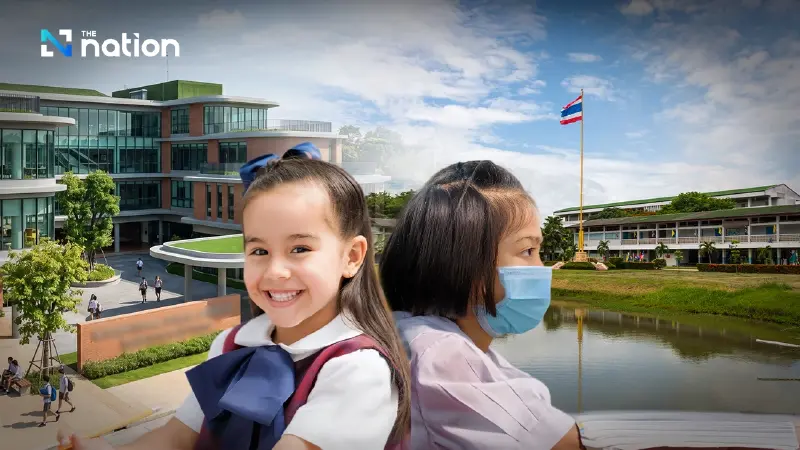


Experts say Thailand should link international and public schools through exchanges, shared facilities and sister-school schemes to narrow education gaps.
- International schools are encouraged to partner with public schools through "sister-school" initiatives and exchange programs to share strengths and teaching methods.
- The public education system can use international schools as a benchmark to improve quality, learning from their practices in student-centered teaching, creative thinking, and mindfulness.
- A proposed "sharing model" suggests international schools could open facilities, such as science and IT labs, to public school students to foster collaboration and reduce the resource gap.
- Collaboration between the two systems can help address specific deficiencies in Thai education, such as English language proficiency and soft skills like confidence in presenting ideas.
Thailand’s rapid growth in international schools is sharpening debate over whether the trend is deepening educational inequality or creating new opportunities to strengthen the wider school system.
With more than 300 international schools now operating across the country, they have become an increasingly attractive option for parents seeking stronger English-language learning, more student-centred teaching, better learning environments and greater opportunities for children to speak up in class.
At The Nation Visionary Club roundtable, titled “Beyond the Classroom: Thai Education Beyond Borders”, on Monday (June 8), speakers discussed whether the rise of international schools reflected waning confidence in public education or whether such schools could become partners in lifting Thai education to international standards.

Language and confidence remain key gaps
Parinyasiri Yohuang, a student at Thammasat University, highlighted language as one of the clearest differences between international and Thai schools. However, she noted that inequality also exists within the Thai public school system itself, particularly between urban schools and those in remote provincial areas.
Drawing on her own experience of growing up in a remote area, she observed that some learning opportunities reached provincial schools in towns but not more isolated communities.
She added that students from remote areas often lacked soft skills, especially confidence in presenting ideas or handling interviews. Many had knowledge, she explained, but struggled to communicate it effectively.

Assoc Prof Dr Suriyadeo Tripathi, Director of the Centre for Morality Promotion, linked the trend to Thailand’s social networks and patronage culture. He argued that many middle- and high-income parents were not only choosing schools for education, but also for social ecosystems, networks and status.
“This kind of mindset is really strong here,” he noted, adding that parents often compared where their children studied. He warned that this approach could become parent-centred rather than child-centred, moving education away from children’s happiness and real needs.

Students need collaboration as much as competition
Krai Satarak, a student at Chulalongkorn University, offered a different view, saying the core knowledge taught in Thai and international schools was not necessarily very different.
Drawing on his experience in Thai schools and study-abroad programmes in the United States, he explained that subjects such as physics were based on the same theories and logic regardless of the school system.
For him, the real value lies in collaboration. He cited examples of working with local businesses in greenhouse farming and Thai fabric, where local students and communities possessed practical knowledge while others could contribute business frameworks.
“It is an integration of local wisdom and the modern business framework,” he reflected, adding that differences between students should teach them that they need one another.

Hartanto Gunawan, Director of Community Learning Centre, pointed to discipline as another difference. He observed that international schools tended to place strong emphasis on punctuality and order, while many had also introduced mindfulness as a way to train the mind.
He noted that parents did not want children to return from school with sadness, anger or negative emotions, adding that mindfulness could help students become calmer and more focused.

Right fit matters more than price
Nisanart Dharmageisirattana, Director of the American School of Bangkok - Green Valley Campus, explained that parents often looked to international schools for creative thinking, analytical skills, research ability and English-language proficiency.
However, she stressed that the most important factor was not whether a school was international, expensive or prestigious, but whether it was the right fit for the child.
A costly school may not work if it does not suit the student, she noted, while the right school could be a nearby institution with suitable facilities, teachers and tuition fees.
“If you look deeply, every school has pros and cons,” she said. “The key is how we can help parents understand what is the right fit for their child.”
She also emphasised that international schools could work more closely with public schools across Thailand. Her school, she explained, had worked with counsellors and volunteer teachers from several provinces to introduce mental practice, a non-religious approach aimed at improving concentration, focus and emotional balance in classrooms.
Nisanart also pointed to the International School Association of Thailand as a platform for exchange programmes. She suggested that Thai schools could share strengths such as Krabi-Krabong and Muay Thai with international schools, while international schools could support Thai schools in other areas.
“Through a simple exchange programme, we could go a long way towards narrowing what some people see as a gap,” she said, noting that collaboration could help reduce those perceived differences.

Relevance is more important than budget
Prof Dr Parichart Sthapitanonda, Vice President of Chulalongkorn University, highlighted the importance of relevance in education.
She recalled an example of a Thai researcher who travelled to the South Pole and was invited by international schools in Thailand to hold live Zoom sessions with students. The sessions allowed students to ask questions about climate, temperature, penguins and scientific work in a place few people have the chance to visit.
For Parichart, the lesson was not about how much budget a school had, but how teachers designed learning experiences that connected with students’ curiosity and real-world issues.
She argued that the challenge was to encourage teachers to recognise available opportunities and make lessons relevant to what students wanted to learn.

Public and private schools as partners
Dr Jomhadhyasnidh Bhongsatiern, Head of the National Education Policy and Planning Division at the Office of the Education Council, said the Ministry of Education viewed the private sector, including international schools, as a valuable partner.
She noted that the Office of the Education Council had recently discussed education cooperation with the British Chamber of Commerce and representatives of international schools. Thai public schools, she explained, could learn from international-school practices and use them as benchmarks to improve quality while remaining relevant to local communities.
She also highlighted ongoing cooperation between the Ministry of Education, the Equitable Education Fund and international schools to pair international schools with local public schools in sister-school partnerships.

A shared education model
Dr Karndee Leopairote, the Democrat Party’s expert on innovation, technology, the digital economy and future studies, said Thailand still faced fundamental problems in education quality and access.
However, she noted that high-quality international schools could also benefit the country economically by attracting skilled expatriates, high-quality immigrants and foreign investment. Thailand, she added, had strong regional advantages in quality of life and international education.
Speaking as both a mother and a politician, Karndee said both Thai public schools and international schools had strengths. English could be improved outside international schools, while global citizenship could be embedded in any curriculum if students were taught to understand different viewpoints, empathise with others and engage with global issues.
She rejected the idea that international and public schools should exist as separate bubbles. Instead, she called for a sharing model in which international schools opened facilities such as chemistry and IT laboratories to Thai schools during evenings or weekends, while students from both systems learned together.
“I think this is the job of the Ministry of Education. Do not set them up as two separate bubbles. They are part of Thai society, and they have to share,” she stressed.
Karndee also pointed to parenting classes at international schools, including sessions on wellbeing, mental health and child development, as practices that public schools could adapt.
For her, the central question is not whether international schools widen inequality, but how Thailand can blend the strengths of both systems through shared facilities, knowledge transfer and closer student interaction.
