
The Two-Dimensional Divide: Why Thailand's 'Free Education' is Failing the Poor
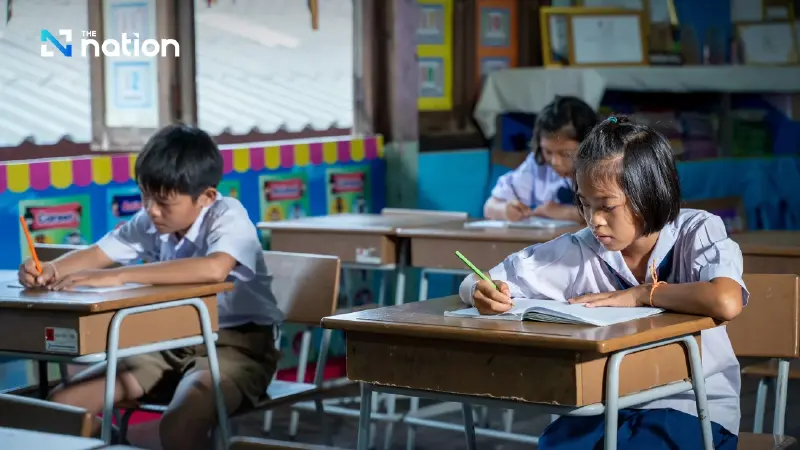


Despite one of the country's largest budget allocations, Thailand's education system is entrenching poverty rather than alleviating it, experts warn
- Despite being officially "free," Thailand's education system imposes significant costs on the poorest families, who simultaneously receive a lower quality of schooling than their wealthier peers.
- This "two-dimensional inequality" is driven by systemic flaws, including a per-pupil funding model that under-resources small rural schools and a uniform curriculum that ignores local needs.
- The failure to provide genuinely free and equitable education results in a stark divide in learning outcomes, with a few elite students excelling while roughly two-thirds of the population fall below basic proficiency standards.
Despite one of the country's largest budget allocations, Thailand's education system is entrenching poverty rather than alleviating it, experts warn.
Thailand has long prided itself on offering universal free education, but a panel of policy experts and student leaders has delivered a damning verdict on that claim: the reality, they say, is a system that entrenches inequality and abandons its most vulnerable pupils.
Speaking at the Nation Visionary Club roundtable on Monday, speakers painted a picture of a country divided not merely by wealth but by the quality of learning available to those on either side of the divide.
The Myth of Free Schooling
The most striking challenge to the official narrative came from Dr Kraiyos Patrawart, managing director of the Equitable Education Fund (EEF). Drawing on nearly two decades of data, he argued that Thai education is not, in any meaningful sense, free.
Thailand has pursued a free education policy for close to 20 years, yet the numbers tell a different story. The Covid-19 pandemic caused a sharp rise in the number of economically disadvantaged pupils in the system — a figure that briefly declined before climbing again in the post-pandemic period.
Despite state subsidies, households in the poorest tenth of the population still spend roughly 10,000 baht per year on their children's schooling, a cost that recurs without fail in every annual survey. Families in the wealthiest tenth spend seven and a half times more.
Dr Kraiyos described this as a "two-dimensional inequality": disadvantaged families are burdened by costs they cannot bear whilst simultaneously receiving a lower standard of education than their wealthier peers.

The gap reflects not only that education is not yet truly free for the poorest households but that those with greater means are able to invest far more in their children — viewing education as among the most important priorities a family can have.
A Tale of Two Thailands
The consequences for learning outcomes are stark. Thailand periodically produces students of genuine world-class ability — the country consistently returns from international academic Olympiads in mathematics, science, and other disciplines with gold and silver medals.
Yet roughly two thirds of the total population falls below the OECD's baseline standard for learning proficiency — a disparity Dr Kraiyos described as a separate dimension of inequality, one measured not by access but by outcome.
Parit Wacharasindhu of the People's Party argued that this gulf represents a fundamental failure of the state's duty to its citizens.
"We would fail as a country if the only way to access good-quality education is through international schools," he said, adding that public education is currently neither sufficiently high in quality nor genuinely free.
The government, he suggested, has failed to convert its considerable education budget into a guaranteed minimum standard for every pupil — what he termed a "high floor" of quality, regardless of background or postcode.
The Per-Head Trap
A central target for reform is the Ministry of Education's per-pupil funding formula, which allocates resources strictly according to the number of students enrolled at each school. For small rural schools — typically those with fewer than 120 pupils — this creates a damaging cycle of chronic under-resourcing.

Because fixed operational costs remain largely constant regardless of school size, smaller institutions receive budgets that cannot cover their basic needs.
The result, in many cases, is that a primary school spanning six year groups may be allocated fewer than six teachers, forcing a single educator to teach two different year groups simultaneously in the same classroom.
In practice, this means that the circumstances of a child's birth — whether they grow up in a Bangkok suburb or a remote highland village — remain the single greatest determinant of their educational prospects.
Localisation: A Lifeline for Those Left Behind
The inequity is compounded by a national curriculum that takes little account of local economic realities. Student representative Krai Satarak of Chulalongkorn University described fieldwork in Nan province, where he found pupils dropping out of school to work on their families' greenhouse farms.
These young people possessed considerable practical expertise in agriculture yet lacked the basic scientific knowledge – on soil chemistry, plant biology, and disease prevention – that would allow them to apply it effectively.
The reason, he argued, is straightforward: the standard curriculum prioritises abstract subjects such as calculus over the practical, vocationally relevant knowledge that rural communities depend upon.
By imposing a uniform, top-down model of learning across vastly different provinces, the system not only fails these students academically but actively alienates them, effectively extinguishing the local knowledge and individual potential it should be nurturing.
Looking Back, Looking Forward
Dr Kraiyos placed the current crisis in a broader historical context, tracing the evolution of Thai education across three centuries. The previous century, he noted, was defined by the country's first Education Act, a teacher-centred curriculum, a focus on acquiring qualifications, the mass production of graduates, and the emergence of the concept of free schooling.
The present century has brought a gradual shift towards learner-centred models, education geared towards the world of work, decentralisation from the Ministry of Education to local innovation zones, and the provision of 15 years of free schooling alongside freely accessible learning resources.
But it is the next century that now demands attention. Dr Kraiyos called on Thai society to begin asking fundamental questions: what is education actually for? What will learning mean for human beings in a world shaped by artificial intelligence, artificial general intelligence, brain-computer interfaces, and quantum computing?
The questions he posed were deliberately wide-ranging — what should be provided free of charge in the next century; how should education be defined; whether a National Education Act remains necessary and, if so, what purpose it should serve; what kind of curriculum the future requires; and whether the emphasis on rote memorisation should finally be abandoned in favour of something more meaningful.
These, he said, are the questions the EEF is actively grappling with – reviewing both the lessons of the past and the possibilities of the future – and ones he urged Thai society to debate openly, in order to learn from history, plan for what lies ahead, and build a genuinely equitable education system.
The Cost of Inaction
The roundtable reached a clear and urgent consensus: without structural reform within the next decade, Thailand faces both economic stagnation and the emergence of a generation disconnected from opportunity.
Speakers called specifically for a shift to needs-based budget allocation—directing greater resources to the schools and communities with the greatest disadvantages—alongside greater autonomy for individual schools to shape their own curricula around local circumstances. Reform of the National Education Act, they argued, is not optional but essential.
The warning to the government was unambiguous. As artificial intelligence and the digital economy accelerate, the gap between well-resourced and under-resourced schools will only widen.
The time for debating the principle of free education, the panel concluded, has passed. What Thailand needs now is education that is not merely free in name but genuinely equitable in practice.
