
Thai Back-to-School Costs Hit 13-Year High Amid Household Squeeze
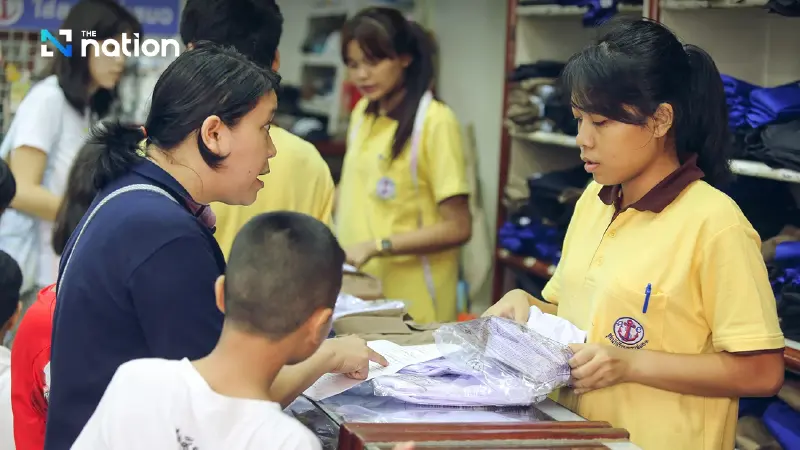


Total education spending for the 2026 term is forecast to reach 66 billion baht, as inflation, a subsidy shortfall and rising household debt compound pressure on Thai families
- Total back-to-school spending in Thailand is forecast to reach 66 billion baht, a 6% increase from the previous year, marking the fastest rate of growth in 13 years.
- The cost surge is driven by 3% inflation, volatile fuel prices, and a government subsidy shortfall of nearly 5,000 baht per family for uncovered expenses like transportation and meals.
- Over a quarter of families report not having sufficient funds, forcing them to take on debt, pawn assets, or cut spending on other household items to cover costs.
- Parents report significant price increases for essential items like school uniforms, shoes, and supplies, with 80% also noting higher transportation costs due to elevated fuel prices.
Total education spending for the 2026 term is forecast to reach 66 billion baht, as inflation, a subsidy shortfall and rising household debt compound pressure on Thai families.
Thailand's back-to-school season is expected to generate total consumer spending of 66 billion baht in 2026, a 6 per cent increase on the previous year and the fastest rate of growth in 13 years, according to research released on Wednesday by the University of the Thai Chamber of Commerce (UTCC).
The findings arrive as the broader Thai economy struggles for momentum, with GDP growth forecast at just 1.6 per cent for the year.
Thanavath Phonvichai, president of UTCC and chairman of the university's Economic and Business Forecasting Centre, said the surge in education-related expenditure is occurring against a backdrop of 3 per cent headline inflation and sustained fuel price volatility — a combination that is placing acute pressure on lower- and middle-income households.
The survey, conducted between 26 April and 2 May among 1,250 respondents nationwide, found that average household back-to-school spending has reached approximately 29,930 baht, with tuition fees alone averaging 23,000 baht.

Rising Prices Across the Board
Parents overwhelmingly reported that the cost of essential school items has increased year on year. More than half of respondents — 52.4 per cent — said shoes and socks were more expensive this term, while 50.4 per cent noted higher prices for school uniforms.
Textbooks and school supplies were flagged by 42.6 per cent and 44.8 per cent of parents, respectively. Fuel costs emerged as a significant secondary pressure, with 80 per cent of parents saying elevated petrol prices had pushed up their children's transportation costs.
Despite these price perceptions, actual spending in several categories appears to have plateaued, with average outlay on shoes and socks capped at 1,450 baht and textbooks at 2,799 baht.
Analysts at UTCC describe this as a "ceiling effect," suggesting families have reached the outer limit of their purchasing power and are opting for lower-tier goods or buying in smaller quantities rather than absorbing higher prices in full.
Some relief has been provided by the Ministry of Commerce's "Back to School 2026" campaign, which offered discounts of up to 86 per cent and an estimated 300 million baht in cost-of-living reductions.
However, UTCC warned this is a fragile equilibrium: manufacturers who have frozen prices for the current term are reporting cost pressures of 20 to 30 per cent from rising raw materials and energy. Without structural intervention, a sharp price increase in 2027 is considered likely.

Funding Gaps and the Debt Burden
Despite the government's 15-year free education policy, the research identifies a near-5,000 baht annual shortfall between state subsidies and the real costs faced by families on lower incomes, with transportation (2,682 baht) and meals (2,574 baht) representing the largest uncovered expenses.
More than a quarter of respondents — 27.1 per cent — said they did not have sufficient funds to meet back-to-school costs. To bridge the gap, 26 per cent turned to formal loans, while 21.7 per cent pawned assets and 15.7 per cent borrowed from relatives.
The proportion relying on formal credit has risen relative to prior years, with researchers noting a shift away from asset pawning as the primary coping mechanism — a trend they say reflects both greater access to formal lending and a depletion of pawnable assets among the most financially stretched households.
To manage the burden, 36.4 per cent of parents said they had cut spending on travel and leisure, 26.9 per cent had reduced outlays on personal clothing and entertainment, and 24.9 per cent reported taking on additional work to supplement their incomes.

A Deeper Crisis in Quality and Wellbeing
The UTCC report goes beyond financial metrics to highlight what it describes as systemic failures in educational outcomes and student welfare.
Thailand's most recent PISA scores place the country significantly below the OECD average across mathematics (394 versus an OECD mean of 472), science (409 versus 485) and reading (379 versus 476) and behind regional peers, including Vietnam and Singapore. Some 61 per cent of parents surveyed said they were concerned that their children would struggle to find employment in the future.
Student wellbeing also emerged as a serious concern: 65.5 per cent of young people reported having experienced bullying, with 83.4 per cent of those incidents occurring within school grounds. Some 68 per cent of students reported burnout and a lack of motivation, while 52 per cent described experiencing profound loneliness.

Policy Demands
In response to the combined financial and social pressures, parents identified several areas where they want greater government action. Tax relief on education expenses was the most commonly cited priority, at 36.9 per cent, followed by direct financial subsidies (34.5 per cent) and transport allowances for students (21.9 per cent). Calls for stricter price controls on school goods were also widespread.
UTCC recommended that the government move towards inflation-indexed subsidies that adjust dynamically for transportation and food costs, prioritising the 5.9 per cent of households earning less than 10,000 baht per month.
Researchers also called for a standardised programme of mental health screening and support in schools, as well as targeted energy subsidies or tax incentives for manufacturers to head off further price rises in the coming academic year.
