
Commerce Ministry pushes ‘Thai Helps Thai’ as grassroots economy platform
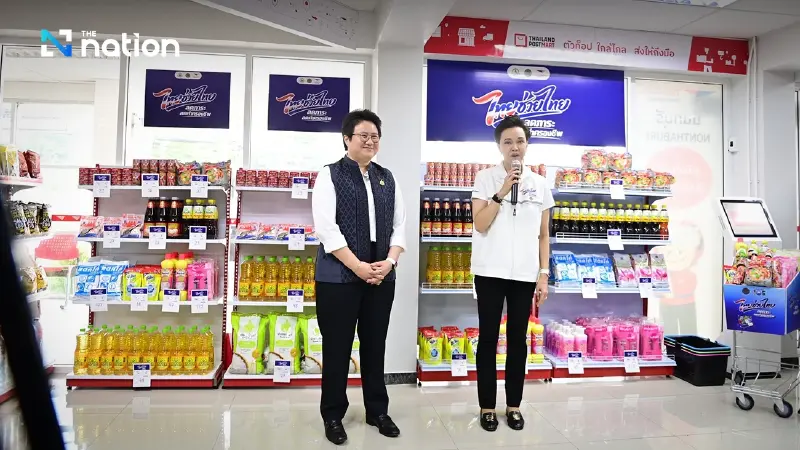


The Commerce Ministry is positioning the “Thai Helps Thai” campaign as a grassroots economy platform to cut living costs while creating income opportunities for SMEs, community products, farm goods and village funds nationwide.
The Commerce Ministry is positioning the “Thai Helps Thai” campaign as a new platform to stimulate the grassroots economy, using affordable-goods sales, SME promotion, community products, farm goods and village funds to generate income across local communities, Deputy Prime Minister and Commerce Minister Suphajee Suthumpun said.
In a post on her personal Facebook page on May 2, 2026, Suphajee said the campaign was not merely a short-term scheme to sell low-cost products, but part of a broader effort to reduce living costs while strengthening local businesses and community-level economic activity.
She said she had attended the kick-off event for the sale of “Thai Helps Thai” products on May 1 at the dome building of Bang Yai City Market in Nonthaburi province.
The event marked the first time the campaign had expanded sales of affordable goods to district offices nationwide, giving people in provincial areas easier access to lower-priced essential products.


Campaign designed to support both consumers and local producers
Suphajee said the heart of the “Thai Helps Thai” project was to help ease people’s cost-of-living burden during a difficult economic period by offering essential consumer goods at affordable prices.
At the same time, she said the campaign was designed to create income opportunities for SMEs, community enterprises and agricultural producers, while helping both buyers and sellers develop online and offline trade skills.
She said the project should be viewed as a set of connected measures forming a larger economic picture, rather than a one-off discount campaign.


Project rolled out in phases
The first phase of the campaign began on April 1, 2026, when affordable products were made available at more than 300 locations nationwide.
The second phase began on April 11, with selected SME products placed on six online platforms. The platforms waived sales commission, or GP, fees, while the Commerce Ministry provided free delivery and issued 500,000 discount coupons worth 100 baht each to help promote SME products.
On April 30, the ministry launched the “Thai Helps Thai Back to School” campaign to help reduce the cost of school uniforms and learning materials.
Most recently, on May 1, the campaign expanded sales of affordable goods to more than 800 districts nationwide, using district offices as sales points every Friday.


Thailand Post and village funds brought into wider network
Suphajee said the campaign was being implemented through an integrated nationwide network.
The Commerce Ministry is working with the Interior Ministry to sell products through district offices, and with the Digital Economy and Society Ministry to distribute goods through Thailand Post.
Sales and distribution have initially been added through 122 Thailand Post locations nationwide, before being expanded to another 824 district post offices, bringing the total to 946 locations.
The ministry is also cooperating with the Prime Minister’s Office to encourage village and community funds to bring local products into the campaign, helping generate income circulation in local areas.


SME products to be pushed onto more online platforms
Suphajee said the Commerce Ministry also plans to help more promising SME products enter online platforms.
This will be carried out in cooperation with the Public Health Ministry on Food and Drug Administration standards and the Industry Ministry on Thai Industrial Standards Institute standards, with the aim of increasing income opportunities and stimulating the domestic grassroots economy.
The move is expected to help local producers improve product standards, gain wider market access and compete more effectively through digital sales channels.
Suphajee says scheme aims to balance market system
Suphajee said the ministry was also seeking to maintain balance across the market system, with cooperation from manufacturers, large businesses, small operators and local communities.
She said the goal was to ensure that small businesses can survive, large businesses can continue operating, communities become stronger, and people have fair and widespread access to affordable goods.
That, she said, is the true purpose of “Thai Helps Thai”.
