
Marine world heritage or the Land Bridge: which would make Thailand richer?


Thailand is pressing ahead with its 1-trillion-baht Chumphon-Ranong Land Bridge, but recent study findings and community concerns are fuelling fresh debate over value, livelihoods and environmental cost.
- The 1 trillion baht Land Bridge project is promoted as a major logistics hub, but studies cited in the article suggest it is not economically feasible and ranks as a poor investment compared to other development options.
- Opponents argue the project would cause severe environmental damage to globally important marine ecosystems, national parks, and wetlands, threatening local economies in tourism and fishing that already generate billions of baht.
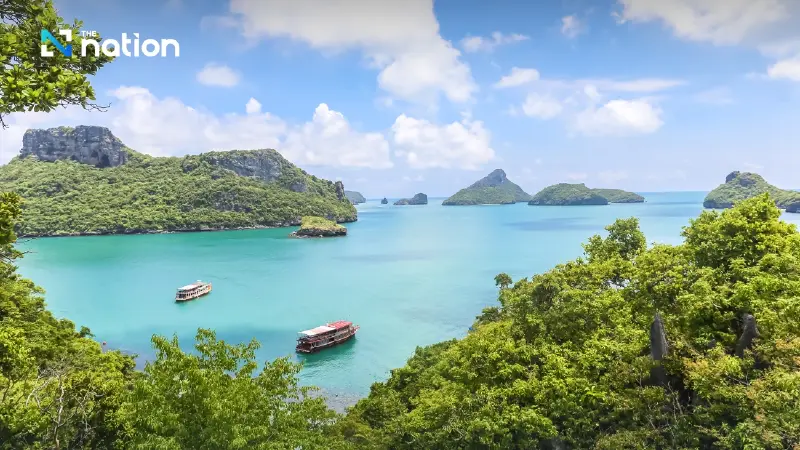
- An alternative path to wealth is securing a UNESCO World Heritage designation for the Andaman Marine Conservation Area, which proponents believe would create a "step-change in wealth" by significantly boosting tourism based on Thailand's natural beauty.
- A key criticism is that the Land Bridge's planning documents completely ignore the pre-existing World Heritage nomination, preventing any assessment of whether the two vastly different development models could coexist.
The government is pushing ahead with the Chumphon-Ranong Land Bridge, a mega-project worth more than 1 trillion baht, and is preparing to submit it to the Cabinet, with construction targeted by 2030. But study findings cited in recent public debate suggest the project may not offer value for money, while civic groups are calling for a review over concerns about environmental damage and the impact on local ways of life.

What is the Land Bridge?
The Land Bridge is a transport infrastructure project designed to develop the Southern Economic Corridor and create a logistics link between the Gulf of Thailand and the Andaman Sea. It is intended to provide an alternative sea-freight route to the Strait of Malacca, with the aim of turning Thailand into a strategic transport hub for Asia.
The Cabinet approved the conceptual framework for the Southern Economic Corridor (SEC) covering Chumphon, Ranong, Surat Thani and Nakhon Si Thammarat in 2018. Under the current concept, the project comprises three connected schemes over a total distance of 109 kilometres:
- Development of deep-sea ports in Ranong and Chumphon
- Construction of a double-track railway linking Chumphon and Ranong deep-sea port
- Construction of an intercity motorway.
The Transport Ministry assigned the Office of Transport and Traffic Policy and Planning to study the project’s suitability during 2024-2025, including the preparation of an Environmental and Health Impact Assessment (EHIA). Reuters also reported this week that the current government expects to take a formal proposal to Cabinet in June or July 2026.

Land Bridge for whom?
Critics argue that the proposed Southern Special Economic Corridor law would pave the way for large-scale industrial development in the South. According to the article’s cited interpretation of the draft framework, the SEC committee would have wide powers to buy, lease and expropriate land, while draft provisions are described as opening long leases of up to 99 years and exempting at least 30 laws intended to protect the environment.
What the South stands to lose
The article argues that Chumphon and Ranong are not empty corridors but productive and environmentally sensitive areas. It says the region is a major source of fruit and fisheries income, with durian and other economic crops in 2024 generating more than 7 billion baht. The proposed Laem Ao Ang port site in Ranong is described as an area of globally important biodiversity, with tourism alone said to have generated more than 6 billion baht in 2023, while the sea remains a source of livelihood for small-scale fishers, creating more than 500 million baht in 2024.
The state is preparing to commit around 1 trillion baht to the Land Bridge, but critics say the economic and environmental impact must first be weighed carefully to determine whether the project is truly worthwhile. The article cites a full study by Chulalongkorn University’s Academic Service Centre, which concluded that the Land Bridge was not economically feasible or not worth building, arguing that the project area would affect national reserved forests, national parks and internationally important wetlands designated under the Ramsar Convention, with losses that could neither be properly valued nor fully restored.
A 1-trillion-baht Land Bridge is not the best option
On April 29, 2026, details emerged from an assessment of maritime logistics development between the Gulf of Thailand and the Andaman coast, described as a collaboration between the National Economic and Social Development Council (NESDC) and Chulalongkorn University. According to the findings cited in the article, the Land Bridge is not the best answer for Thailand.
The report assessed four development options for connecting the two seas. The top-ranked option focused on building from the existing base, or “Thailand Only”, prioritising production and trade development along the coastal SEC without building a major new cross-peninsula link, and instead improving access routes so the country could make fuller use of what it already has. By contrast, the Land Bridge ranked third, described as the least suitable option when set against the required budget and its strategic value.

The official NESDC study summary available online similarly describes a base-case option built around the existing SEC framework, without a new cross-sea land bridge, alongside a separate Land Bridge option based on a new rail-and-road connection between Chumphon and Ranong.
The debate, then, is no longer only about engineering or logistics. It has become a broader question of what kind of wealth Thailand wants to create: one built on large new infrastructure, or one that protects and builds on existing natural assets, local livelihoods and globally significant marine ecosystems.
Andaman world heritage and the Land Bridge
Thon Thamrongnawasawat, a lecturer in the Department of Marine Science, Faculty of Fisheries, Kasetsart University, and a marine scientist, posted on Facebook on April 27, 2026:
“In the case of the Land Bridge in Ranong, data from the published EHIA documents use an average figure of 47.57 benthic animals per square metre. The affected area is 32 million square metres, giving a total of 1.524 billion benthic animals. However…
Data from Professor Sakdi-anan Plathong, president of the Marine Science Association of Thailand and an expert on benthic animals, based on field surveys, found an average of 1,685 benthic animals per square metre.
If this figure is applied to the affected area of 32 million square metres, the total number of benthic animals that would be lost comes to 53.953 billion.
The difference between the two figures is 52.429 billion animals — an enormous gap that is highly significant if the project goes ahead and environmental compensation and compensation for local livelihoods must be addressed.
Explaining and reconciling these two vastly different figures may be difficult. I would suggest that there should perhaps be a new survey by the Department of Marine and Coastal Resources and several other agencies so that the matter becomes clear and public confidence can be established.
Because if the project is to be built and private or foreign investors are to be brought in, the Thai government should protect the national interest, the richness of the sea, and ensure fair compensation for the damage suffered by local people.”

Later, on April 29, 2026, Thon Thamrongnawasawat posted again on Facebook:
“This is not about opposing development. It is not conservation that ignores the economy. It is simply asking an easy question: between the Andaman World Heritage and the Land Bridge, which one would make Thailand richer?
The Andaman Marine Conservation Area was placed on the Tentative List of the UNESCO World Heritage Centre in 2022.
It covers six national parks on the Andaman coast, with a combined area of more than 700,000 rai.
The nominated area consists of six national parks:
- Mu Ko Ranong National Park
- Laem Son National Park (Ranong-Phang Nga)
- Mu Ko Similan National Park (Phang Nga)
- Khao Lampi-Hat Thai Mueang National Park (Phang Nga)
- Mu Ko Surin-Mu Ko Similan-Laem Son National Park (including nearby areas)
- Sirinat National Park (Phuket)
The importance of the Andaman conservation area
- Global value: It is recognised for its natural beauty, ecological value, and as a habitat for rare species.
- It could significantly raise the tourism value of the upper Andaman zone, in line with infrastructure development such as plans to expand the new main airport in the Andaman area (Phang Nga/Phuket).
- Conservation goal: To strengthen the sustainable conservation of marine and coastal natural resources, while enhancing Thailand’s image on the global stage.
At present, the Andaman Marine Conservation Area is still in the process of preparing a full dossier to be submitted to UNESCO for formal consideration as a natural World Heritage Site.
Tourism in the upper Andaman (Phuket/Phang Nga) has long been a hub of Thai tourism, while Ranong has strong potential for expansion.
A World Heritage designation is the ultimate tourism seal of approval. It has been recognised by travellers around the world for decades.
Everyone wants to visit a World Heritage Site.
Especially a World Heritage Site that is full of beauty, easy to access, and supported by infrastructure, as is the case with the upper Andaman.
There has not yet been any assessment of the ‘step-change in wealth’ that could come if the Andaman became a World Heritage Site — but certainly, it would be substantial.
So can we choose both?
Australia’s Great Barrier Reef World Heritage Area is a good example. There, World Heritage, ports, major cities and so on all exist in the same area.
So how can they coexist?
It begins with acknowledging that the Andaman World Heritage exists within the Land Bridge area.
The Land Bridge documents, including the EHIA, do not mention the Andaman World Heritage at all, even though Thailand itself submitted it to UNESCO three years ago. (It was a Cabinet resolution, and many members of the current government were in that Cabinet meeting at the time.)
If it is not even mentioned, then how can coexistence be possible?
The Andaman World Heritage project is a major undertaking, backed by extensive research on nature, people’s ways of life, and much more.
But we are not using any of it, because it is not mentioned. And if it is not mentioned, how can it be used?
If Thailand wants money, we should begin by doing two things:
- Assess whether the Andaman World Heritage or the Land Bridge is what would make us richer, which has greater potential to generate wealth, and which has less impact.
- Assess whether both can go together. Why would we not want to become rich twice over?
All of this is the view of a conservationist who wants Thailand to become richer.
Richer with care. Richer with intelligence. So rich that we cry, ‘Enough, enough,’ and remain so for generations to come.
A national leader who can create that kind of wealth for Thailand will be remembered as truly capable.”
‘Marine World Heritage’ or the ‘Land Bridge’ — which would make Thai people richer?
Thailand’s true strength lies in its beautiful natural environment.
Sasin Chalermlarp, an independent environmental academic, posted on his personal Facebook page on April 28, 2026:
“I have had experience examining projects involving violations of community rights since I was young.
It began when I served as one of the subcommittee members under the first National Human Rights Commission from 2002 to 2009. At that time, we looked very closely into the Satun-Songkhla Land Bridge project.
Apart from environmental impact issues — sea filling, pollution risks, and all sorts of other problems — the key issue was this: what exactly would drive the transport of goods? We would only have rail and roads, but not enough cargo to attract ships to use the service.
Take Map Ta Phut port as an example. It has a large industrial estate to support it, so both the import of raw materials and the transport of products have been relatively successful. But the price paid was the collapse of communities and natural resources. Still, it was seen as a trade-off for a major economic leap that helped lift the country out of poverty.
But this southern Land Bridge still has no cargo base, so additional projects would be needed, such as crude oil storage facilities, refineries, and all sorts of downstream industrial estates. It is not simply a pure cargo port project, because if it were only that, no ships would come.
Whenever this was discussed in meetings, I would ask what cargo we actually had to attract shipping and vessels. The answer was always that we would have to wait and gradually develop it further over time — in other words, just take the risk and see later.
When I had a chance to speak privately with academics in the Marine Department, I would ask whether it was worth the risk. The answer I got, privately and not connected to politics, was that feasibility studies had been carried out internally all along, and the conclusion was quite clear: as a standalone project, it would definitely not be worth the investment.
But these kinds of projects always come back with politics, under every government, in one place or another.
At present, the old Ranong port already exists. The Ranong-Chumphon road has already been expanded to support it. Why not try something small first? I do not think anyone would object. The Krabi-Khanom road was built 20 years ago, and there were already plans for pipeline transport and various other things. If those were revived and tried first, without having to start from scratch, that would probably work.
We have nothing that can compete with Singapore in terms of the business fundamentals of running this kind of port. But at the same time, hardly anywhere in the world can compete with us in terms of managing tourism and preserving nature in the way we have done well.
#I do not agree with the Ranong-Chumphon Land Bridge project.”
