
NESDC says Land Bridge needs special economic zone to pay off
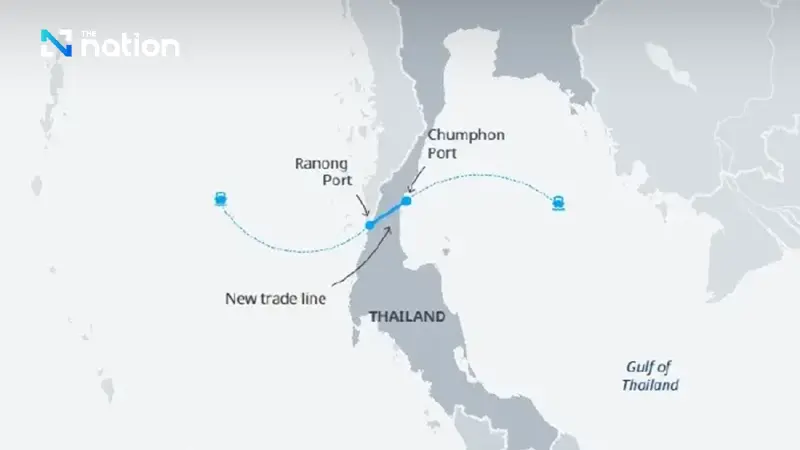


NESDC says Thailand’s Land Bridge must be linked with industrial and special economic development to deliver real benefits
Danucha Pichayanan, secretary-general of the National Economic and Social Development Council (NESDC), has clarified that the agency has never conducted a full study of the Land Bridge project, saying previous work under the Prayut Chan-o-cha administration focused instead on the Thai Canal proposal.
Danucha said the earlier study was conducted after the prime minister and the Thai Canal Association asked the NESDC to examine the potential benefits of the canal project. The agency then made a preliminary assessment comparing the Thai Canal, the Southern Economic Corridor and the Land Bridge.
The comparison found that the Thai Canal would deliver the lowest benefits, followed by the Land Bridge, largely because of its very high investment cost. Danucha said if the Land Bridge were developed only as a logistics link, without additional industrial development, its economic gains would be limited.
By contrast, the Southern Economic Corridor would provide greater benefits because it includes industrial areas, such as light industry and agriculture-related activities.
Danucha stressed that the NESDC has not studied the Land Bridge project in detail.
Asked whether the project previously found to be economically unviable was the Thai Canal, Danucha confirmed that the NESDC’s study had concluded that the Thai Canal would not be worth the investment.
Commenting on the government’s current push for the Land Bridge project, Danucha said the project’s structure and investment model would have to be examined carefully. He said Thailand could not rely only on cargo transport, but would also need industrial zones and further area development to maximise benefits.
He noted that Thailand still lacks a western seaboard port capable of supporting full-scale exports. One possible approach, he said, would be to begin with a port in Ranong before expanding later, depending on the project design.
Danucha said the Ministry of Transport is the agency that has been studying the Land Bridge project seriously and in detail for some time.
Asked whether the project would ultimately prove worthwhile, he said it was too early to answer because the details, components and implementation process still needed to be reviewed.
“If you ask me what should be done, I would say that Thailand still does not have a western port capable of real export operations, not just small vessels or shipments that must be transshipped in Malaysia,” Danucha said.
He said that if Thailand could build its own western seaboard port and connect it with domestic industrial areas, it would help support shipments to India, the Middle East and Europe.
“If goods from Laem Chabang can be moved through this route, it would benefit the country,” he said.
