
Bus driver drug checks tightened as operators face jail warning
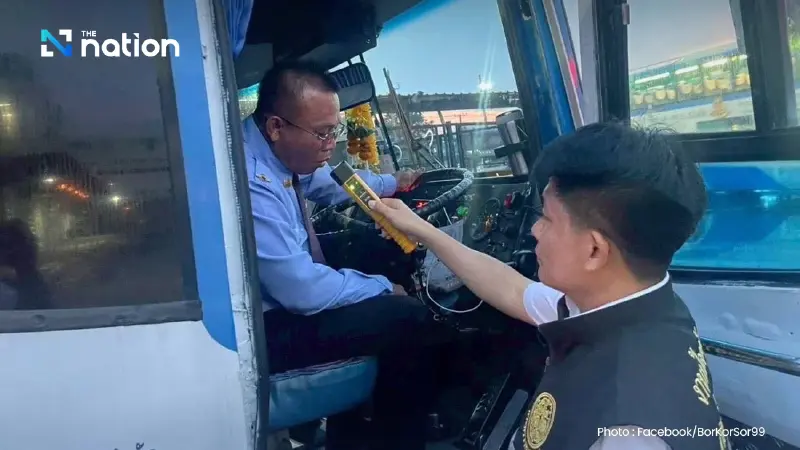


Transport Ministry has ordered tougher checks on public bus drivers, with licences revoked if drug use is confirmed
Transport Ministry has ordered the Department of Land Transport to tighten inspections of public bus drivers nationwide, requiring drivers to be completely free of narcotic substances as part of a wider push to improve passenger safety.
Deputy Transport Minister Siripong Angkasakulkiat said the ministry had instructed the Department of Land Transport, or DLT, to strengthen checks on the readiness of public bus drivers and monitor driving behaviour to ensure safer services for passengers.
The DLT has set safety guidelines covering both vehicles and drivers, with particular emphasis on drug testing and physical readiness before drivers are allowed to operate public transport services.

Key measures include:
- strict checks to ensure public bus drivers are free of narcotic substances;
- inspections of drivers’ physical readiness before duty;
- checks on vehicle condition and operational safety;
- random drug testing of bus drivers nationwide;
- closer monitoring of drivers with past records linked to drug use or reckless driving.

Titipat Thaijongrak, director of the Bureau of Automotive Engineering and spokesman for the DLT, said all public bus operators had been instructed to carry out strict checks on drivers and vehicles.
Transport Safety Managers, or TSMs, have also been assigned to plan and schedule regular safety assessments of drivers.
The department will begin the intensified checks in Bangkok, working with the Office of the Narcotics Control Board, the Public Health Ministry and related agencies to inspect buses operated by the Bangkok Mass Transit Authority, or BMTA.
The checks will cover all 12 BMTA bus operating zones in Bangkok, before similar inspections are expanded to other public bus services across the country.

If a driver is found to have narcotic substances in the body, the case will first be sent for medical confirmation. Once the result is confirmed, the driver will be referred to local police for legal proceedings.
The DLT will also immediately revoke the driver’s public transport driving licence.
Operators that allow drivers who have used narcotics or consumed alcohol to work on public transport vehicles will face penalties under the Land Transport Act B.E. 2522.
Penalties for negligent operators include:
- imprisonment of up to two years;
- a fine of up to 40,000 baht;
- or both imprisonment and a fine;
- possible suspension or revocation of the operator’s transport licence.
The DLT has also prepared a database of public transport personnel, requiring all operators to keep staff records accurate, complete and up to date.
The database will be used to screen drivers, monitor behaviour and prevent people with drug-related records or a history of dangerous driving from returning to public transport work.
Officials say the tighter measures are aimed at improving public confidence in bus safety and reducing the risk of accidents linked to driver impairment.

