
Thailand confronts drought, fires and floods as El Niño grows
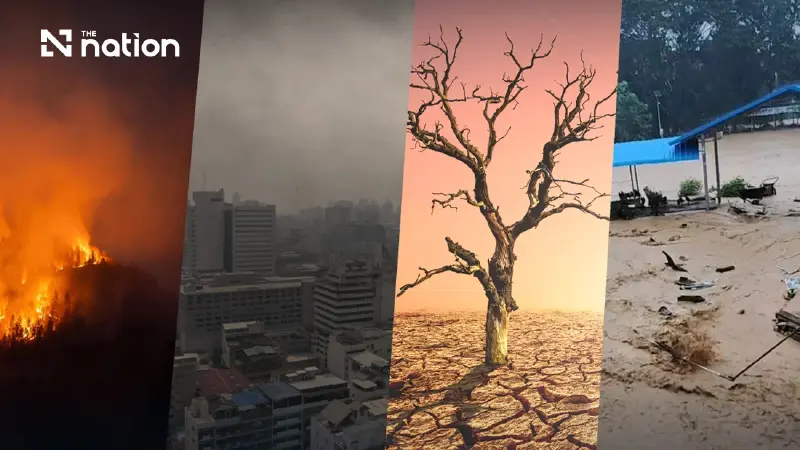


Thai academics warn that a strengthening El Niño could intensify drought, heat, forest fires, PM2.5 pollution, flooding and pressure on farms and coastal tourism.
- Academics warn the current El Niño is expected to intensify into a "super El Niño" by October 2026, bringing more severe drought, fires, and heat to Thailand.
- Despite the drought, typhoon activity is projected to increase by 10-20%, raising the risk of intense storms and flash floods, particularly in northern provinces.
- The extreme conditions are expected to cause more severe forest fires, worsen air pollution, and lead to "feels-like" temperatures exceeding 50°C in urban areas.
- Experts are calling for long-term solutions, including more effective water management, forest restoration, and closer cooperation between government agencies and local communities.
Several academics have warned that El Niño is already affecting several countries and could develop into one of the most severe events in recent years.
Speaking at the seminar “Fire, Dust, Drought and Water: Compounding Disasters”, they predicted that conditions in Thailand would intensify into what they described as a super El Niño in October 2026. Higher temperatures, drought, forest fires and worsening air pollution could increasingly affect public health and quality of life.
Thailand is also expected to face more storms between July and October, with typhoon activity estimated to increase by 10–20% compared with last year.
To limit the damage, the academics called for more effective water management and closer cooperation among government agencies, universities, businesses and local communities, stressing that long-term preparations are essential to protect future generations.

El Niño expected to intensify in October
Asst Prof Dr Thon Thamrongnawasawat, Associate Dean for Special Affairs at Kasetsart University’s Faculty of Fisheries, described the present conditions as only the beginning.
He compared the emerging event with the 2023–24 El Niño, when sea-surface temperatures in the relevant Pacific monitoring area rose by about 1.5°C. Citing projections of around 2.5°C for the current event, he suggested that it could be 30–40% stronger.
He expected the effects on Thailand to become most severe in October 2026, with rainfall becoming increasingly erratic across regions and even within individual regions.
“At present, are we experiencing El Niño? The answer is yes. Has it reached super El Niño conditions? Not yet. When will that happen? In October,” he explained.
Thon noted that the impacts of El Niño have already begun. Some areas could face intense downpours, while others could experience prolonged dry spells.
Thon urged agencies, businesses, farmers and households to store as much water as possible before the rainy season ends, warning that supplies collected by October or November might have to last until June 2027.

Hotter conditions could also increase health risks and household costs. Thon warned that “feels-like” temperatures in urban areas could exceed 50°C between March and May 2027, increasing the risk of heatstroke among older people, children and other vulnerable groups.
Bangkok and other large cities could become several degrees hotter than nearby coastal areas because of the urban heat-island effect. Thon also noted that heavier use of air conditioning would push up electricity bills, while rising fuel prices caused by conflict in the Middle East could add further pressure on power costs.
Storm activity may also increase. Thon estimated that typhoon activity could be 10–20% higher than last year. Although Thailand is often shielded from the strongest winds, storms moving through Hong Kong and Vietnam can carry heavy rain into northern provinces, increasing the risk of flash floods, mountain runoff and rivers overflowing their banks.
Warmer seas would bring another layer of risk. Coral bleaching, deteriorating water quality, plankton blooms and marine animal deaths could become more frequent and severe, affecting coastal fisheries, seafood supplies, hotels and marine tourism.
“Phenomena such as extremely warm seas, marine animal deaths and plankton blooms will occur more frequently, more rapidly and with greater intensity,” he warned. “They can create a continuing cycle in which fish and other marine animals die and plankton blooms develop repeatedly.”
Thon emphasised that a super El Niño is not a rare, isolated disaster that might occur only once in several decades.
“El Niño and super El Niño events will certainly happen again, and the next one could be stronger because the world is becoming warmer,” he warned.
He stressed that Thailand’s response should not consist only of temporary emergency measures. The country should establish permanent systems and infrastructure that can be improved after each climate event and used again when the next severe El Niño develops.

Forest restoration and fire prevention
Asst Prof Bunchong Somboonchai of Maejo University’s Faculty of Architecture and Environmental Design warned that forest fires in Chiang Mai and across northern Thailand have become increasingly difficult to control.
Much of the lower-elevation forest surrounding northern communities is deciduous and contains abundant dry fuel. When fires break out, smoke and fine particulate matter threaten infants, pregnant women, older people, and those with respiratory conditions.
Bunchong called for greater investment in forest restoration and fuel management rather than relying solely on firefighting. Planting trees would expand green areas and increase carbon storage, while systematic management of combustible material could reduce the intensity of forest fires.
He added that cooperation between the private sector, local communities, and villagers is another key element of forest restoration. Under this approach, designated forest plots could be entrusted to local residents, who would benefit from caring for them. The forests and surrounding ecosystems would recover, while participating businesses could benefit from carbon credits.
“The simplest way to store carbon is to plant trees, and the best time to plant them is today,” he explained. “The larger the trees grow, the more carbon they can absorb before it enters the atmosphere and contributes to global warming and the greenhouse effect.”
He noted that forests cover about 31% of Thailand, compared with a national target of 40%, arguing that long-term prevention must accompany efforts to extinguish individual fires.

Rethinking water supplies
Asst Prof Dr Phayom Saraphirom of the Agricultural Engineering programme at Khon Kaen University’s Faculty of Engineering urged Thailand to make better use of “green,” “blue,” and “grey” water.
Green water refers to rainwater held naturally in soil and vegetation, while blue water is stored in reservoirs, ponds, and other surface sources. Grey water is wastewater that can be treated and reused.
Farmers remain heavily dependent on rainfall, but longer dry spells can force them to sow rice repeatedly before crops receive enough water to grow. Phayom proposed adjusting planting calendars to changing rainfall patterns, making better use of natural moisture, and using stored water more efficiently.
Thailand should also recycle more wastewater, particularly as the volume generated by industrial activity continues to increase, he argued. Some countries recover and reuse close to 80% of their wastewater.
Short-, medium-, and long-term plans should cover alternative water sources, emergency reserves, new storage facilities, and urban flood defences. These measures would help the country cope with both drought and the sudden flooding that can still occur during an El Niño period.

Local action and collaboration
Asst Prof Mallika Srisutham of the Department of Soil Science and Environment at Khon Kaen University’s Faculty of Agriculture urged authorities to turn global forecasts into practical local action.
International and Thai agencies already provide advance climate information, she noted, but risks vary sharply between locations. Large national projects remain important, yet communities cannot always wait years for reservoirs or other major infrastructure.
Mallika highlighted community water projects in Khon Kaen and Maha Sarakham that were jointly developed by Singha R-SA, government bodies, private organisations and local residents.
In one case, a small public pond covering three to four rai, or roughly 0.5 to 0.6 hectares, was completed in 2022. It slowed runoff during a La Niña period and helped reduce flooding in surrounding areas, she explained.
Mallika called for climate information to be communicated in language that farmers could understand and apply directly. She also encouraged households to revive simple practices such as collecting rooftop rainwater in jars or tanks for watering gardens and other non-drinking purposes.
The experts agreed that Thailand’s response must combine national planning with community-level measures. Water storage, forest management, wastewater recycling, early-warning systems, and cooperation among the government, universities, businesses, and residents will be essential to limiting damage and helping future generations adapt.
