
Chanthaburi border fence 45% complete, markers intact
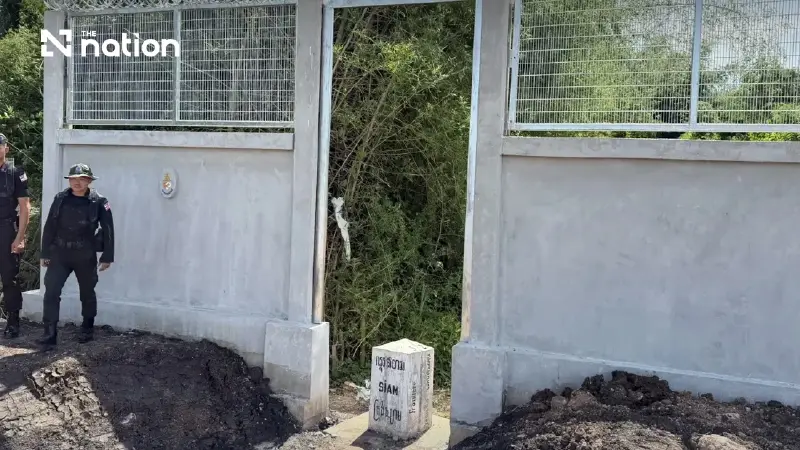


Thailand-Cambodia border fence in Chanthaburi is 45% complete, with marines saying checkpoints remain closed and markers intact
Thailand’s first permanent security fence along the Cambodian border in Chanthaburi is now 45% complete, with Thai military officials insisting the work is being carried out carefully, close to the demarcated border line and without removing any border markers.
Montien Songpracha, a Bhumjaithai Party MP for Chai Nat and chairman of the House committee on state security, Thai border affairs, national strategy and national reform, led committee members to Chanthaburi on June 27 to inspect the construction site in Thep Nimit subdistrict, Pong Nam Ron district.

The visit followed an earlier committee plan to examine the first Thai-Cambodian border fence in Chanthaburi amid continuing public attention over border security and the condition of the crossing points.
During the inspection, Navy Captain Prachya Hanthiem, commander of the Chanthaburi Marine Task Force, briefed the committee on progress and the security situation in the area.
He said Thailand was building the fence close to the border line and had already notified Cambodian authorities to avoid misunderstanding. According to the briefing, Cambodian representatives have also been invited to observe and inspect each stage before Thai officials proceed with work.

Captain Prachya said the operation follows international law and is not being carried out unilaterally. He also stressed that border checkpoints in the area remain fully closed under the policy of the Royal Thai Navy and the government.
The Chanthaburi border fence project in Pong Nam Ron is 45% complete, with the first phase covering border markers 52-54 over 1.3 kilometres and the second phase planned from markers 54-59 over more than seven kilometres.
The project is funded by the Hataithip Fund and is being built by the Development Command under the Royal Thai Armed Forces Headquarters. The first section is being constructed in an area where Thailand and Cambodia have already reached an understanding through border mechanisms.
The second phase, covering the area between border markers 54 and 59, will run for about seven kilometres. Work is now under way to build an access road extending about 600 metres from marker 54 to support the next stage of fence construction and other security infrastructure.
Once both phases are completed, the fence will cover a total distance of about 8.3 kilometres.
The structure consists of solid concrete panels standing 1.95 metres high, with the full wall structure reaching 4.3 metres when security additions are included. Barbed wire will be installed along the top of the fence.

Officials explain wall-gap controversy
The committee also inspected the section that had drawn online criticism over a visible gap in the wall near a border marker.
Captain Prachya told the committee that the marker in question is border marker 52, which dates back to the French treaty period and is considered a shared reference point between Thailand and Cambodia.
He said the space had been left because the Joint Boundary Commission process had not yet been completed for that exact point. Once the process is finished, officials plan to install a hinged cover that can be opened and closed, allowing the JBC to continue inspecting the marker when needed.
He rejected claims that the gap would be left open permanently and also dismissed online images suggesting the marker had disappeared, saying the marker remains in place and had only been edited out of some shared pictures.
The committee also asked about a road running behind the wall. Prachya said the road had been built by Cambodia using its own budget and lies about three metres from the Thai border fence.
Kor Kai-shaped area inspected
After inspecting the fence, the House security committee travelled to the so-called Kor Kai-shaped area in Ban Phak Kat, Pong Nam Ron district.
The area is known locally by its resemblance to the Thai letter “ก” and is surrounded by Klong Takhian, a natural watercourse used as part of the border line.
According to the briefing, a section of the land was cut off in 2020, separating more than three rai from the Thai side and raising concerns about possible effects on the border line if left unresolved.
The Chanthaburi and Trat Border Defence Command later protested to Cambodia, saying the cut-off area had not resulted from natural erosion but from human action intended to alter the watercourse. Cambodian authorities, according to the Thai account, maintained that the change had occurred naturally.
Prachya said the military and local residents have since worked together to fill the canal section and reconnect the land, using more than 200 truckloads of soil. A Thai flag has also been raised in the area as part of efforts to reaffirm control and public confidence.
Military officials said land-reconnection work in the Kor Kai and U-shaped areas had restored more than 10 rai in total, divided between more than three rai in the Kor Kai-shaped area and more than seven rai in the U-shaped area.
Road access to both the Kor Kai and U-shaped areas has also been completed, covering around 15 kilometres, using public donations and local support.
Officials said the next challenge is making the road durable enough for long-term use. That would require conversion into an asphalt road, but a state agency must first be assigned as the formal responsible body before government budget can be requested.
Possible agencies include the Department of Rural Roads or the Development Command. The House committee said it was ready to help push for coordination and budget support once a responsible agency is designated.
Captain Prachya said the military had not neglected its duty and that the progress so far was the result of cooperation between soldiers, local residents and all related agencies.
