
DDPM finds no Thai building damage after Indonesia quake
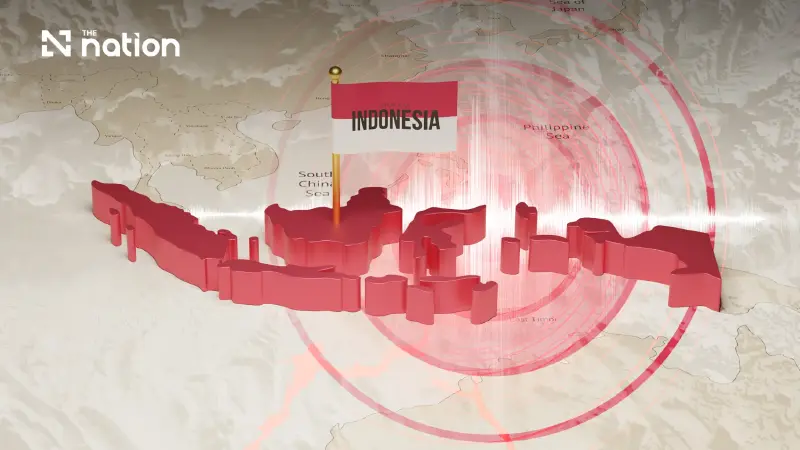


DDPM says tremors were felt in southern Thailand but caused no damage, while tsunami evacuation alerts would begin at magnitude 7.0
- The Department of Disaster Prevention and Mitigation (DDPM) confirmed that no damage was found in high-rise buildings in southern Thailand after an earthquake in Indonesia.
- Tremors from the earthquake, which occurred about 500 kilometres away, were felt in parts of southern Thailand, prompting the damage assessment.
- The DDPM director noted that earthquakes at this distance (500-600 km) can often be felt in Thailand without necessarily causing structural damage.
Thai authorities found no damage to high-rise buildings after tremors from an earthquake in Indonesia were felt in southern Thailand on August 15, according to the Department of Disaster Prevention and Mitigation (DDPM).
DDPM Director-General Teerapat Kutchamath said on Monday (August 17) that the earthquake occurred within about 500 kilometres of Thailand, allowing people in parts of the South to feel the shaking.

Checks conducted through provincial, district and local authorities found no cracks or other building damage, he added.
Thirapat said earthquakes occurring about 500–600 kilometres away could be felt in Thailand without necessarily causing damage.

He also noted that the latest event involved a different fault from the earthquake that affected buildings in Thailand last year.
Previous earthquakes around northern Sumatra have also been felt in southern Thailand without causing damage.
Indonesian tsunami warning lifted within 15 minutes
Indonesia issued a tsunami warning following the earthquake but withdrew it about 15 minutes later, according to Teerapat.
Thai authorities monitored the situation during that period to assess whether tsunami waves could affect the country’s coastline.
Thailand’s warning process combines earthquake information with analysis from several agencies and monitoring systems.
A tsunami evacuation warning is not triggered simply because a buoy records movement.
For a relevant offshore earthquake reaching magnitude 7.0, authorities would first warn residents in potentially affected areas to move to higher ground.
Data from tsunami-monitoring equipment would then help confirm whether a tsunami had formed.
Warning towers remain in place along Thailand’s Andaman coast to relay evacuation instructions if required.
Two monitoring systems relay data by satellite
Thailand has two tsunami-monitoring systems in the Indian Ocean.
One is positioned about 540 kilometres from the Thai coast, while the other is more than 900 kilometres offshore.
The systems use seabed sensors to detect movement beneath the ocean.
Information is relayed to equipment at the surface and then transmitted by satellite for analysis alongside data from other countries.
Teerapat acknowledged that one damaged unit, whose cable had broken, was being recovered.
Its GPS signal remained active.
