
Fence project under way — Thailand moves to secure vulnerable crossings
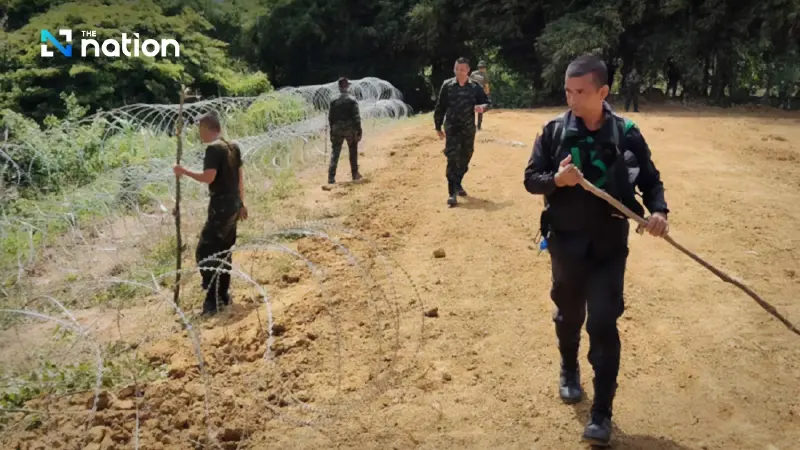


Anutin says border fence budgets are ready as Thailand moves on Cambodia and Malaysia frontiers while reviewing MOU43 after scrapping MOU44
Prime Minister and Interior Minister Anutin Charnvirakul said on April 24, 2026, that Thailand has begun work on border fence projects along both the Thai-Cambodian and Thai-Malaysian frontiers, with budgets already allocated and military units assigned to oversee each area.
Speaking on the progress of cancelling MOU44, the construction of the Thai-Cambodian border fence and relations between Thailand and Cambodia, Anutin said the fence project was already under way.
He said the Navy would be responsible for the eastern border, while the Royal Thai Armed Forces Headquarters would oversee the border line from Sa Kaeo and Prachin Buri through to Ubon Ratchathani. In the South, the Fourth Army Region would take responsibility.
The fences are intended to prevent the smuggling of illegal goods, illegal border crossings and terrorism, he said, adding that the work and budget allocation had already been arranged.
For areas beyond the first phase, Anutin said agencies involved had been asked during a National Security Council meeting on April 23 to submit budget proposals. If regular budgets prove insufficient, central funds could be allocated.
On the possible cancellation of MOU43 after the NSC resolved to cancel MOU44, Anutin said the matter was now under process.
He stressed that the cancellation of MOU44 was not due to conflict with Cambodia, but because there had been no meaningful progress over the past 25 years. He said the global context and international relations had changed significantly, making it necessary to cancel an arrangement that no longer benefited the country or the public.
Anutin said the government’s approach showed professionalism, noting that MOU43 had made progress, with agreements and common understanding between the two countries. If certain issues are not problematic, they can still move forward.
Asked whether the Foreign Ministry supported the cancellation of MOU44, amid concerns from some academics that Thailand could lose benefits from scrapping it, Anutin said the process had already moved beyond the ministry because the NSC had issued its resolution.
On reopening Thai-Cambodian border checkpoints, the prime minister said the matter had not yet been discussed and that there was no need to move to that stage for now.
Asked about reported provocation and troop reinforcement along the border, Anutin said he did not yet know the level or reason behind such actions. However, he said any provocation was not being carried out under orders from the government.
If actions take place within the other side’s territory and do not cross into Thailand, he said Thailand must remain patient and calm, without responding provocatively. However, Thailand must clearly state that certain lines cannot be crossed.
Anutin also discussed his meeting with Wang Yi, China’s Foreign Minister, who paid a courtesy call during his visit to Thailand as a guest of the Ministry of Foreign Affairs.
The prime minister said Wang had earlier visited Cambodia and told Thailand that China was willing to act as an intermediary to help resolve the conflict. According to Anutin, China also conveyed that Cambodia did not want fighting or further confrontation with Thailand.
Anutin said he had told Wang that Thailand did not want conflict with any neighbour. However, Thailand has its own process for talks and must establish clear rules of engagement to restore relations.
He said this could not happen overnight, as mutual trust must first be rebuilt. China understood Thailand’s position, he added, saying the two sides had discussed the real problems in depth and the practical approach needed to resolve them.
