
Customs turns to AI, X-rays to stop Thailand becoming drug-transit hub
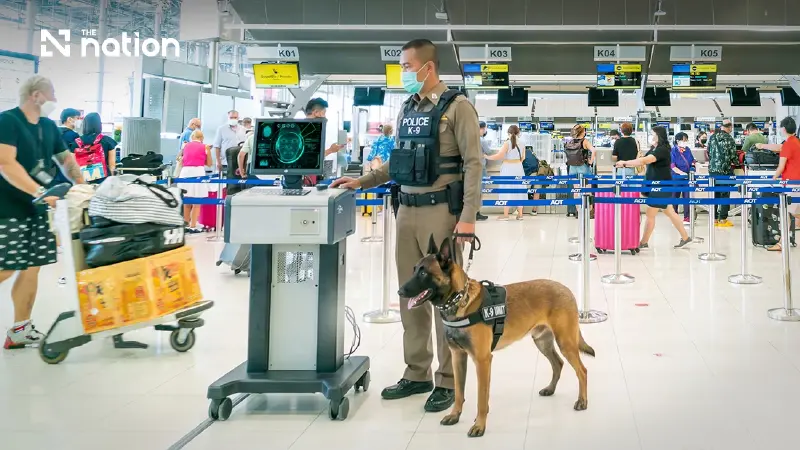


Thailand’s Customs Department is stepping up outbound passenger and cargo screening with AI, X-ray machines, K-9 units and risk-management systems after recent trafficking cases raised concerns that transnational drug networks are exploiting the country’s airports and logistics infrastructure.
Thailand’s Customs Department is stepping up outbound passenger and cargo screening, using AI, X-ray machines, K-9 units and risk-management systems, as the government seeks to prevent transnational drug networks from exploiting the country’s airports, ports and logistics infrastructure as a global transit route.
Phantong Loykulnanta, director-general of the Customs Department, said the agency was responding to the government’s policy that Thailand must no longer be allowed to serve as a passageway for cross-border drug-trafficking networks.
Although Thailand is not a major source of drug production, he said the country’s modern transport and logistics infrastructure — among the most advanced in the region — had created vulnerabilities that trafficking gangs were trying to exploit.
Outbound checks tightened
Phantong said Customs had traditionally focused more on inbound inspections, but was now increasing scrutiny of outbound passengers, luggage, parcels and cargo.
Key measures include expanding X-ray screening of luggage before it is loaded onto aircraft and deploying K-9 sniffer-dog units to help inspect parcels. He said some of the measures had already been put into operation.
The government has also instructed Airports of Thailand, or AOT, to support the installation of outbound X-ray screening points for both passenger areas and cargo facilities. Initial discussions have already been held with Suvarnabhumi Airport to prepare for the upgraded checks.
The government earlier approved measures requiring AOT, Customs and police to raise outbound baggage-screening standards through X-ray scans and K-9 units, while also tightening checks on crew baggage and improving data links between relevant agencies.
Australia arrest adds urgency
The move follows growing concern over international trafficking cases involving routes from Thailand, including the recent arrest of a Thai Airways flight attendant in Australia.
Australian Federal Police said a 26-year-old Thai airline employee was charged after authorities allegedly found more than one kilogramme of heroin during baggage screening at Melbourne Airport in late June.
The case triggered concern in Thailand because it involved airline crew, a group that authorities fear could be targeted by trafficking networks due to their access to international travel routes.
Prime Minister Anutin Charnvirakul later ordered agencies to share information and tighten outbound airport screening. The government also said airlines would enforce stricter rules against crew members carrying items on behalf of others, with serious disciplinary action for violations.
AI to screen high-risk passengers and cargo
Phantong said it would be impossible to physically inspect all outbound traffic, given the scale of Thailand’s aviation and logistics activity.
He said Thailand handles around 85 million passengers and more than 13 million containers, making random checks alone insufficient. Customs is therefore preparing to use artificial intelligence and risk-management systems to process data and identify high-risk passengers, luggage, parcels or cargo for further inspection.
The aim is to make enforcement more intelligence-led, allowing officers to focus resources on suspicious movements without disrupting normal travel and trade.
Over one tonne of drugs seized
Over the past nine months, from October 1 to June 30, the Customs Department seized more than one tonne of narcotics worth an estimated 700 million to 800 million baht.
When other illegal goods are included, Phantong said the department had intercepted contraband worth about 5 billion baht.
He said the figures showed the scale of the threat and the need to prevent criminal networks from using Thailand’s logistics system to move illegal goods across borders.
Cannabis smuggling also under watch
Phantong also pointed to the smuggling of cannabis out of Thailand, saying high prices in some overseas markets had created incentives for repeated attempts to move the substance abroad illegally.
To deter offenders, Customs has increased fines in cannabis-smuggling cases to 30,000 baht per kilogramme. Those who cannot pay the fine may face imprisonment and immediate cancellation of their travel tickets.
He said the acting British ambassador to Thailand and the UK Border Force were expected to meet Customs officials and hold a joint press conference this week to warn foreign nationals, after authorities found that many offenders in such cases were Europeans and British nationals.
Thailand seeks to close transit loophole
Phantong said the Customs Department’s goal was to make it extremely difficult for traffickers to move illegal drugs through Thailand.
“We must make smuggling drugs through Thailand as difficult as possible, or almost impossible, in order to cut off transnational drug networks and prevent them from using our country as an operational base again,” he said.
The policy shift marks a broader change in Thailand’s border-control strategy, from mainly checkpoint-based enforcement to intelligence-led screening designed to protect the country’s transport infrastructure, aviation reputation and international logistics system.
