
Thailand names new snake-necked dinosaur from Kalasin
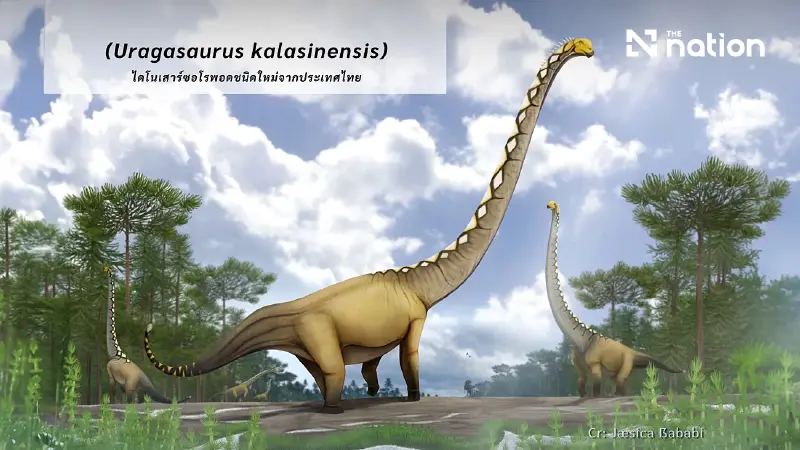


Thai researchers have identified Uragasaurus kalasinensis, a new long-necked sauropod from Kalasin that expands Southeast Asia’s Jurassic fossil record
Thailand has gained a new place on the global dinosaur map after researchers identified a new species of long-necked sauropod from Kalasin province, a discovery that adds fresh weight to the scientific importance of the Northeast’s fossil-rich landscape.
The dinosaur has been named Uragasaurus kalasinensis, a new genus and species of sauropod from the Phu Kradung Formation in northeastern Thailand. The discovery was published in Scientific Reports on July 8, 2026, under the title “A new mamenchisaurid sauropod from the Lower Phu Kradung Formation, Upper Jurassic of northeastern Thailand”.
The research team includes Apirut Nilpanapan, Sita Manitkoon, Varavudh Suteethorn and Komsorn Lauprasert, according to the paper published on Nature’s Scientific Reports platform.
The fossil was recovered from the Phu Noi locality in Ban Din Chi village, Kham Muang district of Kalasin, one of Southeast Asia’s most productive non-marine vertebrate fossil sites. The site lies in the lower part of the Phu Kradung Formation, the basal unit of the Khorat Group.

The discovery was highlighted by the Palaeontological Research and Education Centre of Mahasarakham University. The fossil dates back to the Late Jurassic, around 150 million years ago.
Uragasaurus kalasinensis belongs to Mamenchisauridae, a family of long-necked sauropod dinosaurs known mainly from East Asia. The research paper notes that while mamenchisaurids were abundant in East Asia during the Middle to Late Jurassic, their diversity and distribution outside China have remained poorly documented.
That is what makes the Thai discovery significant. The study describes Uragasaurus kalasinensis as the first formally named mamenchisaurid sauropod from Thailand and says it expands the known geographic distribution of the group in Southeast Asia.
The new dinosaur was identified from a holotype specimen catalogued as PRC 460, an isolated anterior dorsal vertebra that is housed at the Palaeontological Research and Education Centre, Mahasarakham University. The researchers said the diagnosis of the new species is based on this vertebra, while several nearby sauropod remains are treated as associated materials rather than confirmed parts of the same individual.

Although the fossil may appear modest compared with a full skeleton, it contains enough anatomical detail to distinguish the animal from other known sauropods.
The study identifies several key features, including prominent elongated teardrop-shaped pneumatic fossae on the distal part of the transverse processes, a distinctive Y-shaped configuration in the vertebra and a shallow subtriangular pleurocoel without an internal septum.
The most striking internal feature was revealed by computed tomography, or CT scanning. The scan showed a camellate internal pneumatic structure inside the vertebral centrum, made up of many small chambers separated by thin bony walls which resemble a honeycomb, a design that would have helped reduce bone weight in a giant long-necked dinosaur.

The name also carries a local and cultural meaning. The research paper explains that “Uraga” comes from the Sanskrit word meaning snake or serpent, referring to the exceptionally long neck associated with the family, while “saurus” comes from the Greek word for lizard. The species name “kalasinensis” refers to Kalasin province, where the fossil was found.
The Phu Noi locality has already become an important window into prehistoric life in Thailand. The Scientific Reports paper describes the site as preserving a diverse vertebrate assemblage, including fishes, lungfishes, turtles, crocodyliforms and dinosaurs, with other fossil groups also under study.
The age of the Phu Kradung Formation has long been difficult to pin down precisely because of the lack of radiometrically datable horizons. The paper says previous studies suggest a Late Jurassic age, while the formation may extend into the earliest Cretaceous. The occurrence of Uragasaurus kalasinensis in the lower part of the formation supports an Upper Jurassic age for that portion and helps clarify faunal succession within the unit.

For Thai palaeontology, the discovery strengthens the view that northeastern Thailand was part of a wider prehistoric landscape connected to other Jurassic faunas in Asia. The study notes that the Phu Noi vertebrate assemblage shows biogeographic affinities with fossil faunas from China’s Junggar, Turpan and Sichuan basins, supporting its placement near the Jurassic-Cretaceous transition.
The finding also challenges an older picture in which mamenchisaurids were understood largely through fossils from China. The paper notes that earlier remains from southern and northeastern Thailand had suggested the presence of the group, but Uragasaurus kalasinensis is the first Thai mamenchisaurid to receive a formal scientific name.
For Kalasin, the discovery adds another layer to the province’s identity as one of Thailand’s key dinosaur areas. For researchers, it offers a new data point in the story of how long-necked sauropods diversified and dispersed across prehistoric Asia.
The new species may have lived around 150 million years ago, but its discovery is helping scientists answer a very modern question: how much of Southeast Asia’s dinosaur history is still waiting beneath the ground.
Source: Mahasarakham University / Palaeontological Research and Education Centre, Nature.com
