
New giant dinosaur species found in Thailand’s Chaiyaphum
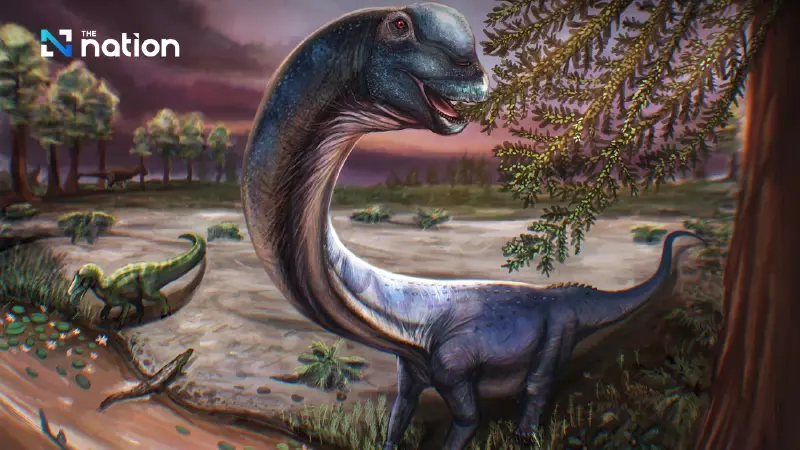


Thai and UK palaeontologists identify Nagatitan chaiyaphumensis, a giant sauropod from Chaiyaphum and Southeast Asia’s largest known dinosaur.
Thailand has announced the discovery of a new dinosaur species, Nagatitan chaiyaphumensis, a giant long-necked plant-eater described as the largest dinosaur ever found in the country and Southeast Asia.
The discovery was made by a team of Thai palaeontologists led by Dr Sita Manitkoon, a researcher at the Palaeontological Research and Education Centre of Mahasarakham University, in collaboration with University College London (UCL) and the Department of Mineral Resources under Project Thaitan, with research funding from the National Geographic Society.
The newly identified dinosaur, whose name means the “giant Naga of Chaiyaphum”, is Thailand’s 14th officially named dinosaur species.

A giant from Chaiyaphum
According to the Department of Mineral Resources, the Thai and British palaeontological team discovered and studied the fossil remains of the new long-necked dinosaur at Ban Phanang Suea in Nong Bua Rawe district, Chaiyaphum province.
Sita explained that whales can evolve to enormous sizes because they live in the ocean, where water helps support their weight. Sauropod dinosaurs, however, were even more remarkable because they were land animals.
To cope with their massive size, sauropods developed air spaces inside their bones to reduce weight, along with other anatomical adaptations that allowed them to become the largest land animals ever to have lived.
Researchers studied more than 20 fossilised bone fragments, including a complete right upper forelimb bone measuring 178 centimetres, as well as rib bones and a thigh bone more than two metres long.
From these remains, they estimated that Nagatitan chaiyaphumensis measured around 27–30 metres in length and weighed more than 26 tonnes.
Thailand’s ‘last titan’
Thitiwoot Sethapanichsakul, a Thai doctoral student at UCL and lead author of the study published in Scientific Reports, said researchers referred to Nagatitan as “the last titan” of Thailand because its fossils were found in the country’s youngest dinosaur-bearing rock formation.
“Younger rocks laid down towards the end of the time of the dinosaurs are unlikely to contain dinosaur remains because the region by then had become a shallow sea. So this may be the last or most recent large sauropod we will find in Southeast Asia,” he said.
Sethapanichsakul, who described himself in a UCL press release as a “dinosaur kid”, said the study also “fulfils a childhood promise of naming a dinosaur”.

The meaning behind the name
Nagatitan was a herbivorous long-necked sauropod belonging to the Titanosauriformes group. Its fossils were found in the Khok Kruat Formation of the Khorat Group, dating to the Early Cretaceous period, around 100–115 million years ago.
The name Nagatitan combines “Naga”, referring to the serpent-like figure in Thai belief, and “Titan”, the giant deities of Greek mythology, reflecting the dinosaur’s colossal long-necked form.
The species name chaiyaphumensis refers to Chaiyaphum province, where the fossils were discovered.

From a villager’s discovery to a fossil learning site
The discovery began in 2016, when a resident of Ban Phanang Suea noticed unusual remains in the area and reported them to the Department of Mineral Resources.
The Fossil Protection Division and the Regional Office of Mineral Resources 2 later continued the survey and excavation, eventually finding more than 20 fossil pieces.
Key fossils included parts of the dorsal vertebrae, sacrum, pelvis, ilium and pubis, as well as a complete right humerus measuring 178 centimetres — the largest of its kind ever found in Thailand. The remains provided important anatomical features for further study.
The site was later conserved and developed into the Ban Phanang Suea Dinosaur Learning Centre. Some of the fossils were also preserved at the Sirindhorn Museum in Kalasin province.
Between 2016 and 2023, the Department of Mineral Resources continued surveying, excavating and developing the site. It has since become an important learning centre for Chaiyaphum province and Chaiyaphum Geopark.

Project Thaitan and Thailand’s fossil heritage
In 2024, Sita received funding from the National Geographic Society for “Exploring the Titans: Investigating Thailand’s Largest Dinosaur and Engaging Local Communities in Chaiyaphum Geopark”, also known as Project Thaitan.
The project aims to study, conserve and develop the fossil site in cooperation with relevant agencies, local communities, Chaiyaphum Geopark and the Department of Mineral Resources.
Alongside the research into Thailand’s latest dinosaur, the project has worked with local communities and schools to promote proper scientific methods for fossil surveys and excavation.
The discovery is also significant beyond the naming of a new species. Fossils are evidence of past life and help reveal ancient geography, environments and biodiversity. They are, in effect, records of the Earth before the emergence of humans.
For scientists, such discoveries are vital to the study of geology, the evolution of life and the exploration of mineral resources. They also form part of Thailand’s natural heritage and provide important evidence for understanding how life on Earth evolved.
