
Thailand and Cambodia diverge over UNCLOS maritime talks and Gulf energy resources
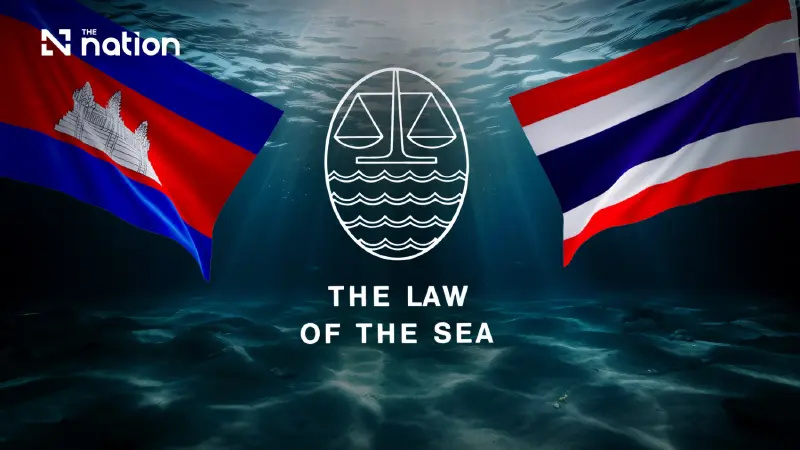


Thailand wants UNCLOS conciliation focused on maritime boundaries, while Cambodia seeks joint development of disputed Gulf oil and gas resources
- Thailand and Cambodia are pursuing maritime boundary talks under a UNCLOS conciliation commission but are divided on the scope of the negotiations.
- Cambodia wants the talks to simultaneously address both the maritime boundary and a framework for the joint development of valuable offshore energy resources in the Gulf of Thailand.
- Thailand insists the process must focus exclusively on delimiting the maritime boundary first, arguing that discussions on sharing resources are premature until sovereignty is clearly established.
- The dispute centers on a 26,000-square-kilometre area estimated to hold substantial natural gas and oil deposits, which is a key motivator for Cambodia's push to resolve the issue.
Thailand and Cambodia are moving closer to forming a five-member conciliation commission under the United Nations Convention on the Law of the Sea, or UNCLOS, but remain divided over whether the process should focus solely on maritime boundaries or also address the joint development of offshore energy resources.
Each country has appointed two independent conciliators, who must jointly select a fifth member to chair the commission handling the maritime dispute in the Gulf of Thailand.
The original deadline for choosing the chair was July 19, but Thailand and Cambodia have agreed to extend it to August 14 following a proposal from the four conciliators. The extension is intended to provide more time to identify a neutral and mutually acceptable candidate.
Thailand says the chair should have recognised expertise in international law, maritime law and diplomacy, together with impartiality and a sound understanding of Thai-Cambodian relations.
Once the chair is appointed, the completed commission is expected to hold its first meeting to establish its procedures and overall framework.
UNCLOS conciliation is not a court process and the commission will not issue a legally binding judgment. Instead, it will consult both countries and submit recommendations intended to help them negotiate a mutually acceptable settlement.
Four international experts appointed
Thailand has appointed German jurist Rüdiger Wolfrum and South African jurist Albert J. Hoffmann as its conciliators.
Both are former presidents of the International Tribunal for the Law of the Sea, or ITLOS. Wolfrum served as president from 2005 to 2008, while Hoffmann held the post from 2020 to 2023.
Cambodia selected Danish diplomat Peter Taksøe-Jensen and French international-law academic Jean-Marc Thouvenin.
Taksøe-Jensen chaired the UNCLOS commission that handled the Timor-Leste-Australia conciliation, the principal precedent for the mechanism now being used by Thailand and Cambodia.
Thailand formally accepted participation in the process on June 19 after Cambodia submitted its notification on June 2.
Bangkok also appointed Deputy Prime Minister and Foreign Minister Sihasak Phuangketkeow as its agent in the proceedings, with Thailand’s ambassador to Kuwait, Songchai Chaipatiyut, serving as deputy agent.
Commission expected to take about a year
After the commission is fully constituted, its members will consult Thailand and Cambodia, examine the dispute and consider possible approaches under international and maritime law.
The process is generally expected to take about 12 months, although the two countries may agree to extend it if further discussions are required.
Its eventual report will contain recommendations rather than an enforceable ruling. Any final settlement will still require agreement between Bangkok and Phnom Penh.
The mechanism was previously used by Timor-Leste and Australia, leading to a treaty establishing permanent maritime boundaries in the Timor Sea.
Cambodia seeks access to offshore energy
Cambodia’s push for conciliation has gained urgency from the global energy shock caused by the conflict involving Iran and disruption around the Strait of Hormuz.
Cambodian Minister of Mines and Energy Keo Rottanak has said the crisis has brought energy security into sharper focus and strengthened the case for resolving the Gulf of Thailand dispute quickly.
Cambodia currently relies heavily on hydropower and growing solar capacity, but considers additional fossil-fuel resources important to its longer-term industrial development.
The disputed maritime area covers about 26,000 to 27,000 square kilometres and is estimated to contain between 11 trillion and 12 trillion cubic feet of natural gas, as well as substantial oil deposits.
Some estimates have valued the potential resources at about US$300 billion.
International energy companies could consider offshore exploration if Thailand and Cambodia resolve their competing maritime claims, although TotalEnergies did not confirm any specific investment plan when approached by Reuters.
Keo warned that exploration and development would take several years even after an agreement was reached.
“If you are going to wait for decades more, the chances of attracting financing to do oil and gas exploration and exploitation may not be there,” he said, adding that major companies understood the narrowing window for investment.
Cambodia therefore views UNCLOS conciliation as a potential route towards settling the maritime boundary and ultimately unlocking the disputed resources.
Thailand says sovereignty must come first
Thailand, however, insists that the immediate purpose of the process should be limited to delimiting the maritime boundary and continental shelf.
The Thai government says discussions about a joint development area or the sharing of offshore resources would be premature before the boundary and the existence of any genuine overlapping claim had been clearly established.
Foreign Minister Sihasak has stressed that the commission should initially focus on maritime delimitation, while joint development may be considered only after the legal and geographical position becomes clear.
Thailand’s position is that sovereignty, territorial integrity and national interests must remain the highest priorities throughout the process.
Cambodia, by contrast, wants the talks to facilitate both boundary settlement and a framework for developing and sharing resources in the disputed waters.
Coastal concerns add to Thai position
Thailand is also concerned about Cambodian coastal structures near the border in Trat province, which Thai officials say have altered sediment movement and contributed to erosion around Ban Hat Lek in Khlong Yai district.
Defence Minister Lt Gen Adul Boonthamcharoen has said the issue affects Thailand’s maritime interests and should be addressed through international-law mechanisms because the structure itself is situated inside Cambodian territory.
Thai officials say the coastal installation is about 300 metres from boundary marker 73 and was originally connected with port development for tourism vessels.
Bangkok maintains that any environmental or coastal effects crossing the border must be discussed with Cambodia.
Thailand is also expected to challenge the basis of Cambodia’s maritime claim line, which Thai officials say runs through the middle of Thailand’s Ko Kut.
The commission will have to consider the competing claims through the principles of international law, maritime delimitation and the relevant geographical facts.
Different goals could prolong dispute
The commission’s recommendations may provide Thailand and Cambodia with a basis for further negotiations, but they will not automatically end the dispute.
The central difficulty is already apparent.
Thailand wants the compulsory conciliation process restricted to maritime-boundary delimitation, while Cambodia wants progress towards the joint development and sharing of offshore resources at the same time.
The divergent objectives raise the prospect that the conciliation may become another extended chapter in a dispute that has remained unresolved for decades.
