
Fuel committee raises pump prices by 90 satang from July 23
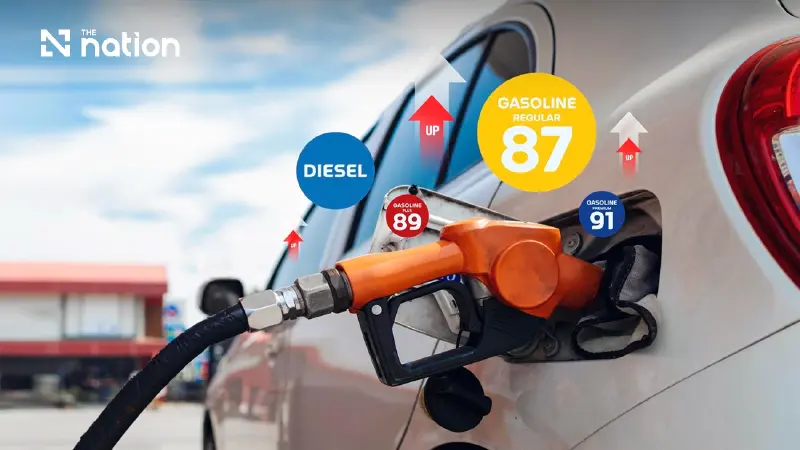


Petrol, gasohol and diesel prices rose across Thailand on July 23 as Middle East tensions drove up global oil and shipping costs
- Retail prices for most petrol, gasohol, and diesel products in Thailand increased by 0.90 baht (90 satang) per litre, effective July 23.
- The price adjustment was a response to rising global oil prices, driven by escalating conflicts in the Middle East and disruptions to major shipping routes.
- The decision was made by the Fuel Fund Executive Committee to ease the severe financial strain on the Oil Fuel Fund, which was facing a daily subsidy burden of over 651 million baht.
- Premium fuel products were not included in the 90-satang price increase announced by major distributors.
Thailand’s retail prices for most petrol, gasohol and diesel products increased by 0.90 baht per litre from 5am on Thursday, July 23, following a decision by the Fuel Fund Executive Committee.
The adjustment pushed the retail price of standard high-speed diesel to 36.69 baht per litre, while diesel B20 rose to 31.69 baht. Gasohol 95 also climbed to 36.69 baht, gasohol 91 to 36.32 baht and gasohol E20 to 31.69 baht per litre.
Gasohol E85 increased to 27.63 baht per litre, while petrol rose to 45.68 baht. The quoted retail prices exclude Bangkok’s local maintenance tax. Premium fuel products were not included in the 90-satang retail increase announced by major distributors.
The committee approved the adjustment at its meeting on Wednesday amid a renewed escalation of fighting in the Middle East following the breakdown of negotiations.
It attributed the pressure on fuel markets to widening attacks involving countries around the Gulf and Iran’s confirmation that it would close the Strait of Hormuz, a crucial route for global oil shipments.
Conditions in the Red Sea have also deteriorated after Yemen’s Houthi movement intensified its maritime blockade and threatened to target oil tankers and cargo vessels calling at or using ports along the Red Sea coast.
The threats have forced many tankers to divert to longer routes, immediately driving up maritime transport costs and adding further pressure to international oil prices.
Singapore benchmark diesel reached US$163.59 per barrel on July 22, while petrol climbed to US$124.92 per barrel, according to information released following the committee meeting.
The surge has placed severe strain on the Oil Fuel Fund, which is now carrying an estimated subsidy burden of about 651.31 million baht per day. The committee said it had therefore become urgently necessary to revise the fund’s levy and subsidy rates so it could continue coping with volatility in global fuel markets.
Under the revised structure, the subsidy for standard high-speed diesel was increased by 0.78 baht to 8.57 baht per litre, resulting in a retail price of 36.69 baht.
The subsidy for high-speed diesel B20 was raised by 0.56 baht to 12.95 baht per litre, bringing its retail price to 31.69 baht. Premium diesel remains subject to a fund levy of 1.50 baht per litre.
For petrol, the amount collected for the fund was reduced by 0.41 baht to 4.19 baht per litre. Its retail price consequently rose to 45.68 baht.
The subsidy for gasohol 95 was increased by 0.30 baht to 2.89 baht per litre, producing a retail price of 36.69 baht. The gasohol 91 subsidy was also raised by 0.30 baht to 2.89 baht per litre, with the pump price reaching 36.32 baht.
Gasohol E20 received an additional subsidy of 0.17 baht, taking the total support to 6.47 baht per litre and setting its retail price at 31.69 baht.
For gasohol E85, the subsidy was reduced by 0.53 baht to 4.37 baht per litre, resulting in a retail price of 27.63 baht. The revised Oil Fuel Fund rates came into force on July 23.
The committee appealed for public understanding as Thailand faces heightened uncertainty over its energy security and urged consumers to use fuel only when necessary and conserve as much energy as possible.
“At a time when the country’s energy security is facing considerable volatility, the committee asks for understanding and co-operation from every sector of society,” it said.
“We encourage people to adjust their energy consumption, use energy responsibly, limit consumption to what is necessary and conserve as much as possible.
“This will not only reduce individual expenses, but will also ease the burden on the country and strengthen the Oil Fuel Fund so that it can continue protecting the public sustainably in the future.”
