
Injured and dehydrated wild elephant calf found in Kanchanaburi
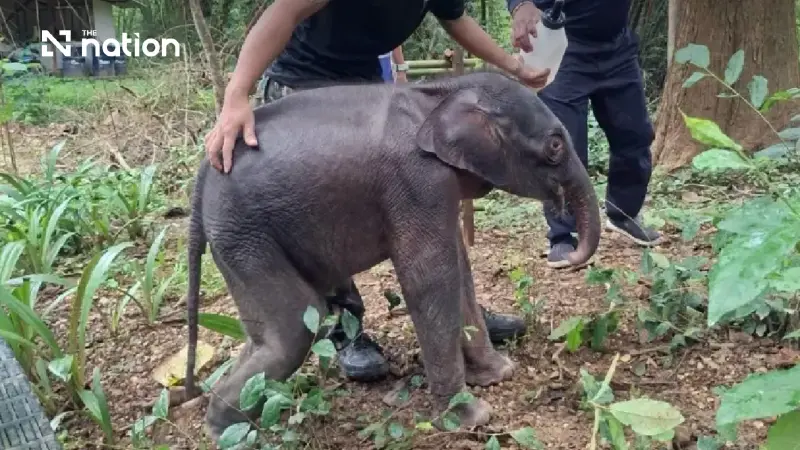


Veterinary teams are monitoring the two-week-old male calf in quarantine at Sai Yok National Park after it was found weak, injured and severely dehydrated.
- A very young male elephant calf was found alone, weak, and stranded on a riverbank in Sai Yok district, Kanchanaburi, after being separated from its herd.
- A veterinary assessment determined the calf was in critical condition, suffering from severe dehydration and multiple injuries, including mouth ulcers, a navel wound, and blistered wounds on its trunk.
- The calf was rescued by national park officers and moved to the park headquarters for intensive veterinary treatment, close monitoring, and testing for potential diseases like EEHV.
Suchart Chomklin, Minister of Natural Resources and Environment, expressed concern on Saturday (August 1, 2026) after Sai Yok National Park officers went to the aid of a lost wild elephant calf found weak and with several injuries.
He also offered encouragement to all personnel working in difficult conditions caused by the weather and strong currents.
He issued urgent instructions for veterinary teams from the Department of National Parks, Wildlife and Plant Conservation (DNP) to mobilise and provide the calf with close veterinary care.
“I have received the report about the lost wild elephant calf and am very concerned about its condition because it is still very young and is in a critical state. I would like to offer my encouragement and thanks to every officer and member of the veterinary team who has made sacrifices and devoted their efforts to reach the calf through the rain and strong currents and provide it with the fullest possible care. I have also instructed the Department of National Parks, Wildlife and Plant Conservation to mobilise specialist veterinarians to closely oversee every stage of its treatment so that the calf remains safe and its condition improves as soon as possible,” Suchart said.

Attapol Charoenchansa, director-general of the DNP, said after receiving a report that Sai Yok National Park Protection Unit No. 5 (Mae Nam Noi) was alerted at 6am on Thursday (July 30) by residents of Ban Mae Nam Noi, Moo 5, Sai Yok subdistrict, Sai Yok district, Kanchanaburi.
They reported finding a wild elephant calf on the bank of Huai Mae Nam Noi.
Officers travelled to inspect the site, which could be reached only by a boat provided by villagers, with the journey taking about one to two hours because the area was difficult to access.
At the reported location, officers found a lone calf in a weakened state and no herd nearby.
They believed it had been stranded there for about two days.
Officers stayed overnight to monitor its behaviour and wait for the herd to return.
The calf periodically called for its mother throughout the night, but there was no response from the herd, leading officers to believe it had moved far away.
The surrounding terrain was steep, leaving the calf only about 1.5 metres of space in which to move, with the river on the other side. It was about 30 centimetres from the riverbank.
The calf was seen sucking tree roots and nearby stones.
Officers believed the herd may have crossed the water and the calf may have been swept downstream.

Heavy rain over the previous two days may have raised the stream level and put the calf at risk.
Following advice from veterinarians at Protected Areas Regional Office 3 (Ban Pong), officers obtained milk to feed the calf so it would not go without food.
Veterinarians from Protected Areas Regional Office 3 (Ban Pong) and its Phetchaburi branch entered the area at 9am on Friday (July 31) to assess the calf.
The boat journey to the site again took about one to two hours.
Continuous rain had raised water levels and created a risk of flash flooding.
The initial assessment identified the calf as male, weighing about 40 kilograms and no more than two weeks old.
It was weak, with abrasions, blisters and several lesions in its mouth, including ulcer-like sores.
It was severely dehydrated and had a wound at the navel.
Its trunk had blistered wounds and areas of dead tissue, but no pus or fly eggs were found.
A mouth ulcer was about the size of a THB10 coin, and the calf drank little milk because the wounds were painful.
Bee-like insects gathered around its eyes, causing conjunctivitis. Its urine was dark yellowish-red, possibly because of infection or dehydration.
It also had loose stools with a foul, sour odour.
Its overall condition was considered worrying.
The veterinary team concluded that “the wild elephant calf is in critical condition” and moved it to Sai Yok National Park headquarters so DNP veterinarians could plan further care and treatment and monitor it closely.
DNP veterinarians later examined the calf at 4pm.
As an initial measure, they instructed Sai Yok National Park to prepare a temporary pen, spray disinfectant around it and arrange rotating shifts of officers to provide continuous care under veterinary supervision.
They also planned to test the calf for elephant endotheliotropic herpesvirus (EEHV).
The calf was kept in the prepared quarantine pen for continued monitoring by the veterinary team on Saturday, while the test result was pending.


