
Call-centre gang tricks university student out of THB3.6m
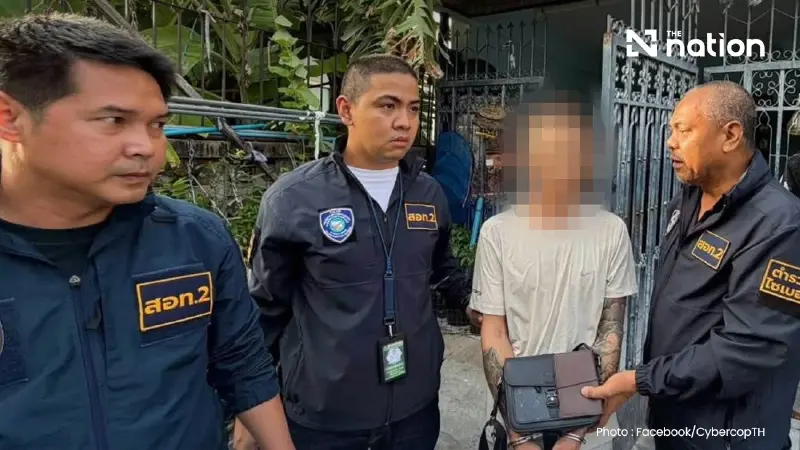


Cyber police arrested five suspects after a first-year student was allegedly coerced into transferring THB3.617 million to a call-centre gang.
Thai cyber police have arrested two Vietnamese nationals and three Thai suspects over an alleged call-centre scam that cost a first-year university student more than 3.6 million baht in a single day.
Police said on Friday (August 28) that the gang posed as telecommunications staff and police officers, threatened the student with a money-laundering case and ordered her to deceive her father into transferring additional funds.

The case began on August 9, when the student, who attends a prominent university in Bangkok’s Pathum Wan district, received a call from someone claiming to work at AIS headquarters.
The caller alleged that another person had used the student’s name to register a mobile phone SIM card at a shopping centre in Loei province. The call was then transferred to someone posing as a duty officer at Mueang Loei Police Station.
The student was instructed to add a LINE account named after the police station. Another member of the gang subsequently contacted her through the application and claimed to be the station superintendent.

Student threatened with money-laundering case
The alleged scammer ordered the student not to end the call and claimed that police had arrested a suspect in a money-laundering case.
The caller alleged that the arrested person had implicated the student, claiming she had sold a bank account that was later used to receive funds from an online gambling operation. The supposed investigation had resulted in 8.5 million baht being frozen, the caller claimed.
The gang further alleged that the student had sold her account for a 10% share because she did not receive financial support from her parents.
Frightened by the accusations, the student disclosed that she had about 850,000 baht in her account.
The caller then ordered her to transfer the money into what was falsely described as a “central Anti-Money Laundering Office account” for verification, promising that it would be returned within one or two hours.
The gang also instructed her to lie to her father by claiming that she needed a large sum of money to apply for funding to join an exchange programme in Australia.
Her father believed the story and transferred a further 2.7 million baht to her.

Cash handed to fake police officer outside hotel
The scammers continued demanding money and instructed the student to make additional transfers.
She was also told to withdraw cash over a bank counter, book a room at a hotel in the Srinakarin area and hand the money to a person claiming to be a police officer outside the property.
Police said the student made five transfers or cash payments on August 9, totalling 3.617 million baht:
- At 12.47pm, she transferred 856,000 baht to an account controlled by the gang.
- At 3.54pm, she transferred another 1.1 million baht.
- At 6pm, she handed 1.6 million baht in cash to a suspect outside a hotel in the Srinakarin area.
- At 7.33pm, she transferred 26,000 baht.
- At 7.36pm, she transferred a further 35,000 baht.
After receiving the money, the gang ordered her to move their communications to Telegram and keep the call connected overnight, allegedly as part of an attempt to extract more funds.
The student’s aunt noticed that something was wrong and questioned her until the scam was uncovered. The family then took the evidence to investigators at Division 2 of the Cyber Crime Investigation Bureau.

Five arrested in raids across two provinces
Cyber police traced the money and other evidence before obtaining arrest warrants for eight suspects.
Officers searched three locations in Samut Prakan and Samut Sakhon provinces and arrested five people.
They included Quoc Nam Nguyen, a 28-year-old Vietnamese national accused of posing as a police officer and collecting the 1.6 million baht in cash outside the hotel.
Police also arrested Huy Tan Nguyen, 26, another Vietnamese national accused of accompanying him to collect the money. Officers seized eight mobile phones and clothing allegedly worn on the day of the offence.

A 48-year-old Thai woman identified only as Donlaphak was accused of playing a central role in laundering the proceeds. Police alleged that she deposited cash into company and shop accounts and used it to purchase goods to conceal the financial trail.
Officers seized 792,690 baht in cash and 13 bank passbooks from her.
Two other Thai suspects, identified as Thitikan, 25, and Phattharaphon, 33, were accused of providing money-mule accounts.
Police initially charged the suspects with jointly committing public fraud by impersonation, conspiracy to launder money, entering false information into a computer system and supporting the alleged offences.
Investigators are seeking the remaining three suspects named in the arrest warrants.

Parents warned as gangs target students
Pol Maj Gen Tinnakorn Rangmat, deputy commissioner of the Cyber Crime Investigation Bureau, urged parents to remain alert because call-centre gangs were increasingly targeting university students who lived alone and had limited experience in handling official or financial matters.
He stressed that government officials would never order members of the public to transfer money for inspection or verification.
Anyone receiving a suspicious call should end it immediately and contact the AOC hotline on 1441, which operates around the clock.
