
Royal water project lifts farming and livelihoods in Chiang Mai
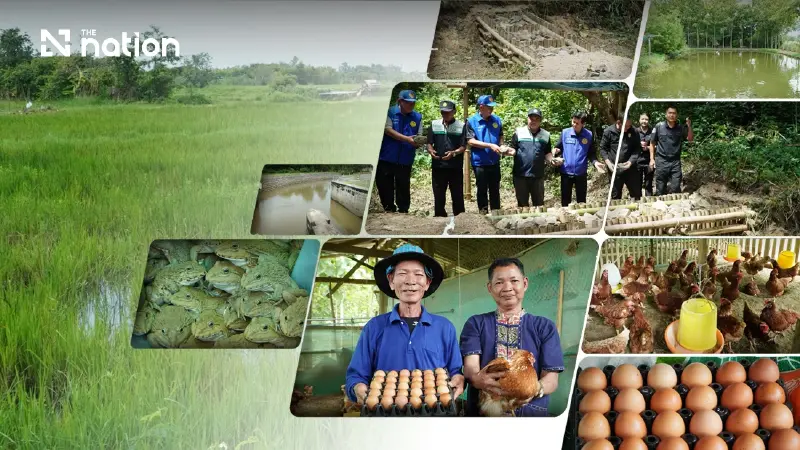


Mae Pu Kha’s royal water project boosts farming, livelihoods and flood resilience while supporting forest restoration and local growth.
- A royal water project in Chiang Mai is providing a reliable supply for farming, enabling farmers to grow two rice crops a year instead of one and significantly increase their income.
- The consistent water access has allowed local people to diversify their livelihoods into new ventures, including aquaculture and free-range egg production, which provide additional food and income.
- The initiative also improves flood control, raises groundwater levels, and incorporates environmental conservation, such as protecting the upstream forest watershed to ensure the water source's sustainability.
- Community participation is central to the project's success, with a local water users' group managing the resource and residents actively involved in conservation efforts.
Water has long been at the heart of Thailand’s royal development philosophy, not only as an essential resource for daily life but also as a foundation for agricultural production, livelihoods and wider economic progress.
In a royal address on March 17, 1996, His Majesty King Bhumibol Adulyadej the Great emphasised the fundamental importance of securing enough water for consumption, everyday use and cultivation.
That principle has become increasingly significant as seasonal rainfall, population growth and expanding agricultural and industrial activity place greater pressure on supplies.
In another royal address on December 4, 1993, King Bhumibol stressed the need for sufficient water for households, farming and industry, warning that shortages would bring development to a halt.
“There can be no progress if there is no water,” he observed.

Reliable supplies strengthen the local economy
The Ban Mae Pu Kha sluice gate and water distribution project in San Kamphaeng district, Chiang Mai, demonstrates how this approach can translate reliable supplies into economic and social benefits at community level.
The project originated after residents of Ban Mae Pu Kha, who had faced severe shortages, sought royal assistance. Their request was subsequently taken up as a royal initiative project.
The system can currently supply 275 rai of agricultural land, with the potential to extend coverage to more than 2,000 rai. It also improves drainage during periods of high water, helping reduce flood risks.

The scheme has improved access to water for 334 households comprising 870 residents, while an 81-member water users’ group gives local people a direct role in managing the resource.
More reliable supplies have also opened opportunities beyond conventional farming.
Livelihood initiatives include backyard free-range egg production and aquaculture involving frogs and tilapia, giving households additional sources of food and income in line with the Sufficiency Economy philosophy.

One example is “Suan Lung Son”, or Uncle Son’s Garden, operated by local farmer Inson Wongkham.
He has transformed a two-rai plot into an integrated farming centre where local farmers can work together under Sufficiency Economy principles. Activities include free-range egg production, which provides regular income, alongside frog and tilapia farming and the cultivation of vegetables for household consumption.

Inson recalled that earning a living had once been difficult because of persistent shortages. Most villagers relied heavily on rice farming, which requires substantial amounts of water.
Since the sluice gate improved availability, residents have been able to diversify into livestock, aquaculture and vegetable production.
The change has also reduced household expenses because families can produce more of their own food rather than purchasing everything they need, he explained, adding that residents were pleased with their improved living conditions.

From farms to forests and flood resilience
The initiative has expanded beyond water infrastructure to include environmental conservation and community resilience.
Activities include the construction of semi-permanent check dams, vetiver planting, biodiversity surveys and firebreaks, alongside measures encouraging residents to participate in forest and natural resource conservation.
The broader programme also aims to improve quality of life through infrastructure, education and health services developed in ways compatible with environmental protection.

Suparach Intrawooth, deputy secretary-general of the Office of the Royal Development Projects Board (RDPB), highlighted the importance of managing the area from its upstream forests through the water system to the communities that ultimately depend on it.
The Mae On National Forest, upstream from the Mae Pu Kha sluice gate, acts as a natural sponge, absorbing rainfall before gradually releasing water into the Mae Pu Kha system. Protecting the watershed is therefore important both for maintaining year-round supplies and reducing soil erosion before sediment reaches the sluice gate.
The RDPB, Royal Forest Department and local communities are working together under a three-year programme from 2025 to 2027 to extend the scheme’s benefits and restore the surrounding forest.
Suparach noted that changes were already visible during the programme’s second year, with greater greenery and moisture accompanied by fewer forest fires. The decline could partly reflect higher moisture levels as well as stronger community participation and awareness of forest conservation.

The programme will enter its third year in 2027, after which the RDPB plans to assess progress in forest restoration and the wider development effort.
Upstream, the goal is to strengthen the forest’s role as a water source while restoring vegetation and preserving the area as a source of food and forest products for nearby communities.
At the midstream level, the focus is on strengthening the local water users’ group so supplies can be managed and distributed more fairly and efficiently. Irrigation authorities and residents are also considering further expansion of the distribution network.
Downstream, the emphasis shifts towards livelihoods, with advice and some production inputs provided by the Huai Hong Khrai Royal Development Study Centre and Chiang Mai agricultural authorities.
Flood management forms another part of the long-term approach. Plans to expand the distribution network could allow canals to serve two purposes: supplying farmland during normal conditions and diverting excess flows away from vulnerable areas during sudden surges.

Better water access lifts farm output and incomes
Khanet Khamnon, chief of San Kamphaeng district, described the Mae Pu Kha project as a mechanism for tackling both drought and flooding while securing supplies for household use and agriculture.
Before the project, many farmers could grow rice only once a year, while failed seasonal rains sometimes prevented planting altogether.
With more reliable supplies, farmers can now grow two rice crops a year and increase production. Khanet noted that off-season rice could also deliver higher yields than the main-season crop, helping boost agricultural income.
The benefits extend to groundwater. Previously, shallow wells often dried up during the dry season. Water retained through the scheme has helped raise groundwater levels, allowing farmers and other residents to pump from shallow wells for household and agricultural use.
A district-level working group, chaired by the district chief and bringing together government agencies, local authorities, businesses and community representatives, is coordinating the expansion of the royal initiative. Its work covers water management, upstream conservation and livelihood development.
Check dams are being used in forest areas to retain water and slow runoff, helping maintain soil and forest moisture. The approach is intended to create conditions similar to a “wet forest”, which can limit the spread of fires while supporting healthier ecosystems.

The district is also raising awareness of the health and environmental effects of open burning. One initiative, known as “Leaves for Eggs”, encourages residents to collect leaves rather than burn them. Residents can exchange the collected material for eggs supplied with support from Charoen Pokphand Foods (CPF).
The scheme is now in its second year and has collected about 20 tonnes of leaves, according to Khanet, helping curb burning in communities and forest areas near villages.
In farming areas downstream, farmers are being encouraged to plough crop residue back into the soil rather than burn it and to use biological products that can reduce environmental impacts, production costs and dependence on conventional farm inputs.
They are also being encouraged to adopt alternate wetting and drying techniques in rice fields. Khanet estimated that the method could cut water consumption by about 30% while raising yields by roughly 30%.
Other livelihood programmes include backyard free-range chicken raising, cage-based frog farming, fish stocking and naturally dyed textiles.
Local weaving and handicraft groups have also received support for natural dyeing and printing using plant materials, along with assistance in marketing products through online channels, including Facebook Shop and livestream sales.

From water to forests, and from farming to income, the Mae Pu Kha project shows how balanced resource management combined with local participation can support sustainable livelihoods and long-term community development.
