
Thai international schools hit 280 in 2026 as competition grows
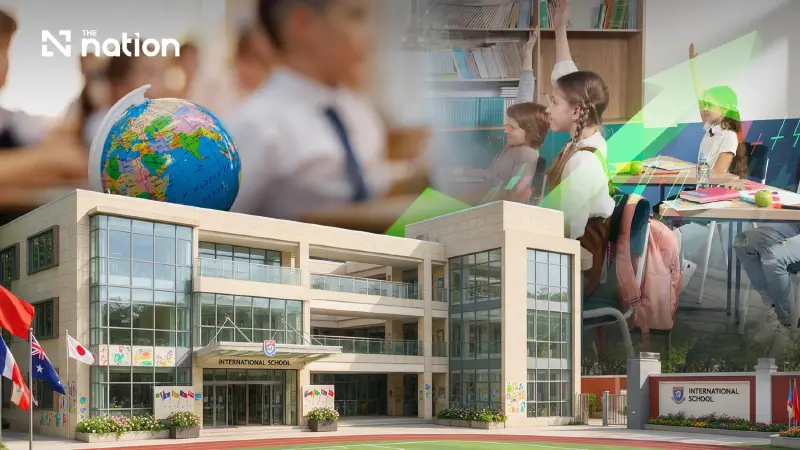


Bangkok international school fees are forecast to rise about 5% in 2026/27 as new schools outpace enrolment growth across Thailand
- The number of international schools in Thailand is projected to reach 280 by 2026, with the rate of new school openings outpacing student enrollment growth.
- This intensified competition is causing the average number of students per school to decline, putting financial pressure on operators, especially new ones.
- To support revenue, schools are increasingly relying on raising tuition fees, with Bangkok schools forecast to increase fees by approximately 5% in the 2026/27 academic year.
- In the crowded market, schools can no longer rely on reputation alone and must differentiate themselves through educational quality and specialized programs to attract and retain families.
Thailand’s international school sector is facing tougher competition as the number of schools reaches 280 in 2026, outpacing growth in enrolment and increasing the importance of tuition fee rises in supporting revenue.
Kasikorn Research Center estimates that school numbers have increased by approximately 5.3% this year, compared with student growth of 3.8%.
The expanding market is therefore being shared among more operators, putting pressure on schools to recruit new pupils, retain existing families and keep costs aligned with income.
KResearch’s analysis, published on October 9, points to declining average enrolment per school as a sign of mounting competition, even though total student numbers continue to rise.
School openings outpace enrolment growth
Thailand’s international school count has risen from 234 in 2022 to 280 in 2026 and is forecast to reach 293 in 2027. Student numbers have increased from 66,352 to 86,056 over the same period, with 89,200 expected next year.
Average enrolment, however, has fallen from 312 pupils per school in both 2024 and 2025 to 307 in 2026. KResearch expects a further decline to 304 in 2027.
The diverging growth rates suggest operators may need longer to build enrolment to a level that covers their costs. Newly opened schools are particularly exposed because they must meet initial investment and operating expenses while establishing a student base.
Bangkok remains the sector’s principal market, accounting for more than 45% of Thailand’s international schools. The concentration of operators is expected to make competition in the capital particularly intense.
Bangkok tuition fees forecast to rise about 5%
Average annual tuition fees at Bangkok international schools are forecast to increase to 839,184 baht in the 2026/27 academic year, a rise of approximately 5%.
The projected increase follows a rise of about 3%, from 776,887 baht in 2024/25 to 799,818 baht in 2025/26.
Higher fees would increase revenue per pupil and help offset the pressure from declining average enrolment per school. Tuition increases are consequently becoming more important to the sector’s continued revenue growth.
School operators nevertheless need to consider parents’ ability to pay. Higher fees could influence families’ choices, particularly as the growing number of schools gives them more alternatives.
Sector revenue grows, but profitability remains under pressure
Thailand’s international school revenue is forecast to reach 128 billion baht in 2026 and 141 billion baht in 2027, according to KResearch.
Sector revenue has risen steadily from 75 billion baht in 2022 to 87 billion baht in 2023, 103 billion baht in 2024 and 116 billion baht in 2025.
Revenue growth does not necessarily mean profits will increase at the same pace. Operators still need to monitor costs and efficiency closely, particularly where enrolment remains below the level needed to sustain their operating model.
Schools with smaller student bases face the challenge of supporting their facilities and services while competing for families in an increasingly crowded market.
Distinctive education becomes central to recruitment
KResearch identifies differentiation as an increasingly important factor in attracting and retaining pupils. Schools can no longer rely solely on their reputation or on international curricula that are widely available elsewhere.
Educational quality and specialist programmes are among the areas in which operators can distinguish themselves. Activities that develop pupils’ skills, the school environment, safety measures and a supportive social and learning culture also influence parents’ decisions.
New operators will need a clear market position from the outset, supported by careful investment management and sustained efforts to build enrolment. Those factors will be important to their long-term viability as competition intensifies.
