
Army Chief reshuffles forces to tackle ‘Southern Insurgency’


Just days after the new 4th Army Commander and 800 troops were deployed to the southern border provinces, a daring gold shop robbery occurred. Initial investigations by both the police and military suggest that the robbery was meticulously planned.
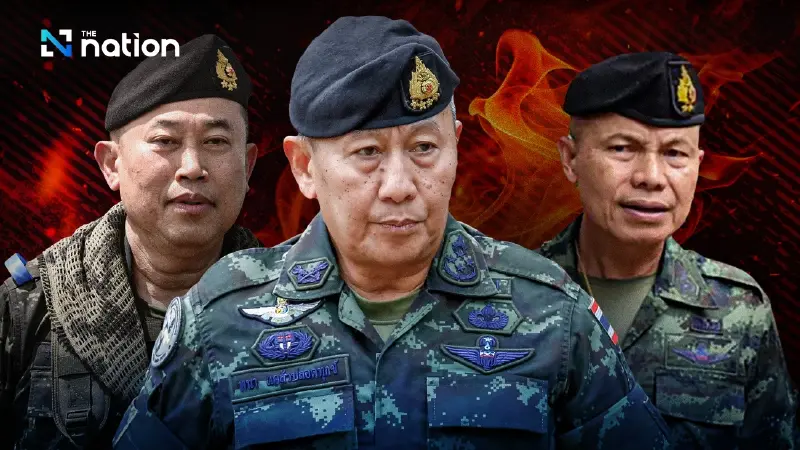
Gen Pana Claewplodtook, Commander-in-Chief of the Royal Thai Army, has made a strategic move to tackle the long-standing issues in Southern Thailand by reshuffling his leadership team. He appointed Maj Gen Narathip Phoynok, a fellow member of the Class 26 Armed Forces Academies Preparatory School and an outsider to the region, to lead the Fourth Army Area.
Narathip has had brief experience in the three southernmost provinces (Yala, Pattani, and Narathiwat), serving for about a year as the staff for the Pattani Task Force. However, he has never commanded a military unit in the region.
In addition to the new appointment, Gen Pana has revisited the approach of previous commanders by deploying forces from all military areas to support operations in the southern border provinces. This follows a period when troops were gradually withdrawn and replaced by volunteer forces, which failed to effectively control the situation.
This time, Gen Pana has opted to deploy only forces from the First Army Area, hoping that their direct involvement will bring a more robust solution.
On October 3, 2025, Lt Gen Worayos Luangsuwan, Commander of the First Army Area, officiated the ceremony to deploy troops under the "Narathiwat Special Task Force" for the fiscal year 2026. The mission focuses on maintaining security, order, and promoting sustainable peace in the southern provinces.
Maj Gen Yod-Arwut Phuengpak, Deputy Commander of the First Army Area, was appointed the commander of the Narathiwat Special Task Force, leading over 800 troops from the 11th Infantry Division, the 9th Infantry Division, and the 11th Military District. The deployment aims to restore peace and stability in the region.
Yod-Arwut had previously served in the southern border region nearly 20 years ago, during the period of intense insurgency following the 2004 gun theft incident, when Gen Apirat Kongsompong, former Army Chief, was the commander of the Yala Task Force 14.
Just days after the new Fourth Army Commander and 800 troops arrived in the southern border region, a daring robbery took place at a gold shop in a shopping mall in Su-ngai Kolok, Narathiwat, with thieves making off with gold worth 35 million baht. The criminals used the Sako-Wang route, crossing natural border paths to escape into a neighbouring country.
Amid ongoing speculations, various issues have been linked to the southern insurgency, including internal military conflicts, the recent leadership change in the Fourth Army Area, and the non-action of officials during a transitional period, which created a window of opportunity for the insurgents.
A security source has raised concerns about the use of explosives in recent attacks, suggesting that only those with experience in military operations could have carried out such acts.
It’s believed that the perpetrators could be current or former state officials, as their tactics and actions closely resemble those of trained personnel. This theory implies that insurgents may have exploited the timing of the leadership change for their benefit.
The involvement of networks or support groups in neighbouring countries has also been noted, with some members of the insurgency believed to be stationed there. The audacity of the recent robbery further points to possible involvement from state officials, as terrorist groups typically avoid such bold moves to prevent alienating local populations.
"These are likely individuals with a high level of planning ability, familiar with internal networks," said a source. "Typically, shopping malls would have security personnel, and the sophistication of the attack, such as the use of weapons and battle tactics, suggests expertise, even against trained soldiers."
On the topic of leadership changes, security sources have noted that the appointment of a new 4th Army commander from outside the region is seen as a challenge. It will test his ability to manage and effectively counter insurgent activities, placing immense pressure not only on the new commander but also potentially on Gen Pana, the Army Chief.
However, it remains to be seen whether this will discredit the military leadership, as only the successful apprehension of the perpetrators can clarify the situation. These factors likely play a crucial role in the unfolding events.
Defence Minister Gen Nathapol Nakpanit has downplayed the link between the leadership change and the insurgency, suggesting that the new 4th Army commander should be given time, as he has only recently taken office, and all soldiers are aware of their responsibilities. Nathapol also reassured that he and Gen Pana are planning to visit the region soon to monitor the situation.
"We have not yet found concrete evidence of any officials' involvement, but we are still monitoring. The reports suggest that this was an operation by the BRN insurgent group, and they escaped back into neighbouring countries. We will coordinate with the neighbouring nations to track the perpetrators and recover the stolen goods," said Nathapol.
This shift in leadership came after the Fourth Army's inability to control the region's situation earlier this year. Insurgents took advantage of perceived vulnerabilities, targeting vulnerable Thai Buddhist citizens, monks, novices, the elderly, and children, resulting in injuries and fatalities.
At that time, Gen Pana had suggested a change in operational methods, especially in the intelligence sector, but his ideas were not fully embraced, leading to his comment that "the 4th Army lost its legitimacy to hold the position" due to its failure to protect Thai Buddhists.
Thus, the search for a new 4th Army commander began to appoint someone outside the region to avoid command and control issues. This led to the selection of Maj Gen Narathip, previously the deputy commander of the Second Army Area.
Gen Pana’s aim is to resolve the southern insurgency within the two remaining years of his term as Army Chief, but whether the reshuffling of the 4th Army will succeed or fall short remains to be seen.
