
Thailand launches 23-agency drive against nominee firms and grey capital



The government has signed an MOU with 23 agencies to link data, monitor suspicious businesses and stop nominee firms and grey capital from using Thailand as a base for economic crime.
The Thai government is turning the nominee-business problem into a national enforcement agenda, with 23 agencies joining forces to link data, monitor suspicious business activity and prevent grey capital from using Thailand as a base for economic crime.
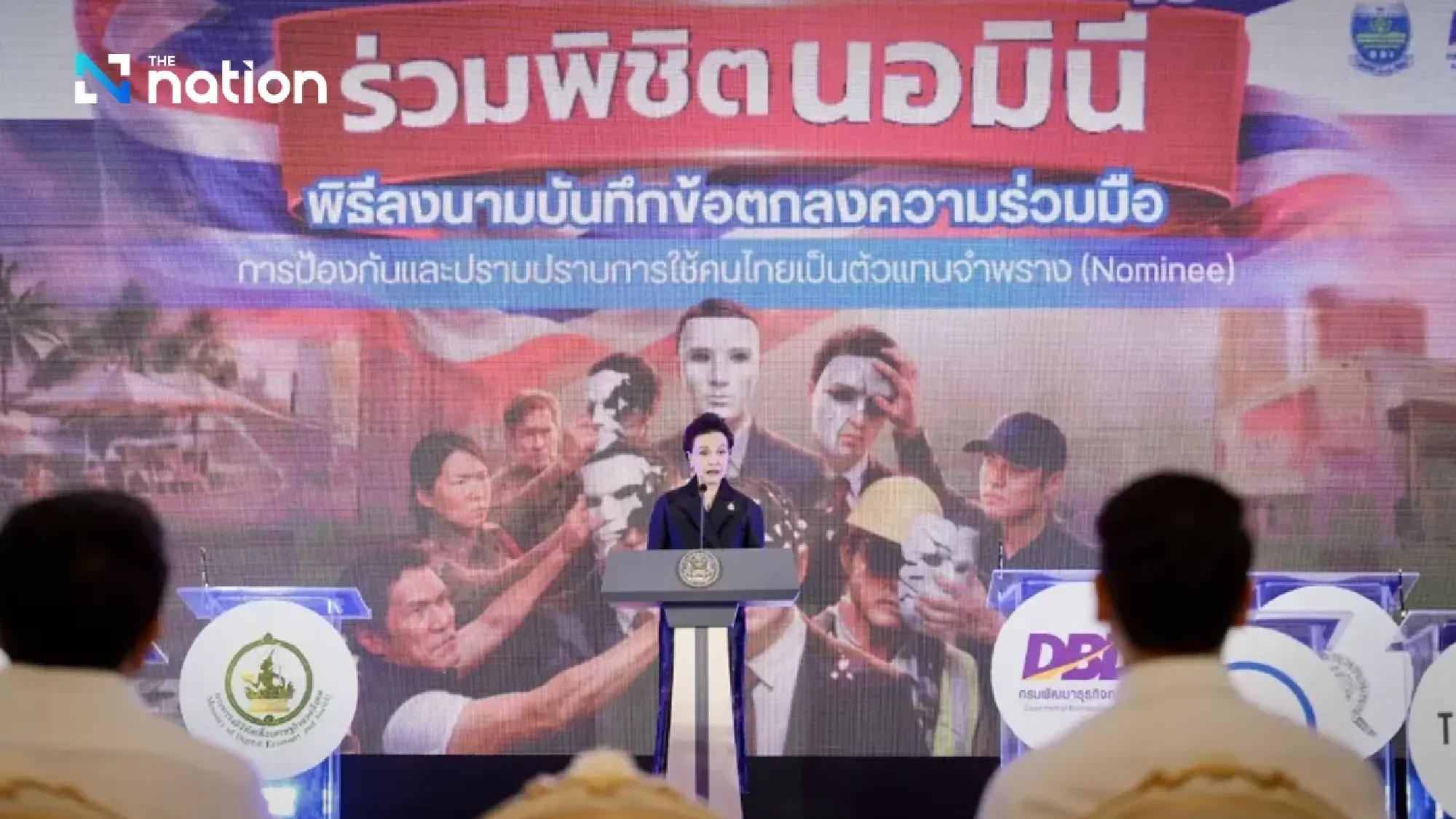
Deputy Prime Minister and Commerce Minister Suphajee Suthumpun on Wednesday (April 29) presided over the signing of a memorandum of understanding at Government House aimed at preventing and suppressing the use of Thai nationals as concealed proxies, or nominees.
The agreement, signed under the theme “Closing economic cracks, joining forces to defeat nominees”, brings together state agencies, regulators and private-sector bodies in a coordinated effort to close legal loopholes, protect legitimate investors and strengthen confidence in Thailand’s business environment.
Nominee problem elevated to law-enforcement agenda
Deputy Government Spokesperson Ploytalay Laksamee-saengchan said Suphajee was joined at the ceremony by Chaichanok Chidchob, Minister of Digital Economy and Society, and Surasak Phancharoenworakul, Minister of Tourism and Sports, who witnessed the signing by all 23 agencies.
Suphajee said the MOU marked a major step in integrating the work of the public and private sectors to tackle nominee businesses and grey capital more systematically.
She said the issue would no longer be treated as a fragmented regulatory problem, but as a serious law-enforcement priority requiring effective coordination between agencies responsible for business registration, banking, taxation, law enforcement, investment, securities, anti-money-laundering and other key areas.
Nominee arrangements generally involve the use of Thai nationals as proxy shareholders, directors or business owners to conceal the real controllers of a company. Authorities have raised concerns that such practices can be used to evade laws, distort fair competition and support illicit business networks.

Business data to be linked with mule-account checks
A key part of the crackdown will involve deeper data integration.
Suphajee said the Department of Business Development currently has more than 980,000 juristic entities in its database and has begun integrating information with the Ministry of Digital Economy and Society and the Royal Thai Police.
The aim is to detect links between registered businesses, mule accounts and possible crime networks. If irregularities are found, authorities will move quickly to take legal action.
She said serious operations had already been under way since October 2025, including arrests, crackdowns and stricter proactive prevention measures.
Three-pronged cooperation plan
The Commerce Ministry is pushing cooperation in three main areas.
The first is data integration among the 23 participating agencies, allowing authorities to connect information more efficiently and detect suspicious business patterns.
The second is the creation of a business-monitoring mechanism to identify and prevent nominee activity before it causes wider damage.
The third is building confidence that business operations in Thailand can be conducted transparently, fairly and in compliance with the law.
Suphajee said the MOU would help close loopholes and strengthen Thailand’s investment sector by ensuring that unlawful operators can no longer use the country as a base for economic crime.
She added that the cooperation would also protect honest business operators and build confidence among investors who comply with Thai law.
Wide range of agencies involved
The 23 signatories include the Ministry of Digital Economy and Society, Ministry of Interior, Department of Business Development, Royal Thai Police, Department of Special Investigation, Anti-Money Laundering Office, Revenue Department, Customs Department, Bank of Thailand, Thai Bankers’ Association, Board of Investment, Securities and Exchange Commission, and the Stock Exchange of Thailand.
Other participating agencies include the Department of Employment, Department of Tourism, Department of Lands, Department of Industrial Works, Department of Agriculture, Department of National Parks, Wildlife and Plant Conservation, Internal Security Operations Command, Office of the Trade Competition Commission, Food and Drug Administration, and the Thai Industrial Standards Institute.
The broad participation reflects the government’s attempt to treat nominee businesses not only as a company-registration issue, but as a cross-sector economic crime risk involving capital flows, labour, land, tourism, tax, banking, securities and law enforcement.
Protecting legal investors
Suphajee said all agencies would now work closely together to protect the interests of lawful business operators and strengthen Thailand’s competitive advantage.
The government believes the crackdown will help restore confidence among legitimate investors while preventing businesses operating through hidden proxies or grey capital networks from gaining unfair advantages over companies that follow the law.
