
Orange Line pushes Bangkok’s east-west hotspots as land prices climb
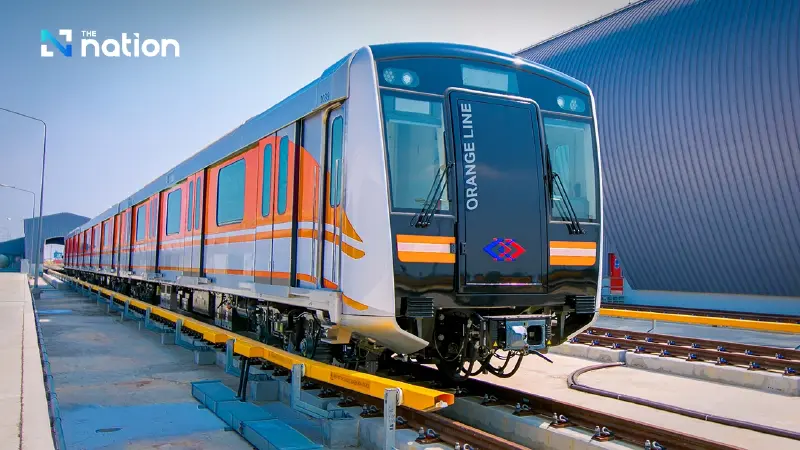


Bangkok’s Orange Line train is reshaping property demand, with the East section due to open in January 2028 and the West line targeted for 2030, lifting land values.
The Mass Rapid Transit Authority of Thailand (MRTA) is accelerating construction of the Orange Line West (Bang Khun Non-Thailand Cultural Centre), which is expected to be completed and opened in 2030, linking with the Orange Line East (Thailand Cultural Centre-Min Buri), where construction is now 100% complete.
The latest estimate puts the East section’s opening at around January 2028, revised from the previous target of late 2027.
With private developers moving in around key stations, the project is expected to improve connectivity while boosting residential values and land potential along the corridor. The Orange Line is also projected to carry as many as 300,000 passengers per trip per day, moving commuters quickly between Bangkok’s western and eastern sides and creating new prime locations around major stations.
Key interchange stations are expected to be the main value drivers—particularly stations linking to existing and future rail lines.
A major focal point is Thailand Cultural Centre station, which connects with the MRT Blue Line and is seen as a crucial interchange. Rama 9 is also in the spotlight, with the area changing rapidly amid major landholdings, including MCOT land, and investment plans by Central Pattana on a prominent Rama 9 corner plot.
The shift also aligns with Bangkok’s revised City Plan (4th revision), expected to take effect around mid-2027, which is designed to better match land-use planning with rail mass transit—supporting housing, mixed-use development and more efficient land use, while encouraging travel by rail rather than private cars to help ease congestion and air pollution.
Cushman & Wakefield Research estimates that the Orange Line’s progress has already pushed up land and condominium prices along the corridor.
On the eastern stretch—especially along Ramkhamhaeng Road around Hua Mak and Lam Sali—multiple new condo launches have emerged, with average selling prices at about THB85,000 per sq m, while some locations have climbed above THB100,000 per sq m. Land values in parts of the corridor have more than doubled in recent years, with some plots near Thailand Cultural Centre station exceeding THB1 million per sq wa.
On the western side, price movement has been most visible around Ratchathewi station, where some condo projects are priced as high as THB250,000 per sq m. Mixed-use development has also continued in the area, including projects such as JRK Tower and The Platinum Square, reflecting strong location potential despite local constraints related to land ownership and development rules.
Beyond housing, commercial projects have also continued to emerge, including Phoenix, a wholesale-retail food centre, alongside new hotels and office developments in the Phetchaburi-Pratunam area—underscoring the Orange Line’s influence on near-term urban change, even as the broader condo market cools.
Project overview
The Orange Line (Bang Khun Non-Min Buri) spans 35.9km with 28 stations, connecting Bangkok’s east and west. It is divided into two main sections:
- East section (Thailand Cultural Centre-Min Buri): about 22.5km (10 underground stations and 7 elevated stations)
- West section (Bang Khun Non-Thailand Cultural Centre): about 13.4km with 11 stations (all underground)
The Orange Line is widely seen as another key rail corridor drawing sustained developer interest, with station areas expected to remain a major battleground for new projects as openings draw closer.
