
Thai developers put cash first as property market faces stacked crises
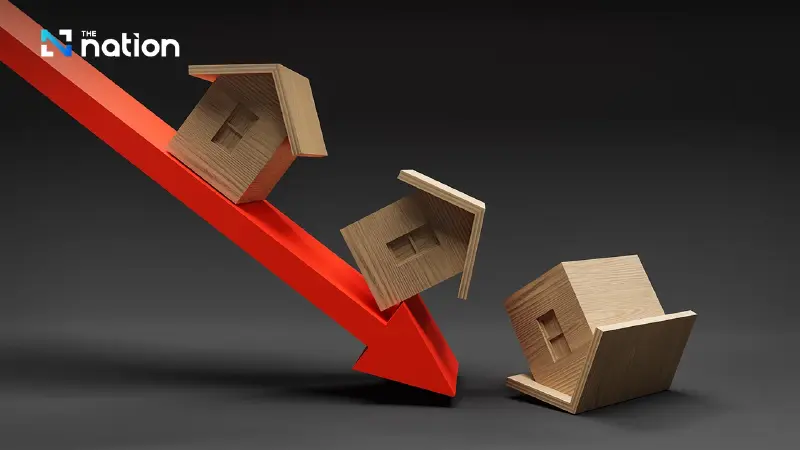


Rising construction costs, weak demand and global turmoil are forcing Thai developers to slow launches, clear stock and put cash preservation ahead of growth.
Thailand’s property sector is being hit by overlapping pressures, from soaring construction costs to weakening purchasing power, prompting developers to slow new project launches and switch into “liquidity first” mode, with survival taking priority over growth.
Prasert Taedullayasatit, president of the Thai Condominium Association, said the sector had been under pressure since 2024 and through 2025, but what many did not expect was that 2026, which should have marked the start of a “new balance”, would instead bring fresh deterioration. Wars in several regions and surging oil prices have accelerated construction costs, while also dragging down consumer demand.
He said developers were now facing costs that were increasingly difficult to control, while consumers were delaying buying decisions. The middle- to lower-income market has been hit first and hardest by higher living costs, from transport to food, leaving purchasing power almost frozen. At the upper end, buyers still have potential spending power, but are taking a wait-and-see approach because of continuing economic uncertainty.
Prasert said these pressures were inevitably forcing the launch of new projects to slow. Last year, the total value of new project launches in Bangkok and surrounding provinces stood at around 294 billion baht, the lowest level in a decade, clearly reflecting the market slowdown. He said 2026 was shaping up in much the same way.

In such uncertain conditions, developers are choosing to defend rather than push ahead aggressively. Pricing new projects has become increasingly risky when costs are highly volatile, because no one can truly lock in costs. Pricing too high to cover risk may make projects unaffordable for buyers, while pricing too low risks losses. As a result, many developers are choosing to delay launches and wait for more stability.
Against this backdrop, completed inventory has become strategically more valuable. These are projects built on older land and construction costs, allowing developers to price them more competitively than new schemes. They can also be transferred immediately, making them more attractive to both buyers and sellers in an uncertain market.
Many developers are therefore focusing on clearing stock and reducing the risks of fresh investment, especially as banks tighten lending standards, making new launches a decision that requires even greater caution.
Prasert said that amid geopolitical instability, another notable trend was emerging: Thailand is increasingly becoming a “second home” for foreigners. Demand is no longer coming only from traditional groups such as Chinese, Taiwanese, Myanmar and Russian buyers, but is now also showing signs of interest from investors and workers from the Middle East and India seeking longer-term security.
He said Thailand’s appeal lies not only in property prices, but in quality of life, with strengths in healthcare, international schools, the exchange rate and a friendly culture. At a time when many countries are seen as more risky, Thailand is increasingly being viewed as a safe haven.
With uncertainty rising, developers are no longer focused on expanding quickly, but on staying afloat. Prasert said new project launches this year could again fall to the lowest level in a decade, matching last year’s weak showing, while projects already under construction may have to absorb higher costs to ensure they are completed and ready for transfer. That is why “liquidity first” has become the dominant strategy: cash must come first.
This, in turn, has created what he described as a golden moment for buyers, as developers rush to sell older stock built at lower cost, potentially offering better prices than in more normal market conditions.
As president of the Thai Condominium Association, Prasert urged the government to introduce urgent measures, including lower mortgage rates in line with monetary policy, extending leasehold terms to 60 years to attract more foreign demand, and setting out a clear long-term property policy.
He also called for broader structural measures, such as loan guarantees for first-home buyers, steps to reduce mortgage rejection rates, using housing as a tool to address household debt, and promoting new types of projects such as wellness developments and fresh tourism destinations. He said the problem was no longer simply about purchasing power, but about the whole structure of the system.
He pointed to Ananda as a case study in survival, saying the company had spent the past three years reducing risk rather than expanding projects. It has already repaid more than 38 billion baht in debt, cut its inventory from more than 100 billion baht to the tens of billions, and sold some assets to improve liquidity. The goal, he said, was not fast growth, but survival in a volatile world.
Today, Thai property is no longer a business in growth mode, but one trying to regain its footing. Developers must manage cash tightly, consumers must make decisions more carefully, and the government must urgently redesign the rules. The storm has not ended, but opportunities still exist within the crisis.
The question, Prasert said, is whether Thailand can turn the world’s search for safety into a new engine of economic growth.
