
Sony's Ace robot takes AI table tennis into expert ranks in Tokyo
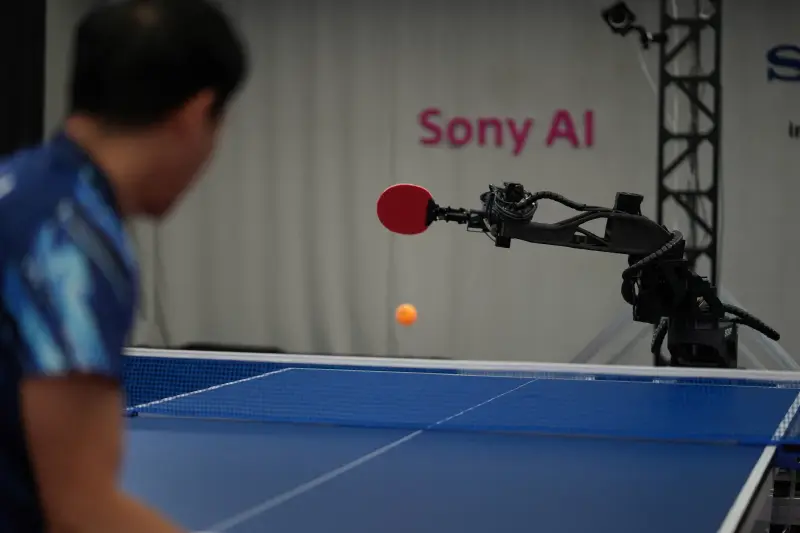


Sony AI says Ace became the first robot to compete at an expert level in a real physical sport, beating elite players and pushing robotics into new territory.
- Sony's AI robot, named Ace, has become the first to achieve expert-level performance in a competitive physical sport by beating elite and professional human table tennis players.
- The robot utilizes a system of high-speed cameras, AI-based control, and a custom robotic arm to perceive and react to the ball's rapid speed and complex spin in real-time.
- Human opponents find Ace unpredictable and difficult to play against due to its lack of emotion, though they have identified some strategic weaknesses, such as its response to simpler serves.
- Trained through self-play simulation rather than by observing humans, Ace can produce unusual shots but is still being improved to better adapt to opponents' strategies.
Sony’s AI research team has pushed robotics into new territory with Ace, a table tennis robot that has shown it can compete with, and at times beat, top human opponents in one of the fastest and most demanding physical sports.
The breakthrough was detailed in a study published on Wednesday in Nature, where Sony AI said Ace became the first robot to reach expert-level performance in a competitive physical sport.
Project leader Peter Dürr said the system combined high-speed perception, AI-based control and an advanced robotic platform to handle the split-second decisions and precision execution required in table tennis.
While ping-pong robots have existed since 1983, none had previously been able to genuinely challenge highly skilled human players.
Ace changed that by facing elite and professional opponents in matches conducted under International Table Tennis Federation rules and overseen by licensed umpires.
According to the study, Ace won three of five matches against elite players in April 2025, before losing two matches against professional players, the highest level in the sport.
Sony AI said the robot then went on to beat professional players in December 2025 and again last month.
Dürr, director of Sony AI Zurich and head of the Ace project, said table tennis remains one of the toughest unsolved tests for AI and robotics because, unlike digital games, it demands rapid, exact and adversarial interaction in real time, often at the edge of human reaction speed and close to physical obstacles.
He said the project was designed not only to build a competitive player, but also to deepen understanding of how robots can sense, plan and act with human-like speed and accuracy in changing environments.
He added that Ace’s perception system and learning-based control could have uses well beyond sport, including in manufacturing, service robotics, entertainment and other safety-critical physical settings that require fast control and close interaction with people.
Dürr said table tennis poses a special challenge because the ball travels at very high speed and carries complex spins and trajectories, forcing both humans and robots to operate at the limit of sensing, prediction and motor control. Ace tackles that with nine synchronised cameras and three vision systems, enabling it to track a spinning ball quickly enough to capture motion that would otherwise be “a blur to the human eye”.
The researchers also built a custom robot with eight joints, which Dürr said was the minimum needed for competitive shot-making: three for racket position, two for orientation, and three to generate shot speed and power.
Mayuka Taira, a professional player who lost to Ace last December, said the robot was difficult to face because its play was hard to predict and it showed no emotion.
Without visible reactions, she said, it was impossible to tell which returns it disliked or struggled against, making it even tougher to play.
Rui Takenaka, an elite-level player who has both beaten and lost to Ace, said his more complex-spin serves were often returned with equally complex spin, which made them hard to handle.
But when he used a simpler knuckle serve, Ace sent back a simpler return, allowing him to attack on the third shot more easily, something he said helped explain why he was able to win.
Dürr said Ace still has room to improve.
He said the robot can read incoming spin and react faster than humans, and because it is trained through self-play in simulation rather than by watching human players, it can produce unusual and surprising responses.
Even so, he said professional athletes remain especially strong at adjusting to opponents and exposing weaknesses, an area Sony AI is still working to strengthen.
Reuters
