
Thailand weighs refined oil exports as storage tanks near limit
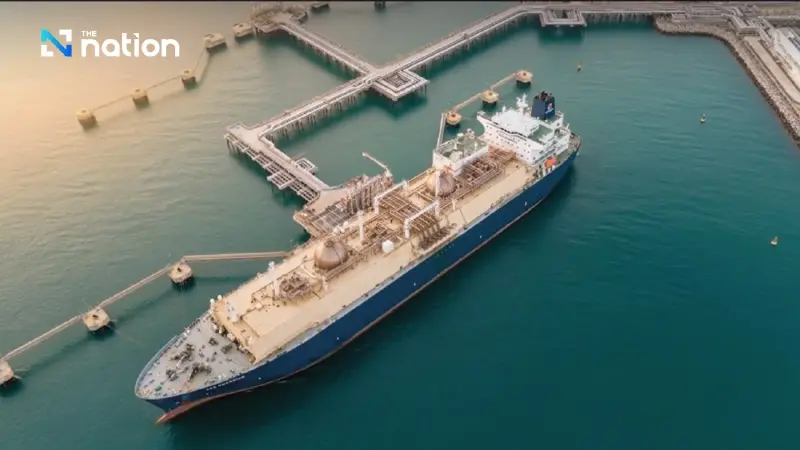


Officials say reserves exceed 100 days, but over-supply has pushed tanks close to safe storage levels as refiners seek approval to export jet fuel.
- Measures to prevent oil shortages have led to overproduction by refineries, causing storage depots to approach their 70% safety capacity, known as the "tank-top level".
- Due to the high storage levels, some refineries have already been forced to reduce production capacity by as much as 15% to prevent tanks from overflowing.
- Refinery operators have formally asked the Energy Ministry for permission to export surplus refined oil, particularly jet fuel, to alleviate the storage pressure.
- The Thai government is currently considering the request to "unlock" oil exports to help balance reserves, with a decision expected soon.
Thansettakij organised the seminar “The Big Issue New Solutions: Sustainable solutions to the energy crisis”, with representatives from public and private agencies invited to share views and exchange experiences to seek joint solutions to the energy crisis.
Oil storage nearly full, export unlock pending
Prasert Sinsukprasert, permanent secretary of the Energy Ministry, said the prolonged conflict in the Middle East would continue to keep energy prices highly volatile, affecting oil prices, which are likely to rise further.
The Oil Fuel Fund would step in to limit the impact on the public.
The fund is currently carrying an accumulated deficit of more than THB63.746 billion, with average outflows of more than THB100 million a day.
On concerns over oil shortages, he confirmed that Thailand was well prepared in terms of strong reserve volumes.
When all components are included, Thailand has an oil supply for more than 100 days: 55 days from legal reserves and domestic commercial stocks, 30 days from oil in transit by sea, and 25-30 days from oil under purchase contracts awaiting shipment.
Altogether, this totals more than 100 days and should not pose a problem, as oil is being ordered continuously to replenish the domestic supply.

However, shortage-prevention measures have led refineries to run at levels that have pushed refined oil product output above domestic demand, or oversupply, bringing oil depots close to the 70% safe storage ceiling, known as the tank-top level.
PTT Global Chemical (PTTGC) has had to reduce production capacity by 15% to prevent tanks from overflowing, and other refineries may also have to cut output.
Refinery operators have submitted a letter to the Energy Ministry seeking approval to unlock oil exports, especially jet fuel (Jet A1), to help move oil out of the system and maintain balance in reserve storage.
The government is considering allowing oil exports, with a conclusion expected soon.
To address the energy crisis at this stage, the public sector is trying to encourage people to turn more to biofuel products, including gasohol and biodiesel, which would help reduce crude oil imports in part.
This is being done by widening the price gap between different fuel types.
At present, diesel B7 is around THB42.20 per litre, but the government’s subsidy policy has brought B20 down to around THB35.20 per litre, a gap of THB7 from regular diesel.
Similarly, gasohol E20 is priced at THB37.90 per litre, THB7 per litre below gasohol 95, making it one option for fuel users.
It also directly benefits Thai farmers and helps strengthen long-term energy security.
Oil Fuel Fund ready to support prices and other missions
Pornchai Jirakulpaisal, director of the Office of Policy and Strategy at the Oil Fuel Fund Office (OFFO), said the Oil Fuel Fund continued to play a role in maintaining energy price stability, especially while global oil prices remained highly volatile.
The fund still has sufficient capacity to assist if oil prices rise further in the future.
“The Oil Fuel Fund is only one of the tools used by the state to maintain energy stability. There are several other tools, including tax measures and budget spending. But the Oil Fuel Fund is considered a more flexible tool and can be deployed quickly, so it is consistently used to manage energy price situations.”
However, use of the Oil Fuel Fund mechanism should be viewed in the context of each period, because the fund has a duty to support every type of fuel covered by law, rather than choosing to help only one type of oil.
While many parties may see it as subsidising diesel, petrol or gas, in reality, it is necessary to consider what the crisis at that time affects and where support is needed.
Pornchai added that the Oil Fuel Fund also had other roles, such as supporting biofuels, promoting energy infrastructure and implementing strategic petroleum reserve (SPR) measures.
If the fund’s financial position returns to strength, it is ready to push these missions again in line with Cabinet policy.
In the long term, however, the country needs to place importance on energy-saving use and on building energy sustainability, rather than relying solely on subsidies.
This is particularly true of promoting alternative and clean energy, issues not specified in the 2019 Oil Fuel Fund law, because the global energy transition was not yet clear at that time.
The office has now gathered proposals and issues in preparation for the review and improvement of the Oil Fuel Fund law so that it is aligned with the future energy context.
PDP plan accelerated to align power-use forecasts with economic growth
Watcharin Boonyarit, deputy director-general of the Energy Policy and Planning Office (EPPO), said that in setting the country’s energy direction, EPPO is currently preparing the draft Thailand Power Development Plan for 2026-2050, or draft PDP 2026, to secure sufficient electricity supply for national demand.
The process is now at the stage of forecasting future electricity demand before determining fuel types or what types of power plants will be needed.
“The agency is currently adjusting electricity-demand forecast figures to align with economic growth. This process is important and requires accurate model analysis to obtain clear final figures before submission to the National Energy Policy Council (NEPC).”
Watcharin added that the country’s energy direction would not be able to end the use of fossil fuels over the next 10-20 years, and a 100% shift to renewable energy was impossible in the near term.
The transition would be gradual.
At the same time, end-stage management must be handled in parallel, an area where Thailand still lacks effective management.
Examples include waste-to-energy plants that still lack efficient waste-separation systems, management of expired batteries and electronic waste.
For the future energy approach, he said there would be energy price restructuring, smart grid development and promotion of various forms of renewable energy.
These include geothermal technology, which may require an initial subsidy mechanism; biofuel, where Thailand has potential from domestic energy sources and agricultural residues; as well as solar, wind, hydrogen and nuclear power.
All these would be combined as a package over the next 5-10 years to support competition and low-carbon and carbon-neutrality goals.
