
Thailand launches five-ministry skills overhaul to confront AI and ageing workforce



Thailand’s THAILAND² strategy aims to reskill workers, strengthen lifelong learning and increase R&D investment as ageing and AI threaten productivity.
Prime Minister Anutin Charnvirakul has warned that Thailand risks remaining dependent on low-cost manufacturing unless it substantially increases research and development investment and equips its workforce with skills for an increasingly technology-driven economy.
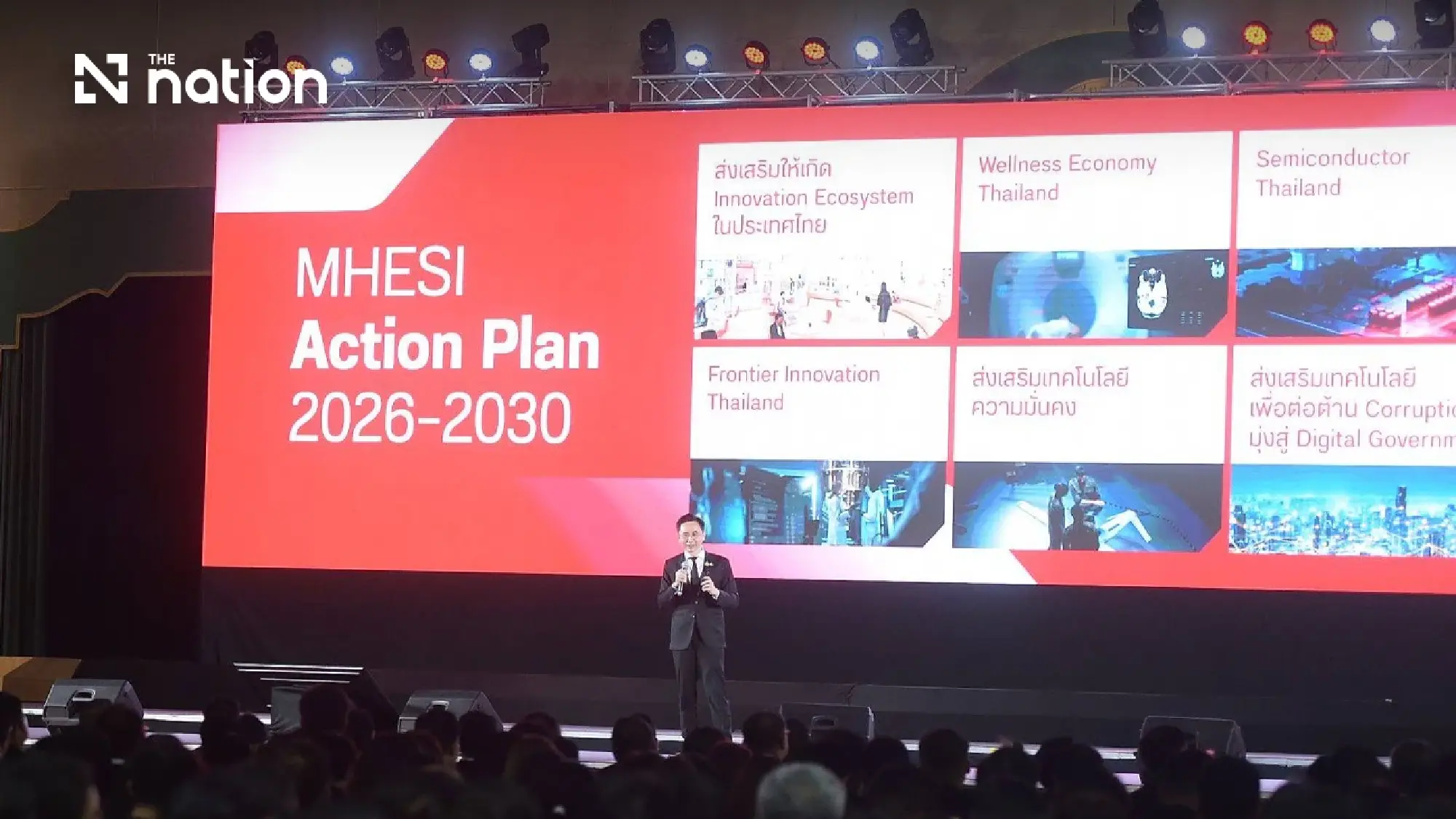
Launching the government’s THAILAND² human-capital strategy, Anutin said five ministries would work together to expand upskilling, reskilling and lifelong learning as Thailand confronts an ageing population, rapid technological disruption, geopolitical volatility and the transition to a green economy.
The initiative brings together the Ministry of Higher Education, Science, Research and Innovation; the Ministry of Social Development and Human Security; the Ministry of Education; the Ministry of Labour; and the Ministry of Agriculture and Cooperatives.
Speaking at the opening of the “THAILAND²: Powering up Thailand, elevating human capital” event at Kasetsart University, Anutin said the cooperation was intended to create a more integrated system for developing people’s capabilities throughout their lives.


Ageing population threatens productivity
Thailand’s changing demographic structure is placing increasing pressure on its labour supply and long-term economic growth.
Anutin said the proportion of working-age people was continuing to decline while the elderly population was expanding, creating a risk that national productivity would fall unless the capabilities of the existing workforce were significantly improved.
The government’s response will focus on raising output per worker rather than relying on an expanding labour force.
That will require employees in industry, services and agriculture to acquire new skills and adapt to production systems that increasingly incorporate artificial intelligence, automation and digital technologies.
Workers who are unable to adjust could face unemployment or see their existing roles lose economic value as traditional tasks are replaced, Anutin said.
The challenge is particularly significant for Thailand because many parts of its economy remain dependent on labour-intensive manufacturing and relatively low-value production.

Five ministries to coordinate reskilling drive
Under the THAILAND² strategy, the government plans to accelerate both the upgrading of existing skills and the development of new capabilities aligned with the modern labour market.
Priority areas include digital literacy, data analysis and the ability to work alongside advanced technologies.
The programme will cover workers across industrial, service and agricultural sectors rather than concentrating solely on graduates or employees in major technology companies.
Anutin said the traditional education model, in which formal learning largely ends after school or university, was no longer adequate for an economy facing constant technological change.
The government therefore intends to promote lifelong learning for children, young people, working-age adults and older people seeking to acquire new skills or return to employment.
Credit-bank systems, which allow learners to accumulate and transfer recognised learning credits, will be connected with short training courses to make education more accessible outside conventional degree programmes.
The five-ministry structure is also intended to reduce fragmentation among government agencies responsible for education, employment, social welfare, agriculture, research and innovation.
Anutin said closer coordination should improve the use of public-sector budgets and personnel while creating a more seamless system for supporting people at different stages of life.
The announcement, however, did not specify the additional budget for the strategy, the number of workers expected to receive training or a timetable for achieving its principal targets.


AI and automation reshape labour demand
Technological disruption is one of four structural challenges identified by the government.
The rapid adoption of AI, automation and digital systems is changing the type of labour demanded by companies and increasing pressure on workers performing routine tasks.
At the same time, geopolitical competition and tensions between major economies are reshaping supply chains and influencing decisions on where multinational companies invest and establish production facilities.
Anutin said Thailand needed a more internationally competitive workforce to attract investment from companies seeking alternative or expanded manufacturing bases.
Labour skills are becoming increasingly important in such investment decisions as countries compete not only through wages and tax incentives, but also through the quality of their engineers, technicians, researchers and digital workers.
The government also identified climate change and stricter environmental trade requirements as major economic pressures.
Thai industrial and agricultural businesses will need workers with the knowledge required to reduce emissions, improve resource efficiency and comply with international environmental standards, including carbon-related trade measures.
The transition towards a green economy could create new employment opportunities, but it may also leave workers and businesses behind unless training is available at sufficient scale.

Huawei spending highlights Thailand’s R&D gap
Anutin used the example of Chinese technology company Huawei to illustrate the scale of investment required to build domestic technological capabilities.
He said Huawei spent about US$25 billion, or approximately 800 billion baht, on R&D annually, equivalent to around 20% of its total sales.
According to the prime minister, the R&D budget of the single company was several times larger than Thailand’s total research and development spending.
Anutin cited the figure following an official visit to China with Deputy Prime Minister Professor Dr Yoschanan Wongsawat and Cabinet members.
The delegation visited major technology and manufacturing companies including Huawei, Alibaba, Changan and Xiaomi.
“The study visit to China reinforced the fact that countries which have successfully transformed their economies for the innovation era all began by devoting resources and funding to human development and research and development,” Anutin said.
“If Thailand continues to invest only a limited amount in R&D, we will be unable to develop our own technologies and will remain a low-cost contract manufacturing base indefinitely. This is something we must urgently change.”
Thailand has long sought to move its industrial base towards higher-value manufacturing, technology development and innovation. However, limited research spending and persistent skills shortages have constrained the ability of domestic businesses to develop proprietary technologies and compete in advanced industries.
The THAILAND² initiative positions human-capital development and research investment as connected economic priorities: companies cannot expand innovation without skilled workers, while workers require stronger research and industrial ecosystems to create higher-value employment.


China agreements target future industries
The government said the visit to China also resulted in memoranda of understanding and other cooperation agreements covering personnel exchanges, advanced technology curricula and joint research in future industries.
Several of the agreements involve policy areas overseen by Yoschanan, according to Anutin.
Such partnerships could support knowledge transfers and give Thai researchers, students and workers greater exposure to advanced industrial technologies.
However, the longer-term economic impact will depend on whether the agreements result in research projects, commercial investment, workforce placements and technologies that can be adopted by Thai companies.
The government will also need to ensure that cooperation with large foreign technology companies contributes to the development of domestic capabilities rather than leaving Thailand primarily as a consumer of imported systems.
Mental well-being added to human-capital agenda
The strategy also includes mental well-being as part of the government’s broader definition of human capital.
Anutin said rapid economic and technological change was increasing pressure on the public, making mental health an important factor in workers’ ability to adapt and remain productive.
The government plans to develop support systems and environments that help people cope with change and participate effectively in the labour market.
Although mental health is not traditionally treated as an industrial or productivity policy, poor well-being can affect workforce participation, absenteeism and the ability of employees to learn new skills.
Its inclusion indicates that THAILAND² is intended to cover social resilience as well as education and technical training.
Implementation will determine economic impact
Anutin described the initiative as the beginning of a major overhaul of Thailand’s human capital rather than simply another government exhibition or project launch.
The economic case for reform is clear. Thailand has fewer young people entering the workforce, while AI and automation are changing employment requirements faster than conventional education systems can respond.
Businesses must also adjust to geopolitical shifts, environmental regulations and growing competition for skilled investment.
The principal test will be whether the government can convert five-ministry cooperation into accessible training, higher R&D spending and measurable improvements in workforce productivity.
Without clear funding, targets and accountability, the initiative risks becoming another broad policy framework with limited effects on companies and workers.
With effective implementation, however, it could support Thailand’s effort to move away from low-cost production and compete through technology, specialised skills and innovation.
