
UN warns Moon exploration boom could worsen space junk and atmospheric pollution
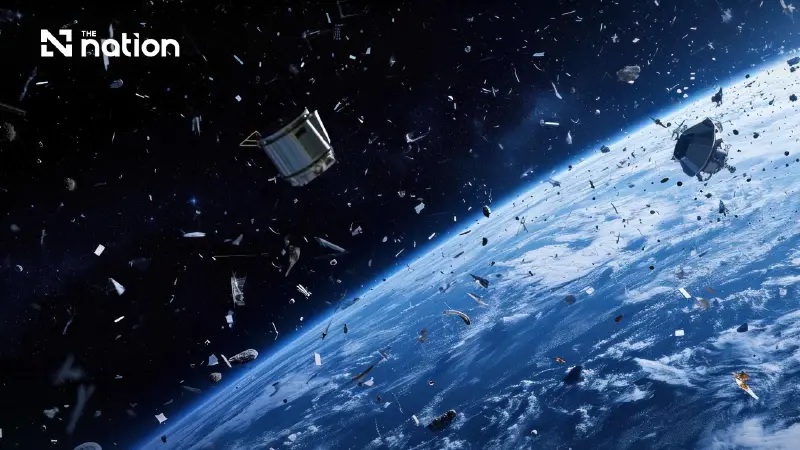


The UN warns that renewed lunar exploration and expanding satellite fleets are increasing space debris, re-entry pollution and risks to Earth.
The accelerating return to the Moon is raising environmental concerns far beyond the lunar surface, as launches, abandoned spacecraft and re-entering satellites add to orbital debris and release metals into Earth’s atmosphere, the United Nations has warned.
The warning came as the UN marked International Moon Day on July 20 amid a resurgence in lunar exploration involving governments and private companies. NASA’s Artemis II mission carried four astronauts around the Moon in April, while China, India, Japan and commercial operators are pursuing their own lunar programmes.
The UN Environment Programme said decisions made during the early stages of the new space expansion would determine whether exploration could continue without causing lasting damage to Earth’s atmosphere, marine ecosystems and the space environment.
“Each launch leaves an environmental footprint,” said Jason Jabbour, a senior UNEP officer, adding that the full consequences of space activities could take years to understand.
Millions of fragments crowd Earth’s orbit
An estimated 140 million pieces of space debris larger than one millimetre are already orbiting Earth, according to UNEP. Most are too small to be tracked, but can still damage functioning satellites and spacecraft because they travel at extremely high speeds.
The debris includes retired satellites, abandoned rocket stages, fragments created by collisions and explosions, and smaller objects released during missions, such as bolts, lens caps and protective covers.
Collisions can make the problem significantly worse. Satellites and rocket components can travel at about 28,000 kilometres per hour, meaning even a small fragment can destroy another spacecraft. The resulting collision can produce thousands of additional pieces, creating a cycle in which each accident increases the likelihood of another.
Explosions caused by leftover rocket fuel or batteries can also scatter debris across orbit. Fragments produced by collisions, explosions and anti-satellite weapons tests may remain in space for decades.
The accumulation of microscopic particles is even affecting the view from Earth. Scientists believe sunlight reflected and scattered by orbiting objects is already contributing to the artificial brightening of the night sky.

Re-entry releases metals into the atmosphere
The environmental threat does not end when a satellite or rocket component falls out of orbit.
Most spacecraft burn up as they re-enter Earth’s atmosphere, releasing aluminium, lithium, copper and other metals into the upper atmosphere. Scientists have detected metals linked to spacecraft in stratospheric particles and are investigating whether the material could alter atmospheric chemistry, influence cloud formation or affect the ozone layer.
Hundreds of tonnes of spacecraft and rocket bodies are estimated to re-enter the atmosphere each year. That amount is expected to increase as large satellite constellations expand and ageing satellites are replaced more frequently.
The consequences of these emissions are not yet fully understood. UNEP said this uncertainty made it important to assess environmental risks before launch rates and satellite numbers increase further.
Not every object burns up completely. Larger or heat-resistant components can survive re-entry and fall to Earth, potentially threatening people and infrastructure.
Fragments landing in the ocean may also damage marine habitats or introduce hazardous materials into marine ecosystems.
The Moon’s environmental influence reaches Earth
The renewed focus on sustainable exploration also reflects the Moon’s close relationship with Earth’s natural systems.
From a distance of almost 400,000 kilometres, the Moon’s gravitational pull generates tides that oxygenate coastal waters, transport nutrients and help sustain marine ecosystems, including the Great Barrier Reef.
Scientific study of the Moon also provides information about the formation and evolution of the wider solar system.
However, the expansion of human activity around and on the Moon raises questions about whether contamination, waste and abandoned equipment could create on the lunar surface the same environmental problems already emerging in Earth’s orbit.
UNEP defines space sustainability as conducting activities in space and on the Moon in ways that preserve those environments for future generations.
Existing rules seek to prevent contamination
International space law already contains principles intended to limit environmental damage.
The 1967 Outer Space Treaty requires states to avoid the harmful contamination of outer space and celestial bodies. It also holds governments responsible for national space activities, including those carried out by private companies.
UN guidelines call on space operators to minimise debris, prevent explosions and avoid the deliberate destruction of spacecraft. Operators are also encouraged to remove retired satellites and spent rocket stages from orbit after their missions end.
Practical measures include venting unused propellant and discharging batteries at the end of a mission, reducing the risk that abandoned spacecraft will later explode.
Under the 1972 Liability Convention, a launching state is liable for damage caused by its space objects on Earth or to aircraft. Liability may be shared when one country commissions a launch using another country’s territory or facilities.
However, the rapidly expanding number of launches, private operators and satellite constellations is increasing the need to incorporate environmental assessments into space governance from the beginning of each programme.
UN agencies seek stronger environmental safeguards
UNEP and the UN Office for Outer Space Affairs are working together to improve scientific understanding of the environmental effects of launches, orbital debris and spacecraft re-entry.
Their work is intended to strengthen the evidence available to policymakers and ensure environmental protection is considered when future rules for lunar and orbital activity are developed.
The central concern is that space exploration should not create a new pollution crisis while seeking scientific knowledge and economic opportunities beyond Earth.
As governments and companies prepare for a sustained human presence around the Moon, the UN is urging them to treat orbital space and the lunar environment as finite shared resources rather than areas where equipment and waste can be abandoned indefinitely.
Without early safeguards, the environmental legacy of the new Moon era could include an increasingly congested orbit, greater metal pollution in the atmosphere and growing risks to ecosystems on Earth.
