
Cabinet approves 160bn-baht Chai Nat–Pa Sak–Gulf of Thailand canal for 2027 start to cut flooding across 3.48 million rai
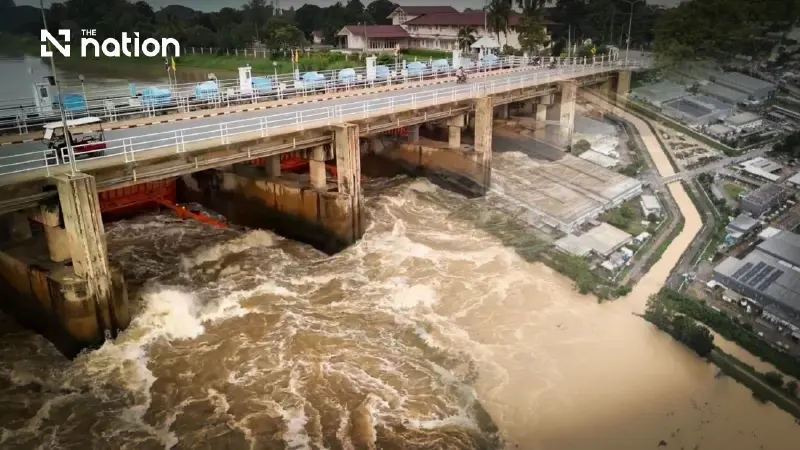


The Chai Nat–Pa Sak–Gulf of Thailand canal aims to reduce flooding across 3.48 million rai, with an eight-year programme due to finish in 2034
- The Thai Cabinet has approved the Chai Nat–Pa Sak–Gulf of Thailand canal project with an estimated budget of 160 billion baht.
- Construction is scheduled to run for eight years, starting in 2027 and finishing in 2034.
- The project is designed to mitigate flooding across 3.48 million rai, particularly in Central Thailand.
- In addition to flood control, the canal will also address drought by storing approximately 1.555 billion cubic metres of water for the dry season.
Cabinet approved the Chai Nat–Pa Sak–Gulf of Thailand flood-diversion canal project on September 29, 2026, with an estimated investment of 160 billion baht and an eight-year implementation programme beginning in 2027. The canal project is expected to reduce flooding across 3.48 million rai, equivalent to 556,800 hectares, particularly in Central Thailand, and avoid an estimated 16.93 billion baht in damage annually.
Prime Minister and Interior Minister Anutin Charnvirakul also announced a separate flood-response package, including central funding for relief and compensation, regional teams to direct operations and efforts to accelerate another major drainage canal.
Canal programme runs from 2027 to 2034
Government spokesman Ekkapob Pianpises said the Chai Nat–Pa Sak–Gulf of Thailand project would address both flooding and drought, with work scheduled to begin in 2027 and finish in 2034.

Ekkapob said an economic assessment had found the project worthwhile. Alongside its expected flood-reduction benefits, the canal network would store approximately 1.555 billion cubic metres of water for the dry season, while drainage canals could provide routes for transporting agricultural goods.
Ekkapob said extensive site preparation would be required, although initial funding had already been set aside for work in Chai Nat in 2027.
Anutin said financing would combine budget allocations and borrowing. The Agriculture and Cooperatives Ministry, National Economic and Social Development Council, Budget Bureau and Finance Ministry would discuss the arrangements.
Anutin said the completed project would improve flood protection for Central Thailand, Bangkok and surrounding provinces while providing water storage and natural retention areas.
Deputy Prime Minister Songsak Thongsri, who oversees the Office of the National Water Resources, was due to chair a meeting on September 29 to consider revising criteria governing local authorities’ development of retention basins.
The proposed changes would allow local authorities to create areas for storing and diverting water, with supplies retained for reuse during the dry season.
Bang Ban–Bang Sai canal faces completion push
The Cabinet also pressed for faster completion of the Bang Ban–Bang Sai flood-diversion canal, an unfinished project intended to connect drainage systems and reduce flooding in Central Thailand.
Ekkapob said the original contracts provided for completion in 2026–2027, but delays in handing over construction sites had prompted a request to extend the timetable to 2029.
The Royal Irrigation Department indicated that the Bang Ban–Bang Sai project could be completed in 2028. The Cabinet called for completion as quickly as possible and opposed further extensions.
4.731-billion-baht relief package covers 24 provinces and Bangkok
The Cabinet endorsed a Budget Bureau recommendation to allocate 4.731 billion baht from the fiscal 2026 central emergency and contingency reserve for assistance to people affected by rainy-season flooding in 24 provinces and Bangkok.
The Interior Ministry’s Department of Disaster Prevention and Mitigation would administer the assistance, coordinating with local agencies and the Bangkok Metropolitan Administration to assess damage and deliver support promptly.
Anutin said the central allocation should be sufficient for relief and flood-response operations nationwide, rather than being confined to Bangkok.
“It should be sufficient for relief and operations to tackle flooding across the country, not only in Bangkok,” Anutin said. “As for whether every household will receive 9,000 baht, there will be criteria and conditions.”
The Department of Disaster Prevention and Mitigation’s preliminary checks identified 553,780 affected households and eight deaths.
A Government House report said the emergency allocation was necessary because flooding had severely disrupted residents’ lives, while the department had neither an existing annual allocation for this assistance nor sufficient scope to redirect spending under its current operational plans.
Assistance rates would require Finance Ministry approval. The funding request was subject to the Prime Minister’s Office’s 2016 regulation governing requests for central-budget expenditure.
The Department of Disaster Prevention and Mitigation also planned to ask the Cabinet to review assistance criteria, procedures and conditions, and to expand the geographical areas eligible for support.
For Bangkok, the Budget Bureau said the Bangkok Metropolitan Administration (BMA), which has special local-administration status, should first use available funds outside the central budget, including its own revenue and accumulated reserves.
The Budget Bureau reported that the BMA held 2.968 billion baht in uncommitted accumulated funds as of September 18, 2026.
Bangkok’s assistance would be governed by the BMA’s 1994 regulation on disaster-victim assistance, as amended, and the Finance Ministry’s 2019 regulation on advances for emergency disaster relief. The Budget Bureau said expenditure should not duplicate claims against the central budget.
The Budget Bureau instructed the Interior Ministry and Department of Disaster Prevention and Mitigation to verify affected residents’ information carefully, comprehensively and accurately, prevent duplicate assistance and ensure support was delivered quickly, fairly and in accordance with the law.
The Government House report also set out the approval procedure for central-budget requests exceeding 100 million baht. Under Clause 9(3) of the 2019 regulation on administering central-budget expenditure, the Budget Bureau would submit a request for the prime minister’s approval before notifying the requesting agency to seek Cabinet approval.
Cabinet assigns regional flood-response teams
Anutin said Cabinet representatives had been assigned to supervise, coordinate and direct relevant agencies on the prime minister’s behalf in each region and in Bangkok.

