
Thailand Orders Probe Into CPRAM Holy Basil Registration as Government Assures Farmers' Rights Remain Untouchable
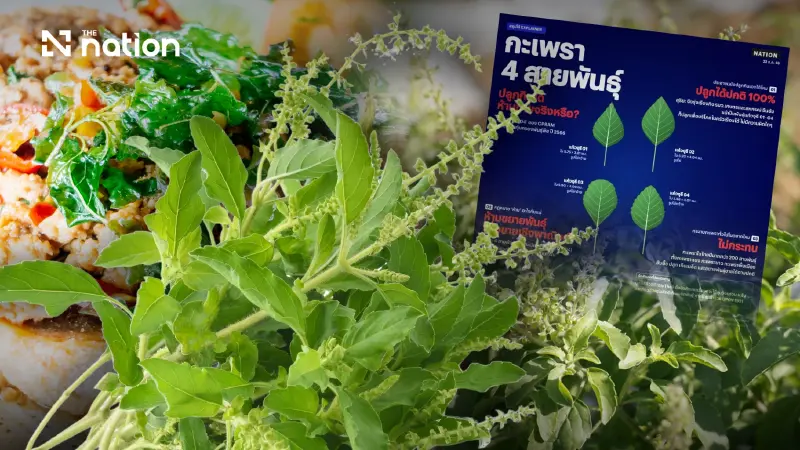


Agriculture Ministry launches a one-week inquiry into CPRAM's holy basil patent while reassuring the public that native strains remain protected
- Thailand's Ministry of Agriculture has launched a one-week investigation into CPRAM Co., Ltd.'s registration of four hybrid holy basil strains following public and farmer concerns.
- The government has assured farmers that their rights to grow and trade traditional holy basil are "untouchable," as the probe addresses fears of a potential corporate monopoly.
- Officials stated that native holy basil varieties are protected by a national DNA database, which prevents existing strains from being registered by private entities.
- CPRAM's registered strains are distinct hybrids used exclusively for industrial food production within a closed contract-farming system and are not sold on the open market, leaving traditional varieties unaffected.
The Agriculture Ministry launches a one-week inquiry into CPRAM's holy basil patent while reassuring the public that native strains remain protected.
The Thai Ministry of Agriculture and Cooperatives has intervened in the ongoing intellectual property debate surrounding holy basil (krapao), ordering a formal one-week inquiry into CPRAM Co., Ltd.’s registration of four hybrid plant strains.
Agriculture Minister Suriya Juangroongruangkit addressed public anxieties on Friday, acknowledging widespread concerns among farming communities and market vendors that corporate entities might monopolise the nation's staple herb.
"We understand the public's concern, as holy basil is deeply tied to the daily livelihoods of Thai farmers," Suriya stated. "The government will safeguard the legal rights of agricultural workers. I have instructed the Department of Agriculture to investigate the private company's registration filing to verify full compliance with the law and report findings as quickly as possible."
The controversy stems from CPRAM’s registration of four specialised varieties—named Kaew Juree 01, 02, 03, and 04—under the Plant Variety Protection Act B.E. 2542 (1999).
Civil society networks and local growers previously expressed fears that the intellectual property protections could criminalise seed-saving or restrict the open-market trade of traditional basil.
Suriya noted that while the company maintains the strains were independently researched for ready-to-eat industrial processing, authorities must verify technical details, including whether the registered variants overlap with indigenous cultivars already catalogued in official research databases.

DNA Database Safeguards Native Varieties
Reassuring the public, senior agricultural officials confirmed that existing native holy basil strains are entirely secure from corporate acquisition.
Sasiya Pantun, deputy director-general of the Department of Agriculture, explained that plant variety registration involves rigorous scientific testing. Applicants must prove distinct genetic differentiation from existing cultivars before approval is granted.
"We can firmly guarantee that native holy basil cannot be registered to overwrite existing rights," Sasiya said. "The Department maintains a comprehensive genetic DNA database and documented phenotypic records of all traditional native strains. Any application attempting to register an identical pre-existing variety would be rejected outright."
According to the Department, only five holy basil varieties are currently protected under the 1999 Act: four held by CPRAM and one registered by Kasetsart University.
Officials clarified that CPRAM’s four proprietary strains are cultivated exclusively within restricted contract-farming networks designed to supply raw materials for industrial food manufacturing, such as packaged stir-fried meals and dried ingredients.
The seeds are not distributed commercially on the open retail market.
Because these commercial hybrids feature distinct physical characteristics—such as larger, coarser leaves in both red and white variants—local vendors and consumers remain entirely unaffected, retaining the unfettered right to grow, buy, and trade traditional varieties.

Legal Protections Incentivise Innovation
Kris Uttamavetin, deputy permanent secretary and ministry spokesperson, emphasised that intellectual property frameworks in agriculture function similarly to pharmaceutical patents, designed to reward long-term research and development.
"Plant variety protection provides incentives for new breeding innovations, equally accessible to smallholder farmers, independent researchers, and private corporations," Kris explained. "Once the statutory protection period expires, those strains transition directly into the public domain for universal use."
The Ministry stressed that statutory requirements mandate a public notice and objection period for all plant patent applications, functioning similarly to public hearings.
Authorities urged citizens and agricultural workers to remain calm, reiterating that public goods and native genetic resources cannot be legally monopolised into private ownership.
