
Conservatives return: from the 2005 protests to the 2025 street revival
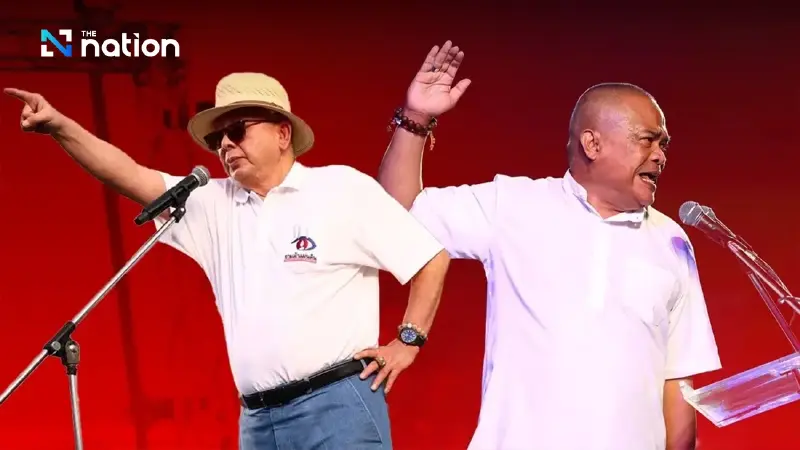


Twenty years on, Sondhi returns to the protest stage to oust Thaksin’s daughter, while Jatuporn shifts from progressive red-shirt to conservative crusader.
It feels like history repeating itself. In 2005, Thaksin Shinawatra’s controversial 73-billion-baht share sale triggered mass protests that shook the nation. Two decades later, his daughter, Prime Minister Paetongtarn Shinawatra, finds herself at the centre of a storm, as a leaked audio clip involving her and former Cambodian Prime Minister Hun Sen ignites nationalist outrage and brings the protest movement back to life.
Following the 2023 general election, where the progressive Move Forward Party stunned the establishment with its meteoric rise, conservative elites swiftly orchestrated a cross-party coalition to block its path to power.
The manoeuvre handed the premiership to Pheu Thai and Paetongtarn, but at a political cost.
Over the past two years, sporadic anti-Shinawatra protests failed to gain momentum, prompting claims that the conservative street movement was dead. But the Thai-Cambodian border conflict, coupled with the leaked recording in which Paetongtarn appears to adopt a conciliatory tone towards Phnom Penh—reportedly undermining the dignity of the Thai military—has revived nationalist sentiment and cast fresh doubt on her political maturity.
On Saturday, June 28, 2025, a mass protest under the banner “Uniting the Power of the Land for the Defence of Thai Sovereignty” was held at Bangkok’s Victory Monument, drawing a far larger crowd than seen in recent years.


The protest was organised by a core group of 40 seasoned activists—veterans of Thailand’s most turbulent political chapters, having taken part in major protests during 2005–2006, 2009–2010, and 2013–2014. They once wore yellow shirts, red shirts, and blew whistles to oust governments. Some had once been on opposite sides of the political divide—now they stand united in opposition to Paetongtarn.

The highlight of the day was a symbolic moment: former People's Alliance for Democracy leader Sondhi Limthongkul sharing the stage with Jatuporn Prompan, ex-leader of the United Front for Democracy Against Dictatorship. Both addressed the crowd, despite their historic differences.
Sondhi, now an advisor to The Thailand Watch Foundation, delivered a stinging rebuke: “If we forget history, we are doomed to repeat it. Twenty years ago, I stood on a stage calling for Thaksin to step down. Now, two decades later, I’m forced to call for his daughter’s resignation. This is not the last protest. If change must come from the streets again, then so be it.”
Jatuporn, the final speaker of the day, raised the stakes. He hinted at a possible return to the streets if the Constitutional Court orders Paetongtarn to cease duties and she refuses to step aside. “If the Court suspends her and she still clings to power, we will no longer demand her resignation. We will demand her removal—nothing less. The captain, the crew, and the ship itself must all go.”
As the “Uniting the Power of the Land” group regains momentum on the streets, political observers are watching closely to see what name or platform will emerge as the new flagship of the conservative movement now mobilising against Paetongtarn’s government.

In what now seems like a fateful coincidence, on Sunday, May 25, 2025, Sondhi hosted the second edition of his “There is Only One Truth” forum at Thammasat University.
That day, he invited former red-shirt leader Jatuporn to launch a campaign under the Thailand Watch Foundation, aiming to gather one million Thai citizens over three years to demand justice and national integrity.
The initiative was formally hosted by the Thailand Watch Foundation, chaired by Panthep Puapongpan. Joining him on stage were Jatuporn and activist-lawyer Nitithorn Lamlua.
Shortly after the event, tensions erupted on the Thai-Cambodian border at Chong Bok, followed by the now-notorious leaked audio clip of a conversation between Paetongtarn and Hun Sen.
The surge in nationalist sentiment that followed brought Sondhi, Panthep, Jatuporn, and Nitithorn together again—this time to launch the “Uniting the Power of the Land” mass rally, signalling the first major conservative mobilisation in a decade, since the PDRC protests of 2014.

Lessons from the 2006 protests
The rise of the People's Alliance for Democracy (PAD), better known as the Yellow Shirts, can be traced back to Sondhi’s solo campaign against then-Prime Minister Thaksin. It began in September 2005, with his travelling talk show “Thailand Weekly” becoming a platform for rallying public opposition.
Public anger intensified after the Shinawatra family sold its stake in Shin Corporation for more than 73 billion baht in a tax-free stock market deal. The move sparked widespread outrage and fuelled the perception that Thaksin was abusing state power for personal gain.
On February 4, 2006, Sondhi staged a large rally under the banner of “Saving the Nation” at the Royal Plaza, followed by a symbolic march to submit a royal petition calling for the return of sovereign powers to the monarchy.
Soon after, various NGOs and civil society activists joined forces with Sondhi, and the movement formally evolved into the People's Alliance for Democracy (PAD).
The campaign escalated quickly, with PAD rejecting the legitimacy of the electoral process. The opposition parties joined in by boycotting the general election, aligning themselves with judicial activism, which culminated in the Constitutional Court invalidating the April 2, 2006, election results.
This convergence of street protests, legal manoeuvres, and elite resistance created a political deadlock that rendered Thailand’s democratic system inoperable.
Ultimately, the impasse was broken by the military. On September 19, 2006, the armed forces staged a coup d’état.
From Thaksin’s Red Shirts to the conservative front
The turning point in the relationship between Thaksin and Jatuporn appears to have come during the Chiang Mai provincial administrative election in late 2020. Jatuporn, once the prominent chairman of the United Front for Democracy Against Dictatorship (UDD), broke ranks by campaigning for a candidate opposing Pheu Thai—the party long seen as Thaksin’s political vehicle.
Following that break, Jatuporn began reconnecting with former allies from the May 1992 street protests, many of whom had drifted into the conservative fold.
In 2022, Jatuporn crossed paths with Nitithorn, former leader of the anti-Yingluck People’s Democratic Reform Committee (PDRC). Together, they founded a new movement called the People's Unification Committee and staged protests under the banner "Stop Prayut at 8 Years," culminating in a march to the Government House.
Both Nitithorn and Jatuporn publicly accused Prime Minister Prayut Chan-o-cha of fuelling division between the monarchy and the public. They claimed that if he could not protect the institution, he had no legitimacy to remain in office.
This marked Jatuporn’s transition from red-shirt leader to conservative activist, echoing the ideological trajectory of Nitithorn.
By 2024, Nitithorn and Jatuporn had fielded close allies—Pichit Chaimongkol and Nasser Yeema—under the banner of the Network of Students and People for Reform of Thailand (NSPRT), in collaboration with the Dhamma Army. The group launched the “Save the Justice System” protest, highlighting the fact that Thaksin had never spent a night in prison despite his conviction. The rally began in February near the Chamai Maruchet Bridge next to Government House.
To this day, the NSPRT and the Dhamma Army continue their protest calling for Paetongtarn Shinawatra’s resignation. However, their rallies have drawn limited public support, prompting critics to declare that the hardline yellow-shirt conservatism of old has lost its momentum.
That’s what made the “Uniting the Power of the Land” rally at Victory Monument so significant—it marked the symbolic return of the conservative street movement. How far it will go from here depends largely on two factors: the intensity of public dissatisfaction with the Shinawatra family and the mass-mobilisation strategy driven by veterans like Sondhi and Jatuporn.
