
Cabinet finalises multi-billion-baht weapons procurement
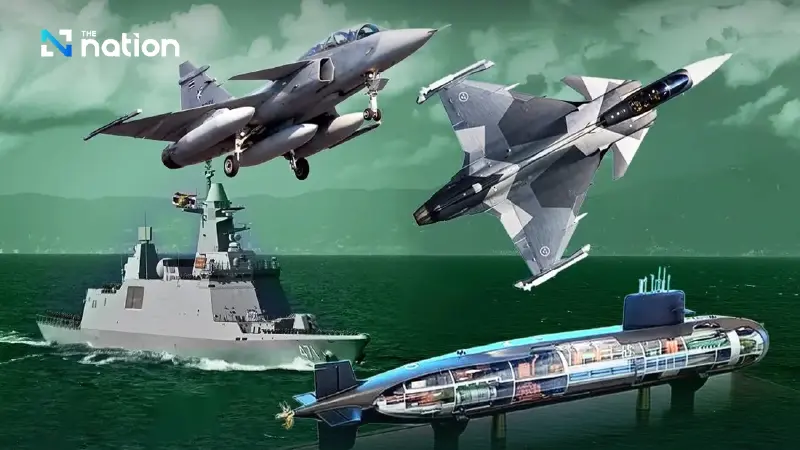


The Cabinet meeting chaired by Deputy Prime Minister and Minister of the Interior Phumtham Wechayachai, acting as the Prime Minister, on August 5, reviewed and approved several important military projects, including both new and ongoing initiatives.
Air Force's Gripen E/F Jet Procurement
The Royal Thai Air Force (RTAF) received approval for the procurement of four Gripen E/F fighter jets, Phase 1, worth THB19.5 billion. The project, which spans five years (2025-2030), will replace the ageing fleet of F-16 jets, which have been in service for over 37 years. The Cabinet has assigned Air Chief Marshal Punpakdee Pattanakul, the RTAF Commander, to sign the contract with Sweden's SABB Company, with Sweden’s Defence Minister serving as a witness on August 25, 2025.
This purchase includes three single-seat Gripen E jets and one two-seat Gripen F jet, along with supporting systems and electronic warfare capabilities. The aircraft will be equipped with advanced air-to-air Meteor missiles and other armaments, as well as ground support systems and spare parts. The procurement is part of the RTAF’s strategy to strengthen the nation’s defence capabilities and sovereignty, as outlined in the White Paper, and replace the F-16 fleet.
The project is planned in three phases over 10 years, with a total of 12 aircraft costing an estimated THB60 billion. The Air Force will continue using its F-16 jets for approximately another 10 years while the new Gripens are being phased in.

"I am preparing to travel to sign the agreement with SABB, along with the head of the military procurement division. Sweden's Defence Minister will attend the signing ceremony as a witness. The ceremony is scheduled for August 25 in Sweden. Everything is proceeding according to the established guidelines, and the Air Force has fully prepared the contract. All procedures are being followed by the United Nations’ international standards and within the appropriate timeframe. There is nothing to be concerned about, and the government fully understands the importance of national security," said Punpakdee.

Naval Approvals: Frigates and Submarine Projects
The Cabinet also approved the procurement of two frigates for the Royal Thai Navy (RTN), with a budget of THB35 billion. For the fiscal year 2026, one frigate will be purchased for THB17.5 billion. This is part of the RTN’s strategic plan to have a total of eight frigates operating by 2037, to strengthen maritime security in both the Gulf of Thailand and the Andaman Sea.
Currently, the RTN operates four frigates, including HMTS Phumipol, HMTS Taksin, HMTS Naresuan, and HMTS Rattanakosin. A committee will soon be set up to select a frigate design, with five international companies from the Netherlands, South Korea, Germany, Spain, and Italy in the running. Once a decision is made, the design will be presented to the Cabinet for approval.

Additionally, the Cabinet approved amendments to the contract for the procurement of S26T submarines, changing the engine specifications to the Chinese-made CHD 620 model. The delivery schedule has been extended, with the first submarine expected in 2030, a delay of several years from the original plan. This decision follows challenges related to the originally specified MTU 396 German engines, which were unavailable, causing a significant delay in the project.
The contract for the submarines was initially signed with the China Shipbuilding & Offshore International Co., Ltd. (CSOC) in 2017, with the first submarine originally expected to be delivered in 2023. Despite these setbacks, the project is now 64% complete, with THB7.7 billion of the total THB13.2 billion already paid.
Since 2021, Thailand and China have engaged in negotiations to resolve the issue by switching to the Chinese-made CHD 620 engine. This decision followed performance tests and a review of the operational results of Pakistani submarines, which were also equipped with the Chinese engine, leading to increased confidence in its reliability.
Geopolitical Factors and the Regional Security Environment
The decision to continue with the submarine project was influenced by geopolitical considerations, particularly China’s growing influence in Southeast Asia. Previously, the Chinese Ambassador to Thailand had inquired multiple times about the progress of the submarine project, which may have influenced the government’s decision to proceed.
Furthermore, reports from the Thai-Cambodian border conflict in late August 2025 highlighted the detection of Cambodian missile movements. However, no missile fire occurred, as China reportedly ordered a halt to such actions.
China has reiterated to the Thai military attaché in Beijing that it has never provided any military equipment to the Cambodian army for use against Thailand. The Chinese military equipment currently in Cambodia is a result of past cooperation. This statement serves as confirmation that China has not permitted Cambodia to use the PHL03 missile to attack Thailand.
In light of these ongoing tensions, the Thai government has ensured that the procurement of military equipment, including these submarines, aligns with the country’s strategic interests in maintaining a balanced geopolitical stance amidst regional power dynamics. The continued military preparedness is considered crucial for safeguarding Thailand's sovereignty and ensuring national security.
These military procurement projects, while addressing immediate defence needs, also consider the broader geopolitical and security context in Southeast Asia. The continued investments in military technology highlight the country's strategy to sustain a strong defence posture amid evolving regional dynamics and international relations.
