
The return home of Sudthisak Rinthalak and the bridge between our peoples
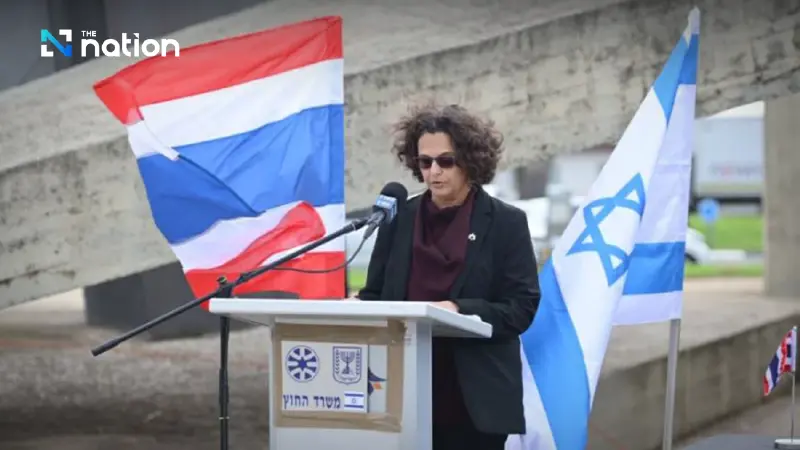


Israeli Ambassador Alona Fisher-Kamm reflects on the return of Sudthisak Rinthalak’s body on December 10, 2025, and calls for remembrance and solidarity against terror.
The return of Sudthisak Rinthalak’s body on December 10, 2025 — the last Thai civilian taken hostage by the terrorist group Hamas on October 7, 2023 — has brought a long cycle of pain to a close. But it cannot close the wound in our hearts. His return is not only a moment of relief, but also a moment of remembrance. It compels us to look once more at the cost of the massacre Hamas carried out on that dark day.
Forty-seven Thais were killed during the Hamas attack on October 7, and another 28 were taken to Gaza and later released. Many more suffered physical and psychological harm from acts of brutality that were indiscriminate — with no exception made for nationality, religion or belief.
Every Thai victim was like tens of thousands of Thai workers who came to Israel to support their families and build a secure future. The Israeli government has taken full responsibility for the future of every Thai victim’s family. This is not only a duty; it is a profound moral commitment.

What happened on October 7 was not battlefield combat, but a massacre. Hamas terrorists crossed into Israel with the clear intention of killing civilians. They set homes on fire, killed families, targeted the vulnerable, committed sexual violence, and abducted innocent people — men and women alike. Thai workers who had come to Israel to work honestly and support their families were targeted simply because they were there. This is the true face of evil — the essence of an ideology of hatred that has no political purpose or rationale, only destruction and fear.
The war that followed did not emerge in a vacuum. It began with Hamas launching an unprecedented attack on Israeli civilians. Any responsible government must defend its people after such an attack. Israel entered the war with two clear and legitimate objectives: to ensure Hamas can no longer pose a military or terrorist threat to Israel, and to bring all hostages — Israeli and foreign nationals — home safely.
Most of the 258 hostages have now been returned. One Israeli hostage, Ran Gvili, remains in captivity. As long as even one innocent person is still being held underground, Israel’s mission is not complete. When he returns, we hope to move forward with the next stage of arrangements in Gaza — and towards a reality in which Hamas can no longer threaten Israel, neighbouring countries, or even its own people.
Israel does not seek war. Israel seeks peace — but it must be genuine, lasting and secure. A peace that allows families torn apart to return home safely. A peace that does not leave terrorists in power, free to rearm and prepare the next massacre. Israel’s painful history has taught us that peace without security is an illusion.
The return of Sudthisak’s body reminds us that terrorism has no borders. It also reminds us that the victims of October 7 were not only Israelis, but also Thai workers, international students, tourists and families from many countries. Remembering them is a moral duty — not a political act.

Since October 7, it has become clear that more Thai citizens are interested in coming to work in Israel. At present, more than 40,000 Thais live and work in Israel. They can be seen everywhere and have become an important part of Israeli society. They are part of daily life and part of us — and this is how we honour them, both in life and in death.
At the same time, more than 400,000 Israelis travel to Thailand every year. They have long been familiar with, and deeply connected to, Thailand. Israelis come to travel, to learn, and to build profound personal ties with Thai society. These two communities are not small groups; they are living symbols of trust, cooperation and mutual respect. Together, they have built a bridge of understanding, solidarity and cultural bonds. Although separated by more than 11 hours of flight time, they are deeply close at heart.
Israel and Thailand have shared a close relationship for a long time, grounded in the goodwill between their peoples. As we unite to remember Thai victims of terrorism, we reaffirm that bond. We have stood together against terrorism, and we remain committed to a shared understanding that bridges between peoples should not be built on sorrowful experiences, but on love, mutual respect, and shared interests and values.
