
'Grey Capital - Scam': The High-Risk Game of Anutin's Government
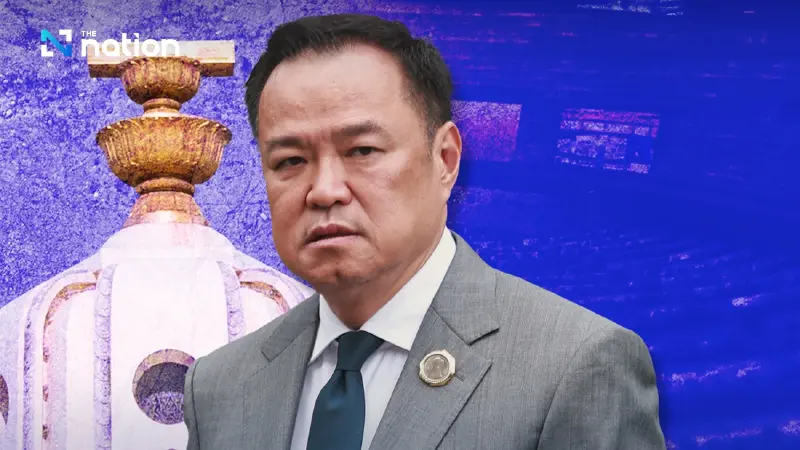


The opposition is preparing to file a no-confidence debate against Anutin's government, focusing on its handling of grey capital and scammer issues. The pressure on the government is mounting due to concerns over its ability to tackle transnational crime and accusations linking politicians to the grey business sector.
Over a month has passed since Prime Minister Anutin Charnvirakul assumed office, taking charge of the government with the condition of dissolving the House of Representatives within four months, as promised to the "People's Party."
During his policy statement to the parliament, Anutin set a timeline for the dissolution of the House on January 31, 2025, followed by elections to be held within 45-60 days.
In the meantime, the government will push for constitutional amendments, currently under review by the committee, and plans to hold a referendum alongside the election.
The main risk facing the "minority government" is its lack of political stability. Although the amendment of the constitution was made a condition to prevent the "People's Party" from overthrowing the government within four months.
However, the "Pheu Thai Party" has a different plan from the "People's Party." They have scheduled a no-confidence debate against the "Anutin government" immediately after the parliamentary session opens on December 12, sensing that the constitutional amendment is nothing more than a facade. The amendment will likely be rejected by the Senate.
Additionally, the Pheu Thai Party knows it cannot allow the Bhumjaithai Party to remain in power for too long, recognising the influence of "Newin Chidchob," who can establish a powerful network of control across the administration, local government, and police, key factors that can determine the outcome of an election.
At the same time, "Newin and Anutin" have assessed that, if under heavy pressure, the "dissolution card" might be played sooner than expected to maintain their popularity at a level that could still be competitive in the 2026 election.
This is due to the People's Party shifting its strategy of "With Us, No Grey", while targeting the "Klatham" Party and Deputy Prime Minister Thammanat Prompao, who is also the Minister of Agriculture and Cooperatives. Anutin cannot avoid responsibility in the matter either.
The main focus is on the growing issue of “scammers” that are threatening the public’s confidence in Anutin. Despite his active efforts, the results may not be as satisfying to the people as hoped.
Anutin seems to have only one option left: avoid the high-risk game in parliament through the no-confidence debate. The meeting between Anutin and Thammanat has raised questions about the continued strong bond between the Bhumjaithai Party and the Klatham Party, which is now inseparable. It seems they must carry on together for now.
If major powers do not apply pressure to Cambodia, such as the United States seizing cryptocurrency linked to Chen Zhi, a key advisor to Cambodia’s Prime Minister and founder of the $15 billion Prince Group, or the UK seizing assets, particularly real estate in London, or South Korea pressuring Cambodia by assisting in the rescue of people from the country and investigating companies linked to Prince Group, it will awaken Thai citizens who want to see the “gray business network” supporting the Cambodian leadership family dismantled.
However, looking at the Thai government, it seems they are still unable to satisfy the people’s expectations.
What is even more concerning is that there are still Thai nationals stranded in Cambodia, both victims who were tricked into becoming scammers and those who voluntarily joined. Can the Thai government assist in bringing them back, as South Korea did?
Meanwhile, there have been reports of Thai deaths from falls, but no proactive measures have been discussed.
One of the four conditions for the Thai-Cambodian peace agreement is to crack down on scammers, which is likely the most difficult. Telling Cambodia to resolve the issue seems overly simplistic, as the ruling family is unlikely to easily cut off a vital source of income for themselves.
Regarding the Army’s planned release of 18 prisoners on November 12, even though the four conditions for peace have not yet been met tangibly, the tone from the government has shifted from firm to surprisingly lenient.
The first meeting of the Committee on Technology Crime Prevention and Suppression, held on October 20, 2025, was chaired by Anutin. During the meeting, three subcommittees were established, with key roles assigned: Pol Lt Gen Ruttapol Naowarat, Minister of Justice, overseeing suppression and money laundering cases; Chaichanok Chidchob, Minister of Digital Economy and Society, defining preventive measures; Pol Gen Trairong Phiwpan, Deputy National Police Chief, handling public relations; and Ekniti Nitithanprapas, Deputy Prime Minister and Minister of Finance, assigned to investigate financial trails.
Following this first anti-scam meeting, actions included blocking Cambodian networks, the Anti-Money Laundering Office (AMLO) seizing 70 million baht in assets from Cambodian Senator Li Yongphat, a close associate of Prime Minister Hun Sen, in Thailand, and revoking Thai nationality.
Additionally, the assets of "Kok An" were seized, amounting to over a billion baht, and arrest warrants were issued even before Anutin became Prime Minister. Once Anutin took office, discussions emerged about revoking the nationality of others in the family.
A meeting between Anutin and the US Ambassador Robert F. Godec resulted in an agreement to exchange information and lists of individuals involved in scams in early November. It remains to be seen whether the list from the US will include Thai nationals, particularly politicians or individuals close to the government.
At the ASEAN Summit, Anutin announced Thailand's proposal to host anti-scam cooperation with China, Japan, and South Korea. However, there has been no progress so far. Meanwhile, the Ministry of Justice has been pressured to act, especially after news broke of seven politicians being involved in the scandal, prompting the government to initiate further investigations into the financial trails of these politicians, particularly a politician whose name started with the letter "Ch."
On the police side, Pol Lt Gen Jiraphop Phuridej, Assistant Commissioner-General of the Royal Thai Police, was assigned as head of the committee to sign a cooperation plan for preventing and combating transnational cybercrime, human trafficking, and scams, in collaboration with the Cambodian National Police, to define an action plan.
Jiraphop also proposed sending Thai police to Cambodia to observe anti-scam operations, but Anutin hesitated to fully endorse this, directing the question to the Commissioner-General, stating that the government’s policy is clear and he cannot overstep anyone’s authority.
Recently, the government signed an MOU with 15 agencies to declare war on scammers and initiate proactive operations across five areas. However, this seems like the work of the involved agencies already. As is typical in Thai style, major announcements and fanfare precede actual action.
Despite these efforts, Anutin's moves have yet to create enough impact, as public attention remains focused on Thammanat, especially after revelations about “Politician Ch.” being linked to the "Klatham Party."
There’s also lingering public concern over the case of Vorapak Tanyawong, the former Deputy Finance Minister, whose name has been linked to the BIC Group, a Cambodian business group. Anutin had him sign a resignation letter to quell the negative publicity surrounding the government.
Additionally, the ongoing feud between Thammanat and the "Klatham Party" against the "People’s Party" continues to spark controversies, such as the lottery quota issue and the Ministry of Agriculture’s project budgets being divided into smaller sums of 500,000 baht. These scandals have dragged the "Anutin government" into negative public sentiment, contrasting sharply with the honeymoon period when their popularity was at its peak.
Recently, Anutin responded to questions about a potential no-confidence debate from the opposition, saying, “What’s the purpose of the no-confidence debate? If it’s just to settle scores, then when the parliament opens in December, I will be ready to dissolve the House on January 31, 2025. I won’t let anyone criticise the government for free. If it becomes a political game that the government can’t handle, I’ll dissolve the House. A month won’t make much of a difference. So, we shouldn’t get too excited about these things.”
This marks the first signal from Anutin indicating a possible dissolution of the House, prompting political observers to anticipate that the Bhumjaithai will be preparing an exit strategy in case the opposition decides to file a no-confidence motion.
From now until December 12, when the parliamentary session opens, it will be crucial to see how Anutin manages the situation and scores points in his final efforts. The dissolution of the House will have only one deadline: before December 12. If the opposition files a no-confidence motion, the power to dissolve the House will be lost immediately. By that time, the "Anutin government" will likely face a thorough dissection in the House, an outcome that seems inevitable.
