
Songkhla resident criticises Anutin for slow response to flood crisis
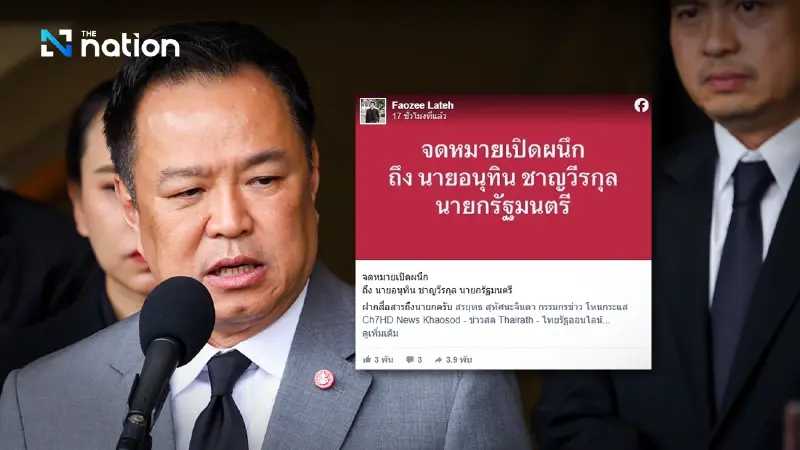


A Songkhla resident criticises Prime Minister Anutin for focusing on photo opportunities instead of implementing urgent evacuation measures amid the ongoing flood crisis in the South.
A Songkhla resident, who is an officer with Amnesty International Thailand, has criticized Prime Minister Anutin Charnvirakul for wasting crucial time on photo opportunities instead of ordering the evacuation of flood victims in the South.
The criticism was voiced in an open letter posted by Faozee Lateh on his Facebook page at 7:22 pm, addressed directly to PM Anutin.
In the letter, Lateh pointed out that as floodwaters continue to rise across several southern provinces, many areas are submerged, leaving thousands of residents trapped in their homes without access to essential services like electricity, water, or communication. Lateh accused Anutin of failing to take decisive action, saying that local authorities, overwhelmed by the scale of the crisis, have been left to handle the emergency alone with little support from the central government.
He emphasized that as Prime Minister, Anutin has the duty and authority to implement systematic emergency operations, but instead, the public has only seen him visit Hat Yai for photo opportunities, without any concrete measures to assist those affected by the floods.
Full translation of the original statement below.
"Currently, the flood situation in several provinces of the South is at a critical point. A large number of people are still trapped inside their homes, with floodwaters rising rapidly. Meanwhile, electricity, water, and phone signals have been completely cut off in many areas. Many people are left in the dark, in fear, and in uncertainty, without any means to request help. The situation is so severe that we cannot afford to waste even a single minute. Yet, until now, we have not seen clear, strong, or actionable measures from the central government as we should.
"Although Thailand has a local disaster management structure, the reality is that many areas are facing situations far beyond the capability of local leaders. Allowing local authorities to handle everything on their own, especially when the power is out, floodwaters are high, all roads are cut off, and communication is down, is unfairly forcing the public to face their fate alone. It is an inevitable failure of the state.
"As Prime Minister, you have the direct responsibility and authority to order systematic, rapid, and effective emergency measures. However, what the public is seeing now is only photo-ops, photo shoots, and flood inspections that do nothing to save the lives of people waiting for help on rooftops, in schools, and in countless other isolated areas. At this moment, no one wants a publicity campaign; they want action. They need real emergency evacuation measures, and they need them now—not after a press conference or endless meetings.
"The government urgently needs to announce a clear evacuation plan. Routes, assembly points, and accessible safe areas must be defined immediately, with boats, rescue vehicles, helicopters, and medical teams deployed to every cut-off area without waiting for requests. The sick, elderly, children, and disabled must be evacuated systematically, not left waiting as floodwaters rise to their rooftops, as is happening in many areas right now.
"Most importantly, the government must stop leaving citizens to "guess" which areas are safe. A centralized real-time information system must be created, providing updates on rising water levels, flooded roads, power and water status, accessible evacuation routes, and disaster relief points. This information must be continuously updated and broadcast through all channels, including online media and local radio, so that everyone can make timely decisions and avoid costly mistakes that could cost lives.
"Thailand must have an operational disaster management center. Centralized command from the government is needed to ensure all agencies work as one. We cannot afford separate efforts and delays that will lead to the tragic events unfolding before us now.
"The public is caught between life and death, and what they are receiving in return is silence, delay, and being left to handle it all alone by local authorities—while this crisis is one no one should have to face alone anymore.
"In the end, we have a government to manage the country, including disasters. It is not meant to offload the responsibility to volunteers."
