
“Wayo” and People’s Party legal team sue nine EC officials on three charges
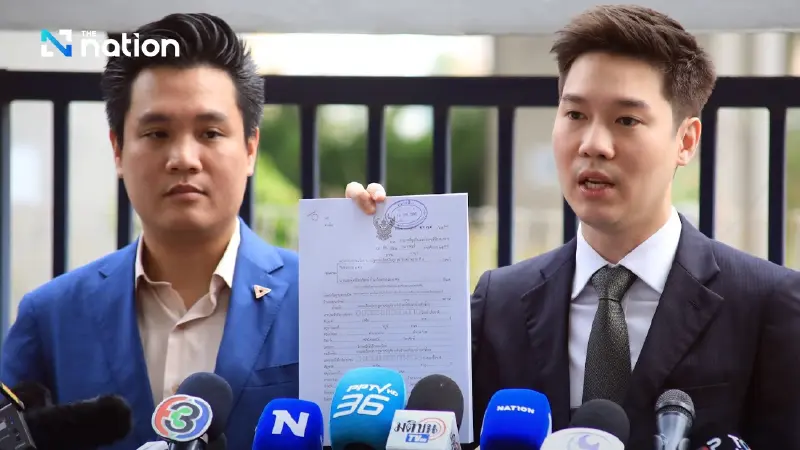


Wayo Assawarungruang files suit against nine EC officials over 2026 poll, citing three charges and invoking 2006 Supreme Court precedent
Wayo Assawarungruang , deputy leader of the People’s Party, accompanied by the party’s legal team, filed a lawsuit on Thursday morning at the Central Criminal Court for Corruption and Misconduct Cases against nine election officials over the management of the 2026 election.
Wayo, together with Nithi La-iatdee, the People’s Party’s lawyer, lodged a complaint against the seven Election Commission (EC) commissioners, as well as Sawaeng Boonmee, the EC secretary-general, and Worawong Anancharoenkit, director of the Election Support Bureau — a total of nine defendants.

Wayo said the lawsuit alleges offences under Section 157 (malfeasance by an official), the Organic Act on the Election of MPs, Section 69, and the Organic Act on MPs, Section 96 in conjunction with Section 164. He said the court has already assigned a case number, and the complaint runs to 24 pages, excluding attachments. The court has scheduled a hearing on March 24, 2026 to decide whether to accept the case for trial.
If the court accepts the complaint — or orders amendments — it will proceed to a preliminary inquiry into the merits. Wayo said he believed the process would remain within 45–60 days.
He said there were many facts indicating wrongdoing, and cited a precedent case involving Pol Gen Wasana Phoemlap, who was found to have given benefits to associates in the 2006 election. He said the Supreme Court’s ruling in that case was handed down in 2015, and the legal team had studied it in detail and applied its approach to the current case.
He said the court in that case punished offences under the Organic Act on the Election Commission, Section 24 in conjunction with Section 42, which he said was comparable to Section 69 of the Organic Act on the Election Commission that they are invoking in this lawsuit.
Wayo said some legal experts might be concerned about Section 157, which requires proof of a specific intent beyond general intent. He said that because the plaintiffs are filing the case themselves — not a public prosecutor — they must prove the hidden “special intent” causing harm to a particular person, and he acknowledged this was not easy.
For that reason, he said, the lawsuit is not based on Section 157 alone, but includes other provisions. He said the law clearly provides that if the defendants are commissioners, the secretary-general, and a bureau director involved in election administration, then Section 69 of the Organic Act on the Election Commission could support criminal liability as an additional layer. He said it remained to be seen how the preliminary inquiry would proceed, and believed the case would be a long fight.
Asked whether earlier lawsuits filed by other parties against the EC could make this a duplicate case, Wayo said the decision to consolidate cases was at the court’s discretion, but it was not duplicate litigation because the plaintiffs are different people.
Wayo also outlined the plaintiffs and the alleged conduct. He said the plaintiffs are:
Plaintiff 1:Natthaphong Ruengpanyawut, as party leader representing the legal entity of the People’s Party
Plaintiff 2: Natthaphong Ruengpanyawut, as party leader and as an eligible voter
Plaintiff 3: Wayo, as deputy leader of the People’s Party and as an eligible voter
Plaintiff 4: Parit Wacharasindhu, as People’s Party spokesman and as an eligible voter
He said that, based on the 2006-case precedent, the Supreme Court had set out guidance that when an election is not honest and fair, and the conduct affects citizens’ rights on a wide scale, all eligible voters are deemed “injured parties” as a matter of law.
He said the harm claimed by Plaintiffs 2–4 includes a violation of privacy rights protected by the Constitution, because elections must be direct and secret, and this is also set out in several laws.
As for the party as a legal entity, he said it also suffered economic damage, because political parties are established under the Organic Act on Political Parties to field candidates, present policies to the public, and contest elections — all of which involve expenses and the use of significant personnel — and an election that is not honest and fair causes damage.
Wayo insisted the People’s Party had not acted late, but said the case was difficult and new facts were emerging almost daily. He said he had originally waited for developments on February 22 regarding new ballot papers — including what they looked like — and then used those facts to draft the entire complaint. He said the complaint seeks separate penalties and does not treat the matter as a single act.
He added that the EC’s certification of constituency MPs, which took only 17 days after the election and three days after a recount, appeared rushed, as if to quickly discharge its responsibilities. He said this point was added to the complaint.
On the EC’s earlier complaint to the Crime Suppression Division against the civic sector, Wayo said he planned to amend the complaint to add this issue within 15 days, or within the time allowed by the court, if additional necessary and highly important facts emerged. He argued that the EC chose to file a police complaint against citizens, yet did not set up its own committee to investigate the matter under its authority — which, he said, showed selective enforcement. He said this would align with the fact pattern and approach in the 2006 precedent ruling, and he described the EC’s complaint as a SLAPP (a lawsuit intended to silence criticism).
He acknowledged it was currently very difficult for the civic sector to take action against, or remove, an independent agency. He said Parit had drafted amendments to an organic law linked to constitutional change, and when parliament opens, the People’s Party would submit them immediately. He said the party did not seek to rewrite the entire constitution, but to amend individual sections that could be changed.
Wayo said the legal team had prepared a witness list and identified potential witnesses, including several legal experts who appear frequently in the media such as Wissanu Krea-ngam, as well as all three companies that printed the ballot papers. They also plan to seek the two contracts, the TOR, ballot stubs and draft materials, to determine at which draft stage barcodes and QR codes appeared, as well as minutes of EC meetings, to support the evidence in the case.
