
Opposition asks House Speaker to send 400bn-baht loan decree to Constitutional Court



Opposition MPs have asked House Speaker Sophon Saram to forward a petition to the Constitutional Court challenging the government’s 400-billion-baht borrowing decree, targeting a 200-billion-baht energy restructuring plan they say lacks urgent necessity.
Opposition parties have asked House Speaker Sophon Saram to forward a petition to the Constitutional Court seeking a ruling on whether the government’s 400-billion-baht borrowing Emergency Decree violates Section 172 of the Constitution.
The move targets the 200-billion-baht portion of the decree earmarked for energy restructuring, which the opposition says lacks urgent necessity, while insisting that the 200-billion-baht portion intended for public relief should not be blocked.
People’s Party leader Natthaphong Ruengpanyawut, People’s Party deputy leader Sirikanya Tansakun and Democrat Party deputy leader Korn Chatikavanij submitted the petition to Sophon at Parliament on Monday, asking him to send the matter to the Constitutional Court under the procedure allowed by Section 173 of the Constitution.


Opposition targets energy restructuring fund
Natthaphong said the opposition was exercising its constitutional right to seek a ruling on whether the borrowing decree complies with the charter.
He accused the government of “inserting” 200 billion baht for energy restructuring into the decree, arguing that the measure is not directly related to economic security and does not meet the test of urgent necessity.
He said the opposition was not trying to block relief for the public, but wanted the court to examine whether the energy restructuring portion should have been handled through the normal annual budget process instead of an Emergency Decree.
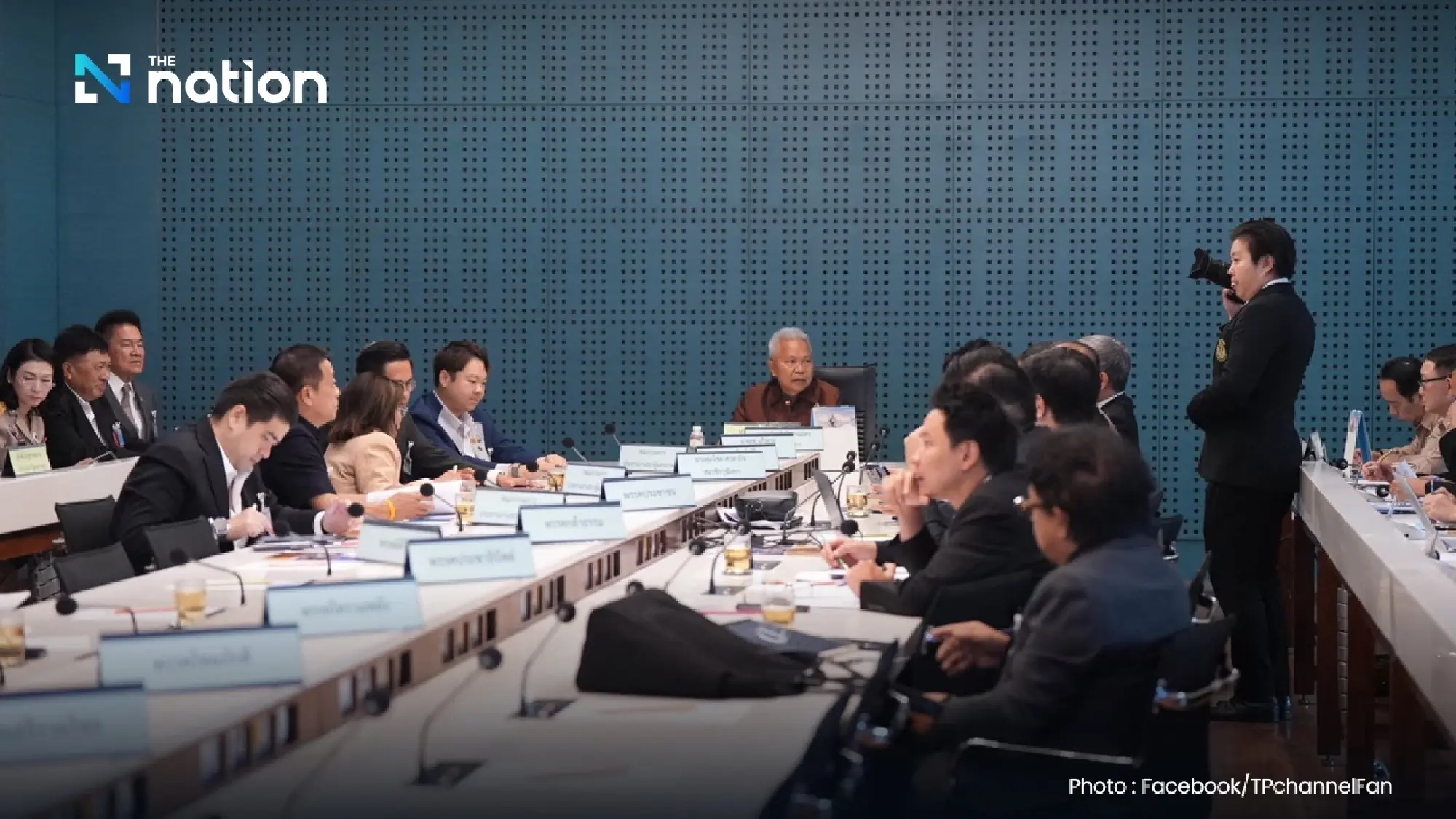

Relief funds should still go ahead, Sirikanya says
Sirikanya said the petition was designed to separate the two parts of the decree.
She said the opposition was seeking to suspend spending only on the 200-billion-baht energy restructuring portion, while the 200-billion-baht allocation for public relief could still proceed.
She added that it would ultimately be up to the Constitutional Court to decide whether to review the decree in full or only the disputed parts.
Korn questions legal basis for emergency borrowing
Korn said the Constitution allows the government flexibility to borrow during an economic crisis or in cases of unavoidable urgency. However, he said the opposition had a duty to scrutinise whether the latest decree meets those conditions.
He argued that the 400-billion-baht borrowing decree does not appear to comply with Section 172 of the Constitution, adding that the case should be compared with previous emergency borrowing during major crises such as the Tom Yum Kung crisis, the global financial crisis and the Covid-19 crisis.
Korn also cited Section 53 of the State Fiscal and Financial Discipline Act, saying an Emergency Decree should be issued only in cases of urgent necessity.
Speaker says petition must be checked first
Sophon said that after receiving the petition from the opposition, he must first check the accuracy of the motion before forwarding it to the Constitutional Court within three days.
Asked whether the petition would be sent before May 14, when the borrowing decree is due to be considered, Sophon said he would proceed as quickly as possible.
Opposition seeks interim order on 200bn-baht portion
Natthaphong said the decree had already been published in the Royal Gazette and had taken effect.
He said the opposition had asked the court to consider what should happen if the government spends the money before the court delivers its ruling, and if the court later rules that the decree was invalid from the outset.
The petition also asks the court to issue an interim order suspending disbursement only for the 200-billion-baht energy restructuring portion, which the opposition says lacks urgency.
Special committee proposed to monitor spending
Natthaphong said the opposition would also propose a motion to set up a special House committee to monitor spending under the borrowing decree.
He said the government should not vote down the proposal if it has no intention of hiding information, inserting unrelated spending or issuing what he described as a blank cheque.
Unlike the normal budget process, he said, spending under the decree would be screened by only a limited number of committees.
Cabinet issued decree amid energy crisis
The Cabinet approved the 400-billion-baht Emergency Decree on May 5, 2026, authorising the Finance Ministry to borrow funds to ease cost-of-living pressure and support energy-related measures. Prime Minister Anutin Charnvirakul said the measure was needed because higher energy prices were affecting the public, while Finance Minister Ekniti Nitithanprapas said half of the borrowing would be directed to vulnerable groups and the other half to support the energy transition.
The government has argued that the decree is necessary to cushion the economy from the impact of the Middle East conflict, which it says has driven up oil, food and other prices and raised the risk of stagflation. The decree is scheduled to be submitted to the House of Representatives for consideration on May 14, 2026.
The decree was published in the Royal Gazette on May 9, 2026, and took effect from that date. It authorises borrowing of up to 400 billion baht, with the money to be used for relief for people, farmers and businesses affected by the energy crisis, as well as measures to promote energy efficiency and support the transition to renewable and alternative energy.
