
House delays debate on 400-billion-baht loan decree pending Constitutional Court ruling
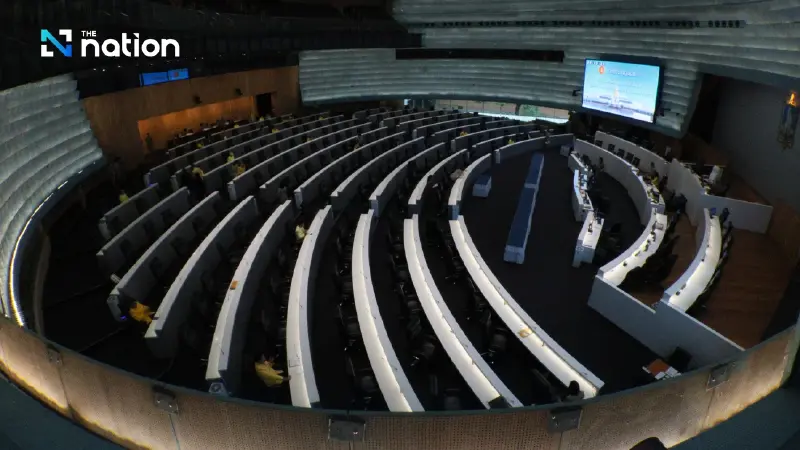


The House has postponed consideration of the Anutin government’s 400-billion-baht emergency borrowing decree after Natthaphong Ruengpanyawut and 135 MPs sought a Constitutional Court ruling on its legality.
The House of Representatives has put off deliberation of the government’s 400-billion-baht emergency borrowing decree after opposition MPs asked the Constitutional Court to rule whether the decree complies with the Constitution.
Deputy House Speaker Lertsak Pattanachaikul informed the House meeting that the Cabinet had approved the emergency decree authorising the Finance Ministry to borrow funds to address the impact of the energy crisis and support Thailand’s energy transition. Under the Constitution, an emergency decree takes effect with the force of an Act once issued, but the Cabinet must submit it to the National Assembly for approval without delay at the subsequent sitting. However, the decree cannot yet be placed on the House agenda because the opposition has triggered a constitutional review process.
Natthaphong leads 135-MP petition
Before House Speaker Sophon Saram could place the decree on the agenda, Natthaphong Ruengpanyawut, a party-list MP from the People’s Party and Leader of the Opposition, led 135 MPs in signing a petition asking the Speaker to forward the matter to the Constitutional Court.
The number of signatories was not less than one-fifth of the current number of MPs, meeting the threshold required to seek a court ruling under Section 173 of the Constitution. The petition asks the court to decide whether the decree fails to meet the requirements of Section 172, paragraph one.
As a result, the House must wait before considering the decree until the Constitutional Court has issued its ruling.
Court given 60 days to rule
Under Section 173, the Constitutional Court must complete its ruling within 60 days of receiving the petition and notify the House Speaker of its decision. If the court rules that an emergency decree does not comply with Section 172, the decree is deemed to have had no legal effect from the outset.
A ruling that an emergency decree is unconstitutional must be supported by at least two-thirds of the total number of existing Constitutional Court judges. With the court currently having nine judges, that would require at least six votes.
Decree issued to tackle energy shock
The 400-billion-baht borrowing decree was approved by the Cabinet on May 5 and later published in the Royal Gazette on May 9. It authorises the Finance Ministry to borrow up to 400 billion baht, either in baht or foreign currency or through debt instruments, with borrowing contracts or debt issuance to be completed by September 30, 2027.
The government says the decree is needed to cushion the public, farmers and entrepreneurs from the impact of the energy crisis, maintain economic stability and support Thailand’s transition towards renewable and alternative energy.
Prime Minister Anutin Charnvirakul has linked the measure to rising energy prices and higher living costs, saying the government must prevent economic pressure from spreading further. The Cabinet earlier said the funds would be split into two broad parts: 200 billion baht for immediate relief and 200 billion baht to support energy transition.
Opposition questions use of emergency power
The opposition argues that the government has not shown enough justification for using an emergency decree rather than a normal bill, especially for the energy-transition portion of the borrowing.
Opposition figures have argued that Section 172 allows emergency decrees only in specific urgent circumstances, such as national security, public safety, economic security or public calamity, and only when there is unavoidable urgency.
The People’s Party has said energy transition may be necessary policy, but it is largely a medium- to long-term agenda and should not be pushed through by an emergency borrowing decree that bypasses normal parliamentary scrutiny.
Relief portion not the main target
The opposition has also sought to distinguish between the two parts of the borrowing plan. Sirikanya Tansakun of the People’s Party said the petition was intended to separate the 200-billion-baht relief package from the 200-billion-baht energy-restructuring component.
She said the opposition wanted to suspend spending only on the energy-transition portion, while allowing the public-relief portion to proceed. Natthaphong has also asked the court to consider what would happen if the government spends money before the ruling and the decree is later found invalid.
Natthaphong said the opposition would also propose setting up a special House committee to monitor spending under the decree, arguing that the borrowing package should not become a “blank cheque” for the government.
Government insists decree is already in force
The Finance Ministry has defended the decree, saying it is already legally in effect despite the court challenge and that the executive branch can continue working while judicial and parliamentary processes proceed in parallel.
Finance Minister Ekniti Nitithanprapas said the decree was urgently needed to protect economic security amid energy-cost and cost-of-living pressures. He said the borrowing amount had been reduced from an initial 500 billion baht to 400 billion baht to keep public debt below the legal ceiling and maintain fiscal stability.
Political test for Anutin government
The court challenge turns the borrowing decree into an early political and constitutional test for the Anutin government.
For the government, the decree is a flagship measure to respond to energy-driven inflation, living-cost pressure and the need for longer-term energy restructuring. For the opposition, the case is about whether the Cabinet can use emergency powers to authorise large-scale borrowing without the level of parliamentary scrutiny required under a normal budget or loan bill.
Until the Constitutional Court rules, the House cannot proceed with formal consideration of the decree, leaving one of the government’s largest economic measures in legal and political limbo.
