
Court accepts challenge to 400-billion-baht energy loan decree, orders Cabinet to explain
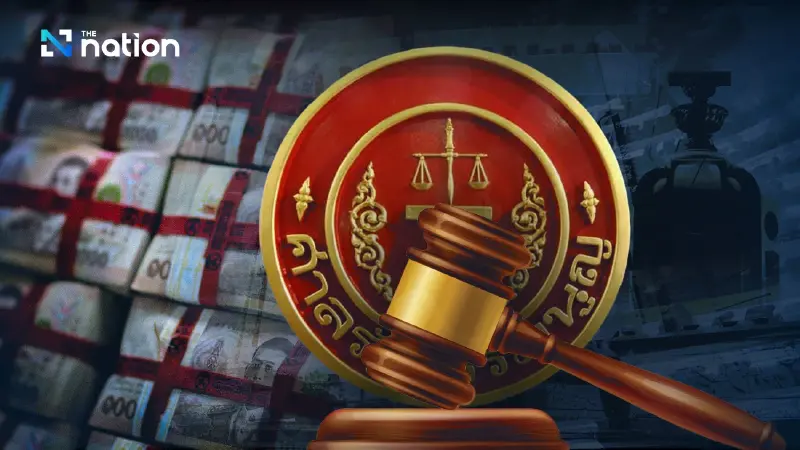


Thailand’s Constitutional Court has accepted a petition questioning whether the government’s 400-billion-baht emergency borrowing decree complies with Section 172 of the Constitution, giving the Cabinet seven days to submit its defence.
Cabinet given seven days to defend emergency borrowing
The Constitutional Court has accepted a petition questioning whether the government’s 400-billion-baht emergency borrowing decree for energy-crisis relief and energy transition projects complies with the Constitution, ordering the Cabinet to submit its explanation and supporting evidence within seven days.
The petition was filed after 133 members of the House of Representatives signed a motion asking whether the decree authorising the Finance Ministry to borrow 400 billion baht violates Section 172, paragraph one, of the Constitution.
The court said the petition and supporting documents met the requirements under Section 173, paragraph one, of the Constitution, together with Section 7(1) of the 2018 Organic Act on Procedures of the Constitutional Court. It therefore accepted the case for consideration and notified the petitioner.
Legal challenge turns political row into constitutional case
The case centres on whether the government had sufficient constitutional grounds to issue an emergency decree, rather than using the normal legislative and budgetary process.
Under Section 172, an emergency decree may be issued in urgent and necessary circumstances, including cases involving national security, public safety, economic security or public disaster. The opposition argues that the borrowing plan, especially the energy-transition portion, does not meet that threshold.
The court has not ruled on the substance of the case. Its latest order only means the petition has been accepted for review and that the Cabinet must now formally defend the decree.
MPs question urgency of borrowing plan
The MPs submitted their petition to the House Speaker, who then forwarded it to the Constitutional Court for a ruling.
Their argument is that the loan decree does not meet the constitutional conditions required for emergency legislation. The opposition has particularly targeted the 200-billion-baht energy restructuring portion, saying it lacks urgent necessity and should instead go through the normal annual budget process. The opposition has said it is not seeking to block the other 200-billion-baht portion intended for public relief.
The House had already delayed consideration of the decree pending the Constitutional Court’s ruling. Under Section 173, if such a petition is filed, Parliament must wait for the court’s decision before proceeding with approval. The court is required to rule within 60 days of receiving the case.
Why the government issued the decree
The Cabinet approved the draft emergency decree on May 5, 2026, authorising the Finance Ministry to borrow up to 400 billion baht. Prime Minister Anutin Charnvirakul said the borrowing was aimed at easing cost-of-living pressure and supporting energy-related measures. Reuters reported that half of the borrowing would be directed towards vulnerable groups, while the other half would support the energy transition.
The government said the decree was necessary because the energy crisis had increased living costs, production costs and economic pressure on low- and middle-income earners, farmers, small businesses and SMEs. The Public Relations Department said the plan was divided into two main parts: 200 billion baht for public, farmer and business relief, and 200 billion baht for energy-efficiency and clean-energy transition projects.
Government officials argued that using the normal budget process would be too slow and would not provide enough scale, speed or flexibility to respond to the crisis. The government also said the measure was intended to reduce Thailand’s dependence on fossil fuels and strengthen long-term energy security.
Opposition says energy transition is not an emergency
The opposition’s disagreement is not mainly over whether people affected by higher energy costs should receive help. Its central objection is that the government bundled long-term energy restructuring into an emergency borrowing decree.
People’s Party leader Natthaphong Ruengpanyawut argued that the energy-transition programme could be handled through the annual budget process, while Democrat figure Korn Chatikavanij questioned whether the decree met the legal test for emergency borrowing under Section 172 and the State Fiscal and Financial Discipline Act.
The opposition also argues that using an emergency decree could reduce parliamentary scrutiny over major spending plans. Isranews, citing the petition, reported that opponents viewed parts of the decree as spending that should not bypass normal legislative checks through emergency legislation.
Court warns over criticism of rulings
The Constitutional Court also issued a legal reminder that people have freedom of expression under Section 34 of the 2017 Constitution.
However, it warned that criticism of a court order or judgment that is not made in good faith, or that uses vulgar, sarcastic or malicious language, may constitute contempt of court under Sections 38 and 39 of the 2018 Organic Act on Procedures of the Constitutional Court.
Such conduct could also amount to insulting the court under Section 198 of the Criminal Code.
High-stakes test for government borrowing power
The case is politically significant because it will test the government’s power to use emergency decrees for large-scale borrowing.
If the court rules that the decree complies with the Constitution, the government would be able to proceed with parliamentary consideration. If the court rules otherwise, the decree could be invalidated under the constitutional process.
For now, the Cabinet must submit its explanation and evidence within seven days, while Parliament waits for the court’s decision.
