
India uses AI cameras to catch traffic offenders, issuing over 2m tickets
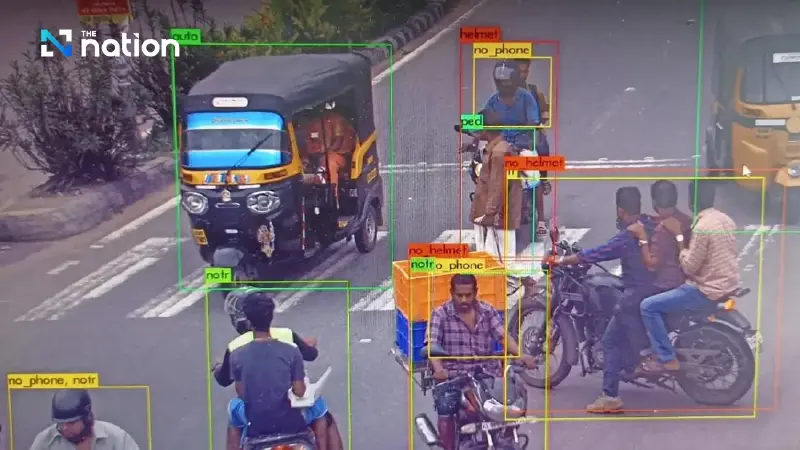


India is using AI traffic cameras to detect violations, issue digital tickets and reduce accidents on some of the world’s most chaotic roads.
Following the tragedy in which a train collided with a bus near the Asok-Phetchaburi intersection, leaving at least eight people dead and more than 30 injured, the incident has reflected not only repeated loss, but also a deeply rooted “culture of breaking traffic rules” that has become normalised in society.
Whether it is passing through railway barriers, driving against the flow of traffic or running red lights, these risky behaviours happen in front of people every day, to the point that they are often seen as “normal”. Part of the problem is that “the cost of breaking the rules in Thai society” remains far too low. Many offenders are barely punished, leading many people to believe that “rules can be broken as long as you are not caught”.
This problem is not unique to Thailand. India, too, has faced similarly chaotic traffic conditions, including rule-breaking behaviour, complex road conditions and one of the world’s highest accident rates.
In India, 177,177 people died in road accidents in 2024, or an average of almost 485 deaths per day. India’s road system is considered one of the most complex in the world, with “mixed traffic” involving cars, motorcycles, pedestrians, stray animals, roads without clear lanes and unpredictable driving behaviour.
What is interesting, however, is that instead of relying only on traffic police or traditional campaigns, India has begun seriously using AI cameras and artificial intelligence systems to tackle the problem. These systems detect offences such as using a mobile phone while driving, failing to wear a seatbelt, reckless driving and other traffic violations. They also issue electronic tickets with evidence attached, sending them to the vehicle owner via SMS or the government’s Parivahan app.
Crucially, AI does not see the “chaos” of Indian roads as an obstacle. On the contrary, it is using that chaos as valuable “training data”.
AI can even read signs of drowsiness
Modern AI systems using vision-based camera analysis have been developed to detect risky behaviour in real time, including tailgating, lane departure, sudden braking, using a mobile phone while driving and even drowsiness behind the wheel.
Unlike ordinary dashboard cameras, which only “record evidence after an incident”, the new generation of AI systems is designed to intervene “before an accident happens”.
Teja Gudena, vice president of engineering at Netradyne, explained that these AI systems work more like a “safety coach” than a “fault-finding tool”.
When the system detects that a driver’s behaviour is becoming risky — such as signs of microsleep, taking their eyes off the road or abnormally slow reactions — it immediately sends an alert inside the vehicle. The aim is not punishment, but preventing an accident before it occurs.
The technology has advanced beyond simply observing external behaviour. AI can also detect a driver’s “physiological signals”, such as blink frequency, unusually long eyelid closure or head movements, which are often warning signs only seconds before drowsiness sets in.
Data from India’s transport ministry shows that speeding is responsible for more than 63.7% of accidents and is linked to 60.8% of road deaths nationwide. Once AI began to be introduced, the results started to show clearly in statistics.
Hitachi Cash Management, one of the organisations using Netradyne’s AI safety system, reported that accidents fell by 50% after the new system was adopted.
The technology also helped reduce drowsy driving by 74% and distracted driving by 38%, according to data disclosed by Netradyne.
AI cameras have issued more than 2 million tickets
In some Indian states, the use of AI has expanded from “inside vehicles” to wider “urban management systems”.
In Thiruvananthapuram, Kerala, state transport minister Antony Raju said that after AI traffic-detection cameras were installed, road deaths fell from 1,669 to 1,081 over the same period of the following year.
Within just five months, AI cameras detected more than 7 million traffic offences, ranging from failing to wear a helmet and not wearing a seatbelt to using a mobile phone while driving. More than 2.1 million tickets have already been issued.
During that period, more than 139 million rupees in fines were collected. Failing to wear a helmet remained the most common offence, followed by drivers failing to wear seatbelts.
Even 13 vehicles belonging to MPs and politicians were fined, showing that the system is attempting to enforce rules equally against everyone.
Importantly, the system does not merely “issue tickets”. It is also being linked to insurance systems and state databases. The Indian government has begun discussions with insurance companies on adjusting premiums based on actual driving behaviour. It may also require people with unpaid fines to be blocked from renewing certain vehicle documents or certificates.
Another interesting aspect is that India is becoming one of the world’s toughest “testing grounds for safety AI”. If an AI system can work accurately on Indian roads, which are full of uncertainty, it could almost mean the system is ready for use anywhere in the world.
The results are leading many to question whether what truly changes people’s behaviour is not just “campaigning” or superficial problem-solving, but making people understand that “if they break the rules, they will definitely be caught” — through AI systems that are watching all the time, with no exceptions.
