
Constitutional Court to rule on Thailand’s THB400 billion decree
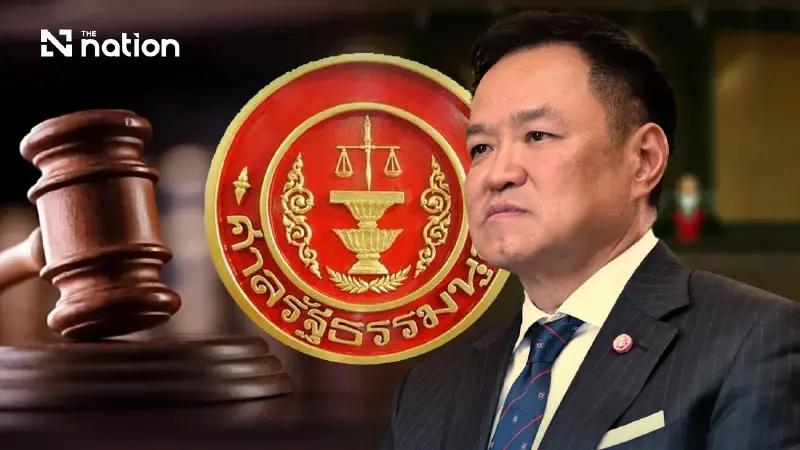


The Constitutional Court will decide whether the THB400 billion emergency borrowing decree meets the constitutional test for urgency.
- Thailand's Constitutional Court is set to rule on the constitutionality of a THB400 billion emergency borrowing decree.
- The legal challenge questions whether the situation meets the constitutional requirement of being "emergency, necessary and urgent," especially for long-term projects.
- The funds are allocated for both immediate relief from the energy crisis (THB200 billion) and long-term investment in the country's energy transition (THB200 billion).
- The ruling is a major political test for the government, as a finding that the decree is unconstitutional could force it to halt its plans and face significant political pressure.
The Constitutional Court’s ruling on Thursday (July 9, 2026) is emerging as a decisive point for the government of Prime Minister Anutin Charnvirakul, as the emergency decree authorising the Ministry of Finance to borrow THB400 billion to address the impact of the energy crisis and support the country’s energy transition is brought before the court for a decision on whether it complies with the Constitution.
The ruling is regarded as a major test for the government at a time when the economy continues to face pressure from energy costs, living expenses and the need for long-term investment.
At the same time, the opposition has raised a key question over whether the use of an emergency borrowing decree meets the constitutional requirement of being “emergency, necessary and urgent” under Section 172, paragraph one.
The case began when 133 members of the House of Representatives signed a submission to the Speaker of the House of Representatives, seeking referral to the Constitutional Court for a ruling.
The court found that the case involved a question of law and that there was sufficient evidence for consideration.
It therefore ended the inquiry process and scheduled oral statements, deliberation and a vote for 9am on Thursday.
At the heart of the decree is the THB400 billion borrowing limit, divided into two major allocations.
The first THB200 billion is intended to ease the immediate impact of the energy crisis and rising living costs through measures such as the Thais Help Thais Plus scheme and top-ups under state welfare, helping low-income people cope with rising goods prices and higher costs.
The other THB200 billion is earmarked to drive the energy transition, including the promotion of clean-energy transport systems, public solar installations, electricity buy-back arrangements and upgrades to transmission infrastructure to support a modern energy system.
The government has argued that the energy price crisis caused by conflict in the Middle East has created a chain reaction, from higher oil prices and transport costs to increased living expenses and risks to the current account balance.
Ekniti Nitithanprapas, Minister of Finance, has set out the key approach through the 5T principles: Target, Transition, Transform, Transparency and Together.
The aim is to support the economy, accelerate the energy transition and build a long-term economic base.
But the question now awaiting the court’s answer is which measures amount to an immediate crisis response and which are long-term investments that may not require a special instrument such as an emergency decree.
Particular scrutiny has fallen on the second THB200 billion allocation, which has raised questions over whether it could be carried out through the normal budget process.
The possible rulings are therefore being watched in three directions.
If the court finds the entire decree unconstitutional, the decree could lapse, and the government would face heavy political pressure, including the need to find a way to compensate for money already spent.
The government may have to adjust its plan, particularly long-term energy projects, if the court finds only some parts unlawful.
But if the court finds the decree constitutional, the government will gain momentum to continue its relief and investment measures.
Former election commissioner Somchai Srisutthiyakorn has observed that although the law does not require a prime minister or minister to resign if an emergency decree is ruled unconstitutional, the question of political responsibility would be unavoidable.
Anutin has confirmed that the government has submitted all explanations and evidence in full and is ready to respect the court’s ruling in every case.
Thursday (July 9, 2026) is therefore not merely the day that decides the fate of the THB400 billion loan, but also the day on which the Anutin government must prove whether this use of special fiscal powers is a tool to steer the country through crisis or a policy gamble that could return to shake the government itself.
Source: Post Today
